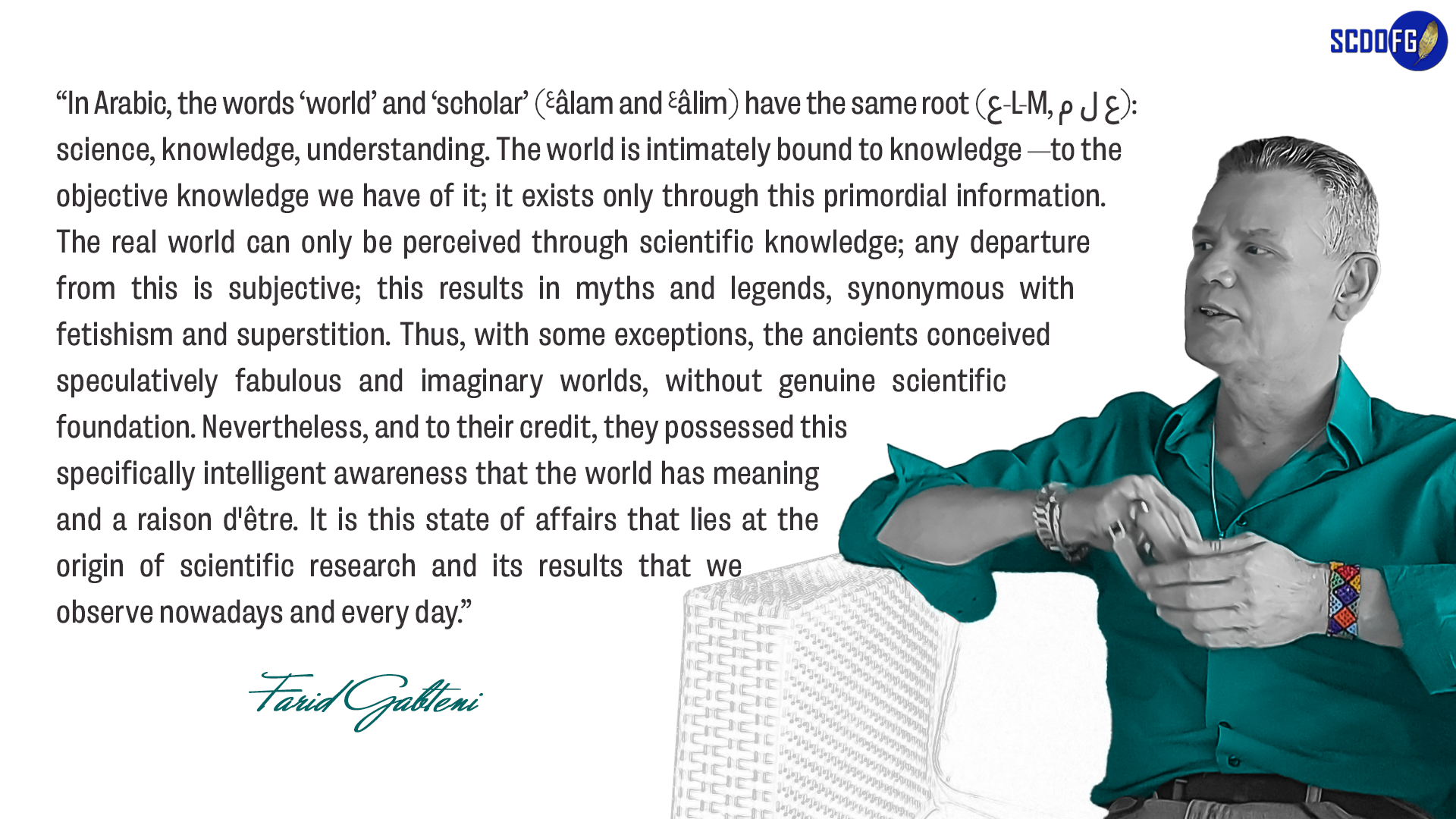
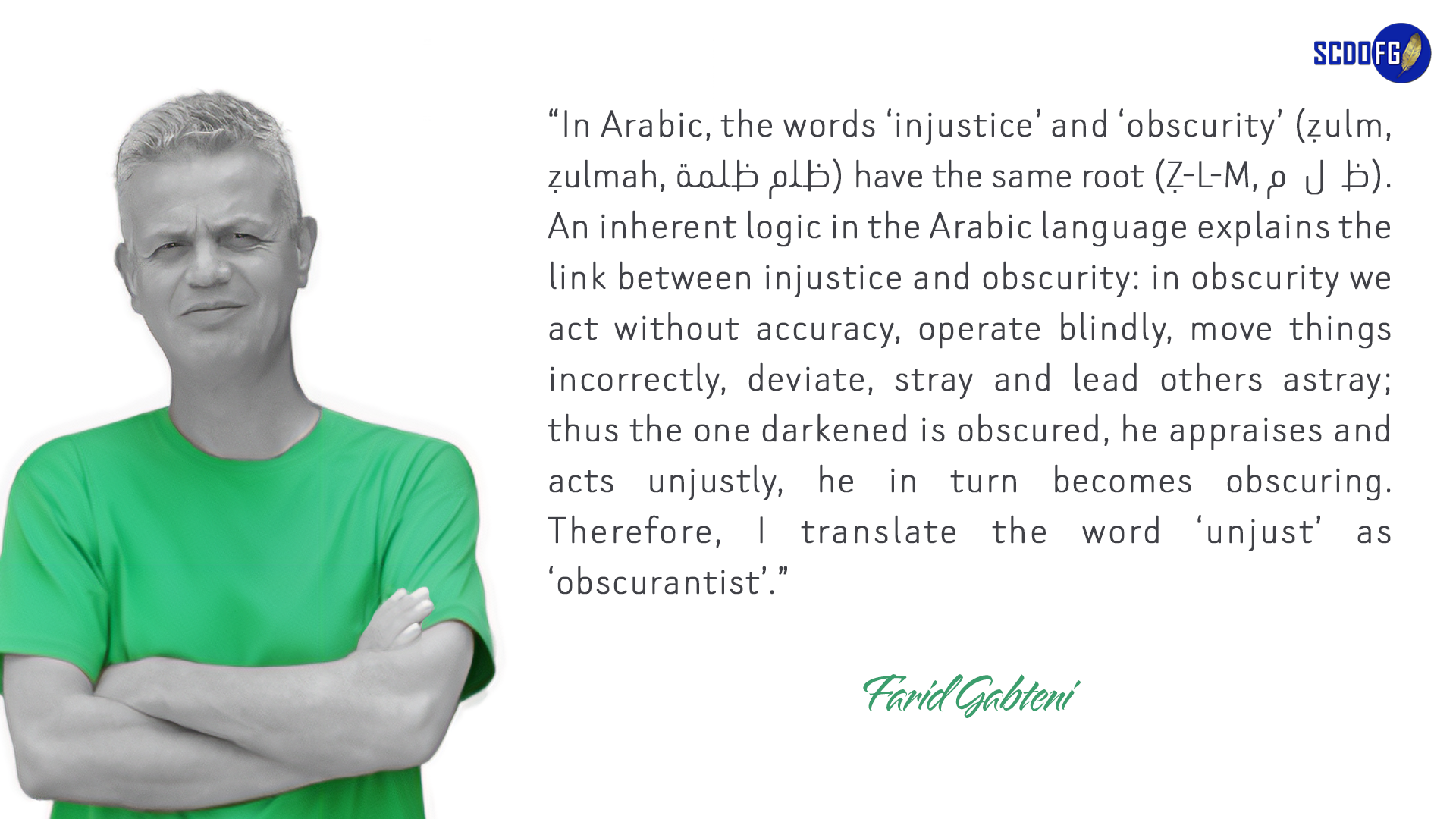
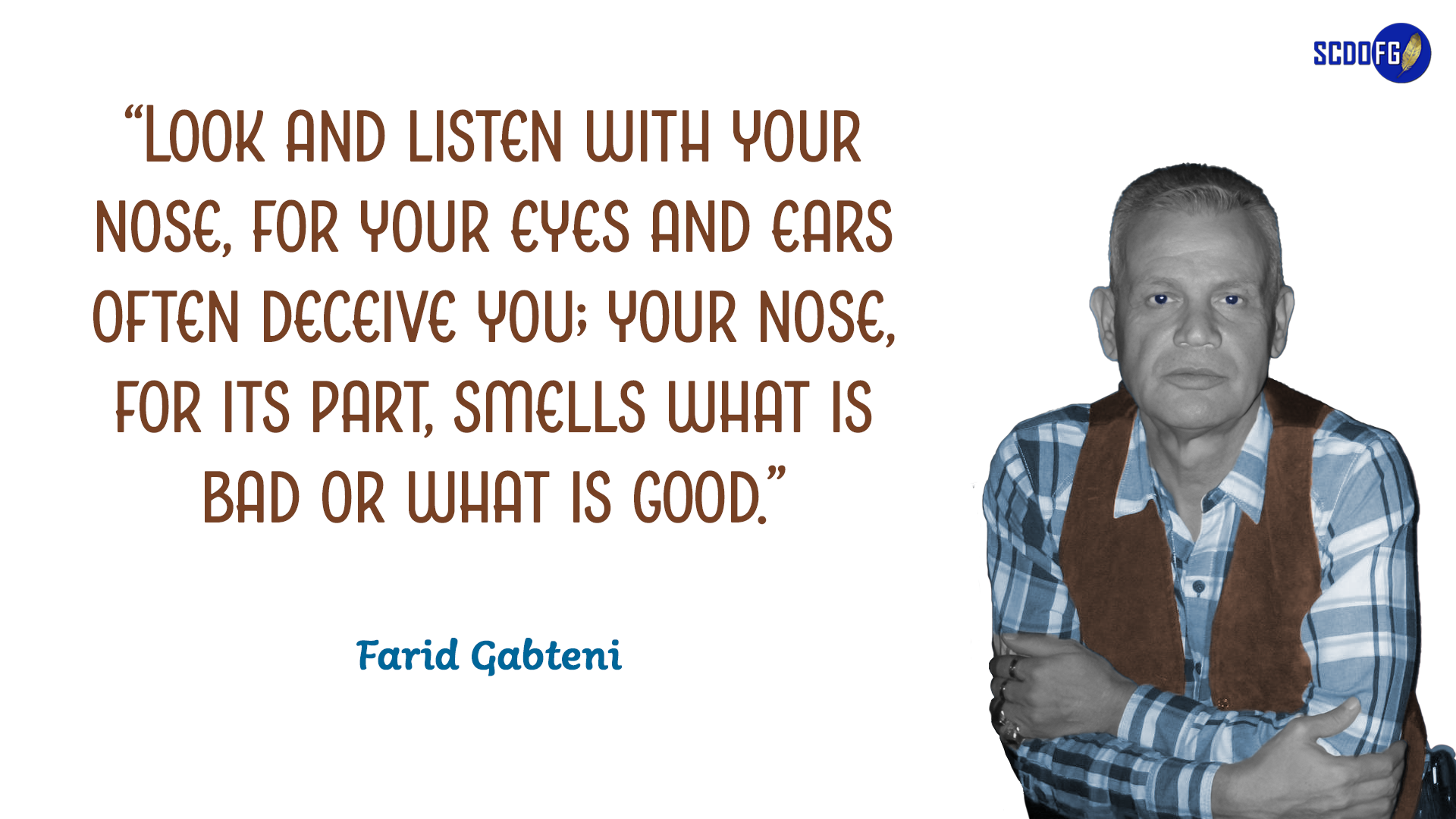
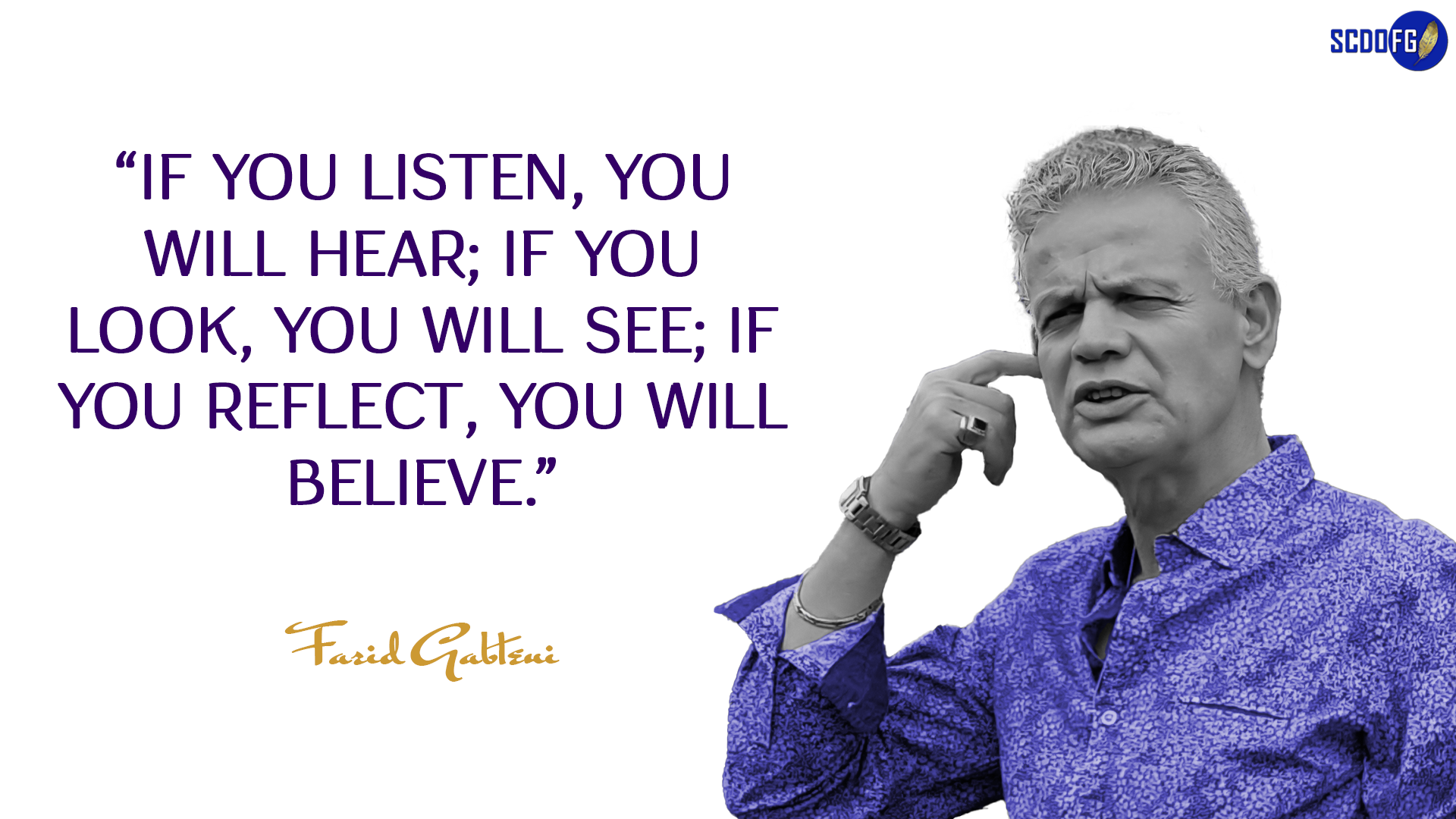
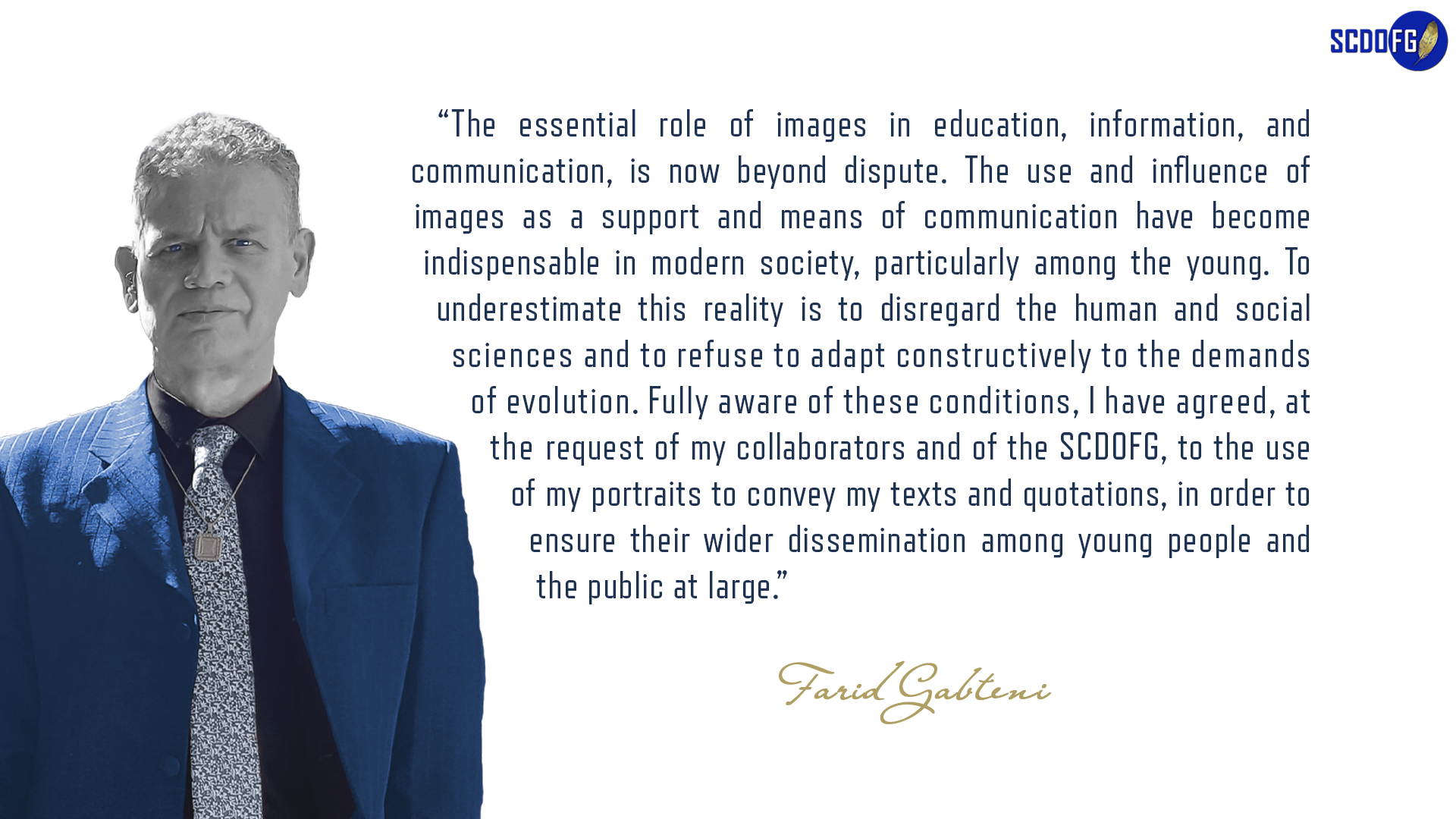
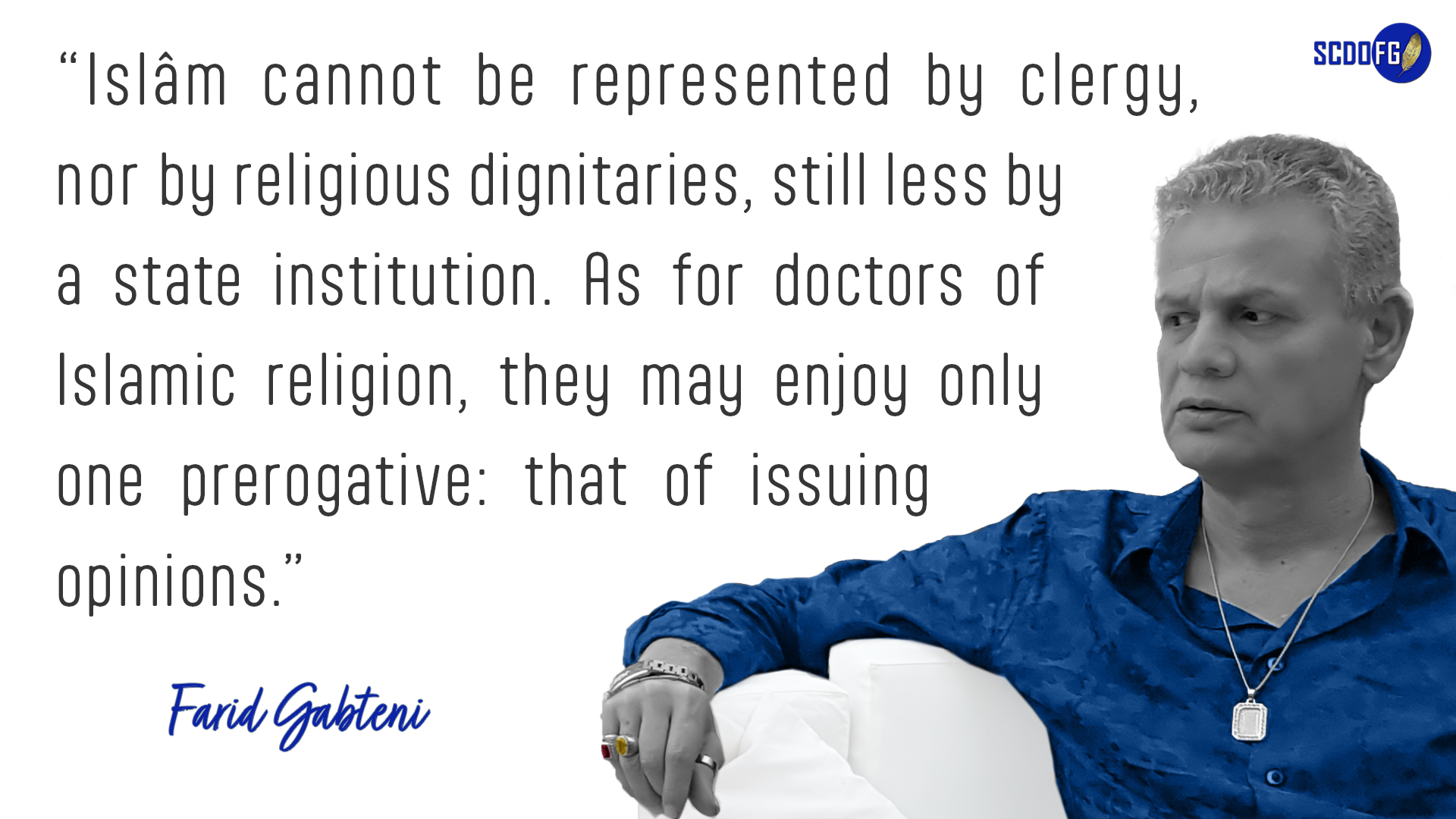
« The essential role of images in education, information, and communication, is now beyond dispute. The use and influence of images as a support and means of communication have become indispensable in modern society, particularly among the young. To underestimate this reality is to disregard the human and social sciences and to refuse to adapt constructively to the demands of evolution. Fully aware of these conditions, I have agreed, at the request of my collaborators and of the SCDOFG, to the use of my portraits to convey my texts and quotations, in order to ensure their wider dissemination among young people and the public at large. » — Farid Abbes Raja Gabteni
« ‘Indeed, We have Sent it down as frank (Arabic, عarabî) Qurân; perhaps you will reason!’ (Qurân / Chapter 12, verse 2). In Arabic, the word aعraba (أعرب), from the root ع-R-B (ع ر ب), means ‘to speak openly, clearly, frankly’, whereas the word aعjamî (أعجمي), from the root ع-J-M (ع ج م), signifies ‘to speak unintelligibly, hermetically, in code.’ عArabî (clear/frank, عربي) is thus the antonym of aعjamî (hermetic/coded, أعجمي). In other words, عarabî (عربي) denotes an expression, language or discourse that is clear and frank, whereas aعjamî (أعجمي) denotes an expression, language or discourse that is hermetic and coded, that therefore requires clarification to be understood. The Qurân was revealed in Arabic—that is, in a clear and frank language; it does not refer here to a language intrinsically tied to an ethnic group. » — Farid Abbes Raja Gabteni
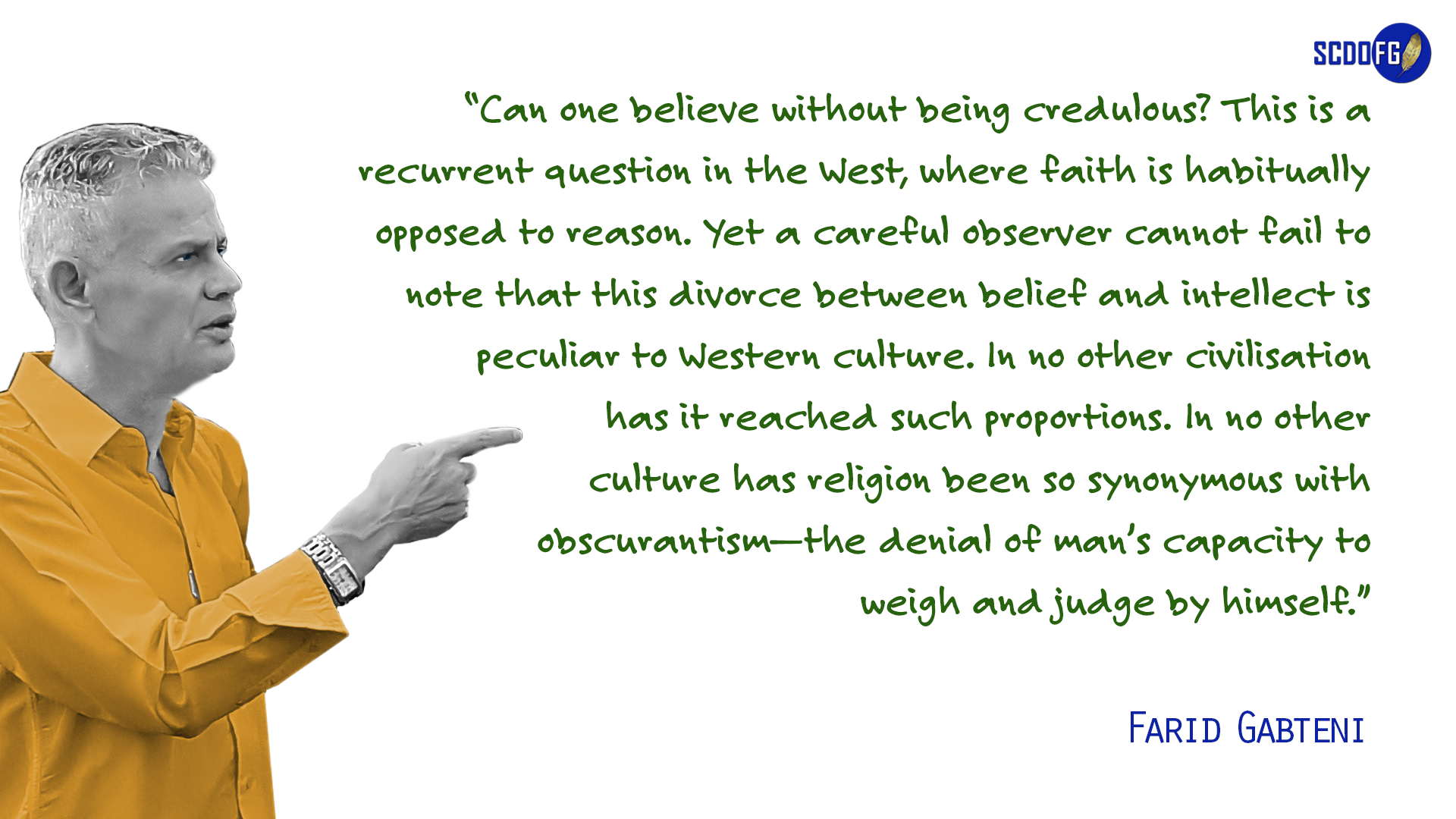
“Can one believe without being credulous? This is a recurrent question in the West, where faith is habitually opposed to reason. Yet a careful observer cannot fail to note that this divorce between belief and intellect is peculiar to Western culture. In no other civilisation has it reached such proportions. In no other culture has religion been so synonymous with obscurantism—the denial of man’s capacity to weigh and judge by himself.” Farid Gabteni
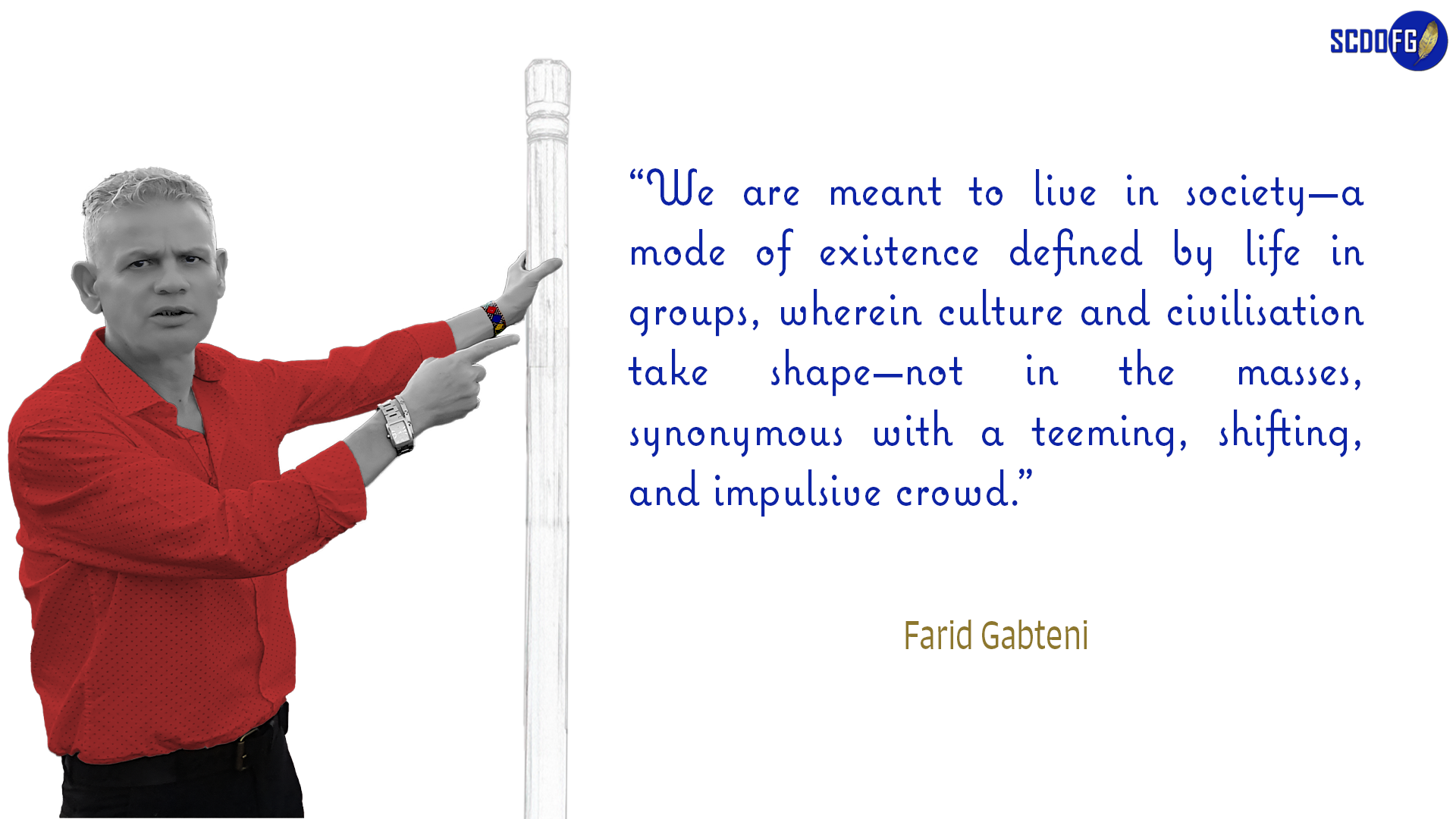
« we are meant to live in society—a mode of existence defined by life in groups, wherein culture and civilisation take shape—not in the masses, synonymous with a teeming, shifting, and impulsive crowd.” Farid Gabteni
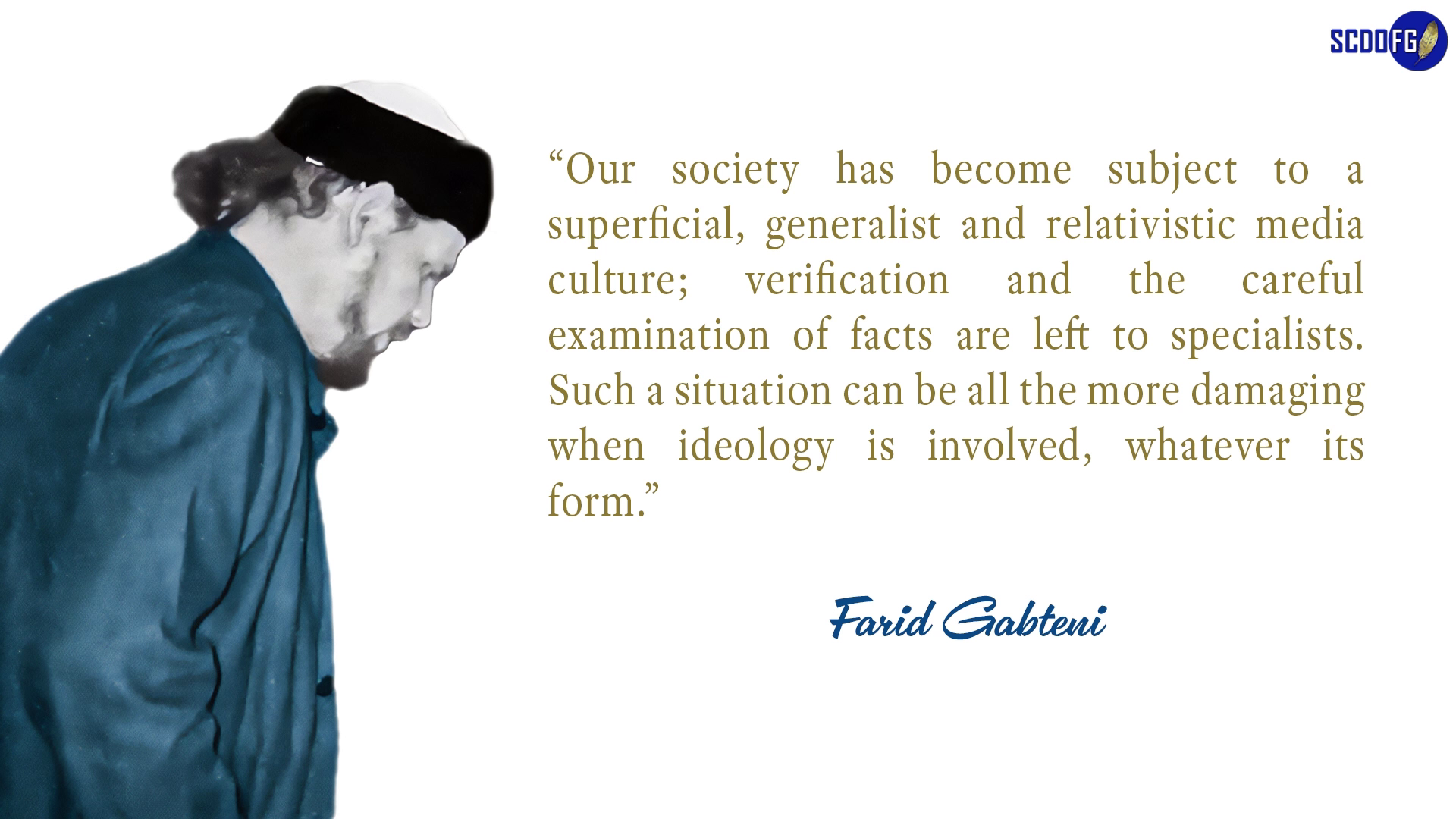
» Our society has become subject to a superficial, generalist and relativistic media culture; verification and the careful examination of facts are left to specialists. Such a situation can be all the more damaging when ideology is involved, whatever its form. » — Farid Abbes Raja Gabteni
« There can be no evil in good, yet good may be used to evil ends, and conversely. There can be no wrong in science, yet science may be used to wrongful ends, and conversely. Believers, who fear God, think and act with discernment and full awareness. » — Farid Abbes Raja Gabteni
» Faith is not synonymous with ignorantism; atheism is not synonymous with scientism; fanaticism, for its part, is synonymous with totalitarianism. » — Farid Abbes Raja Gabteni
“The question ‘Where are we going?’ has re-emerged with renewed force, casting into perspective the frenetic transformations of a society becoming more globalised every day, made up of disoriented individuals. Evolution is no longer mastered, as it is now driven exclusively by technological discoveries, without genuine regard for socio-economic, societal, and psychological factors … in a word, simply human factors.” Farid Gabteni
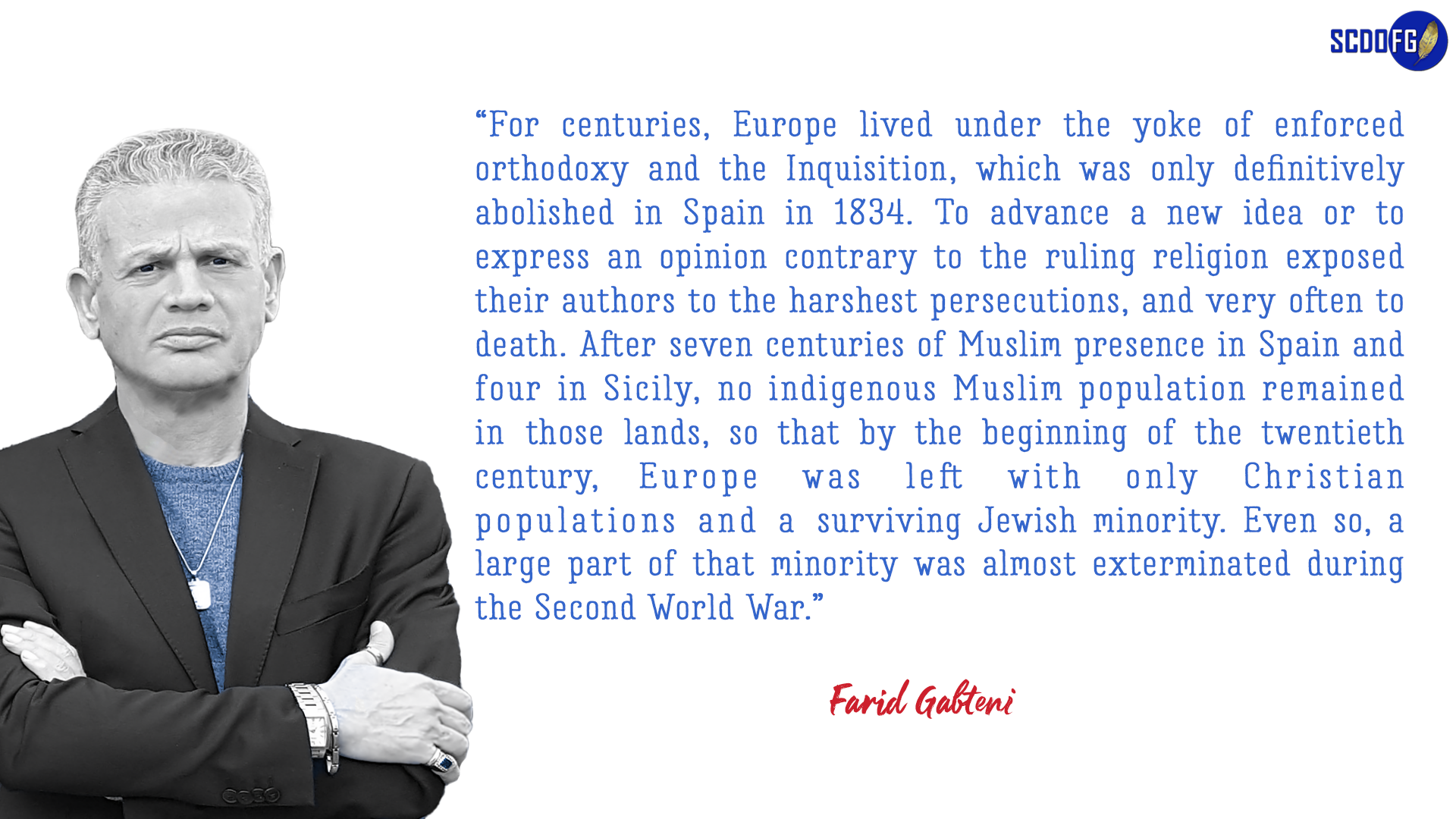
« For centuries, Europe lived under the yoke of enforced orthodoxy and the Inquisition, which was only definitively abolished in Spain in 1834. To advance a new idea or to express an opinion contrary to the ruling religion exposed their authors to the harshest persecutions, and very often to death. After seven centuries of Muslim presence in Spain and four in Sicily, no indigenous Muslim population remained in those lands, so that by the beginning of the twentieth century, Europe was left with only Christian populations and a surviving Jewish minority. Even so, a large part of that minority was almost exterminated during the Second World War. » — Farid Abbes Raja Gabteni
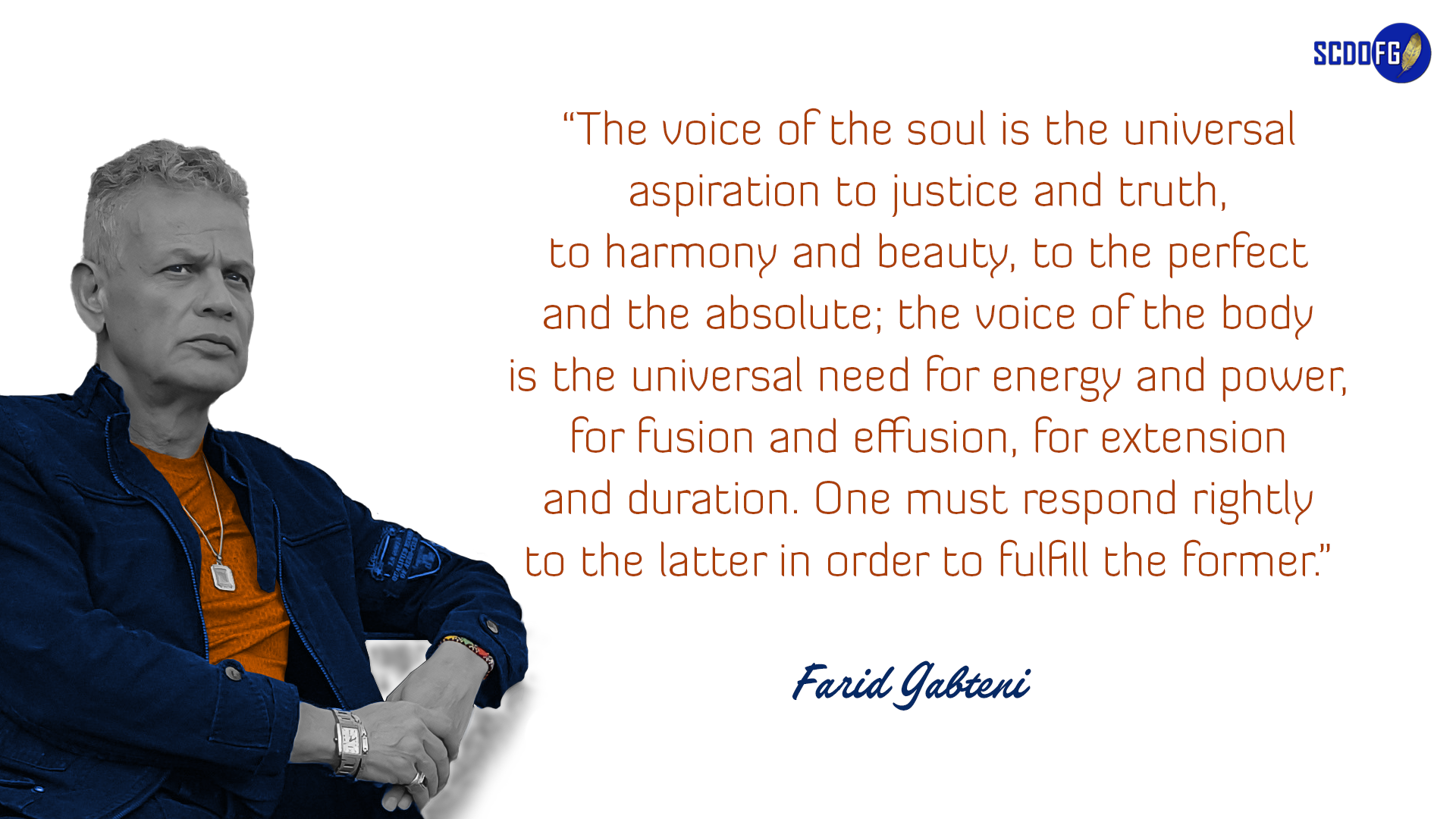
« The voice of the soul is the universal aspiration to justice and truth, to harmony and beauty, to the perfect and the absolute; the voice of the body is the universal need for energy and power, for fusion and effusion, for extension and duration. One must respond rightly to the latter in order to fulfill the former. » — Farid Abbes Raja Gabteni
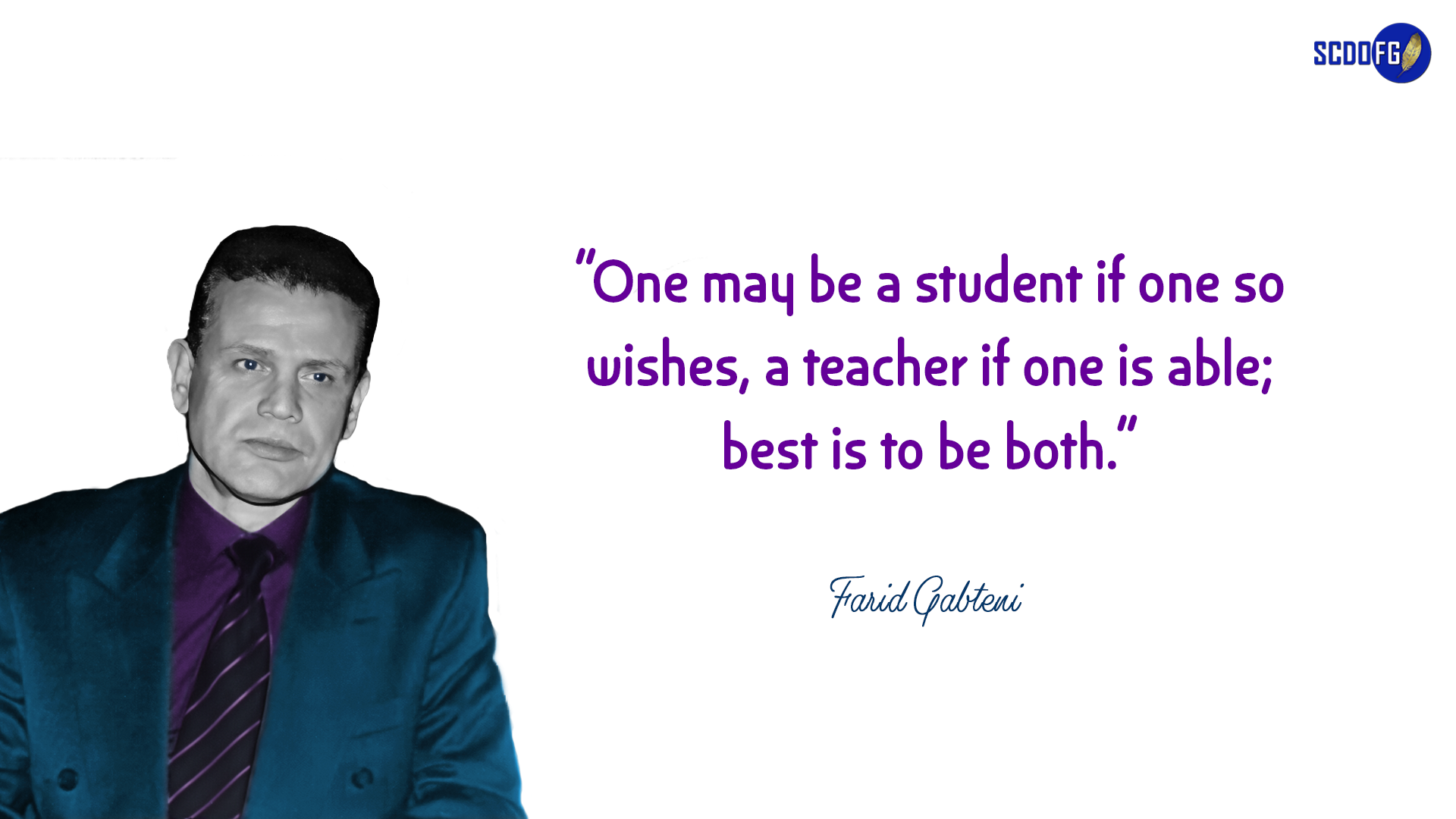
« One may be a student if one so wishes, a teacher if one is able; best is to be both » — Farid Abbes Raja Gabteni
« Scientists assess the meaning and scope of the terms they employ. These convey unequivocal information, corresponding to a single semantic value, and excluding any alternative interpretation. » — Farid Abbes Raja Gabteni
“To suppose that successive strokes of chance lie at the origin of the Universe and of our own existence is akin to believing that one could systematically win the lottery at every draw, every second, twenty-four hours a day, without interruption, for fourteen billion years. Failing to explain this extremely precise fine-tuning of the laws of physics by mere chance, some put forward string theory, or the idea of several, or even an infinite number of Universes, including our own, each governed by its own laws, thereby allowing the probability that at least one of these worlds would be properly fine-tuned. Well, by chance—‘as usual؟’—we happen to be in that one.” Farid Gabteni
“The Universe may be said to possess a universal language made up of mathematical instructions, which underlie the laws of physics and all that exists within it. All that we can know and observe in this world rests upon mastery of this language, which is expressed in every thing. Study the heaven, the earth, man, the ant, the molecule, the atom, or any other thing, and you will perceive the transcription of this language. It is the seal of the Creator of the heavens and the earth and of what lies between them.” Farid Gabteni
“Sometimes you talk and you do not always know what you say; sometimes you listen and you do not always understand what you hear; sometimes you look and you do not always perceive what you see.” — Farid Abbes Raja Gabteni
“Man is distinguished by an intelligence unmatched by any other living being on Earth. That he may be related to the monkey, the fly, or the earthworm does not alter his distinct and exclusive specificity.” Farid Gabteni
“It is not by enumerating your titles of nobility that you prove yourself noble. Likewise, it is not by trumpeting your academic degrees and research credentials that you prove yourself an accomplished scientist. A person’s nobility is distinguished by their worth, their qualities, and their merits; a scientist is likewise defined by objective knowledge—methodically and rationally established, grounded in the strict observation of facts. Our names, degrees, and titles are symbolic, our good works are eternal.” — Farid Abbes Raja Gabteni
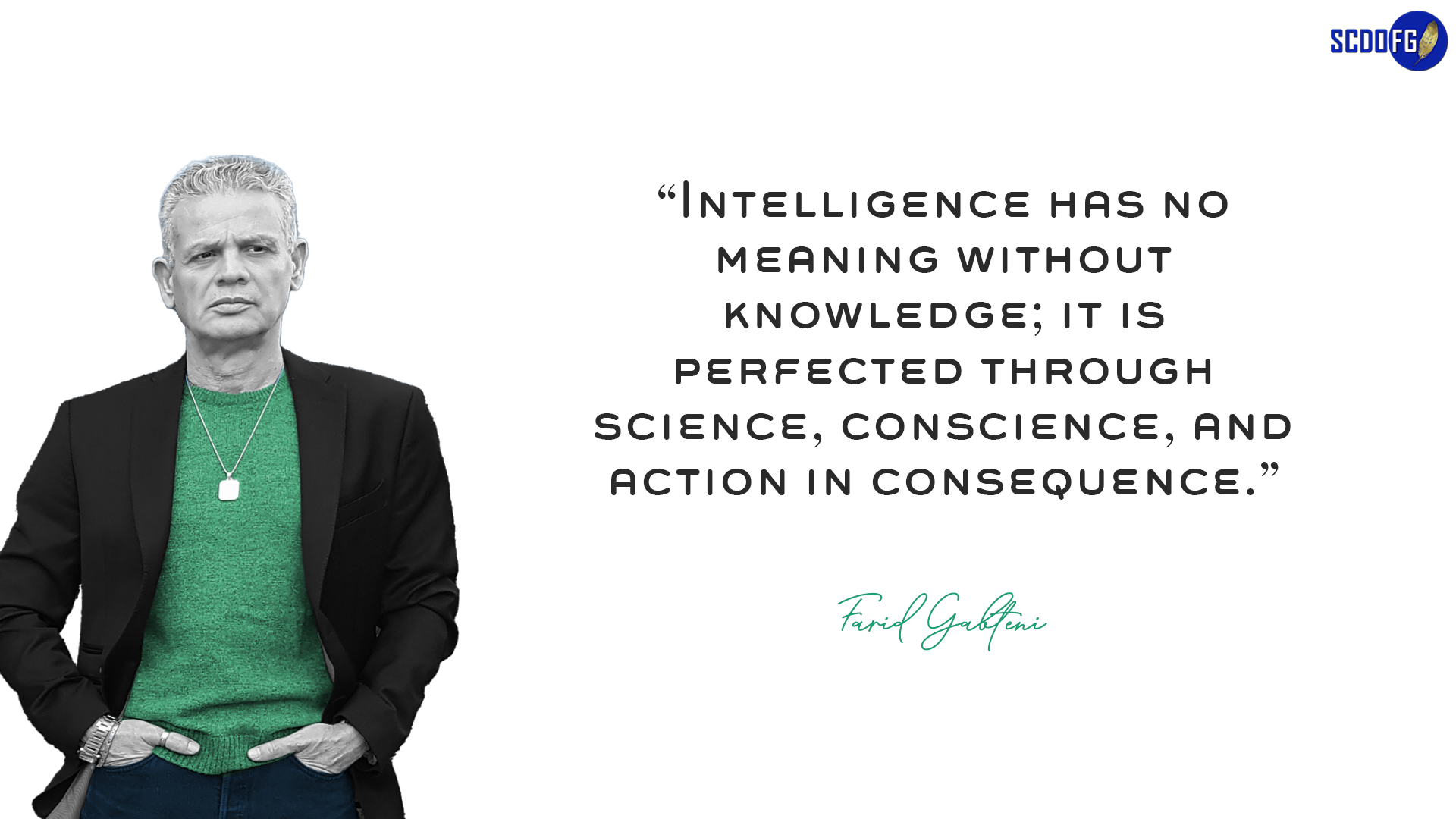
« Intelligence has no meaning without knowledge; it is perfected through science, conscience, and action in consequence. » — Farid Abbes Raja Gabteni
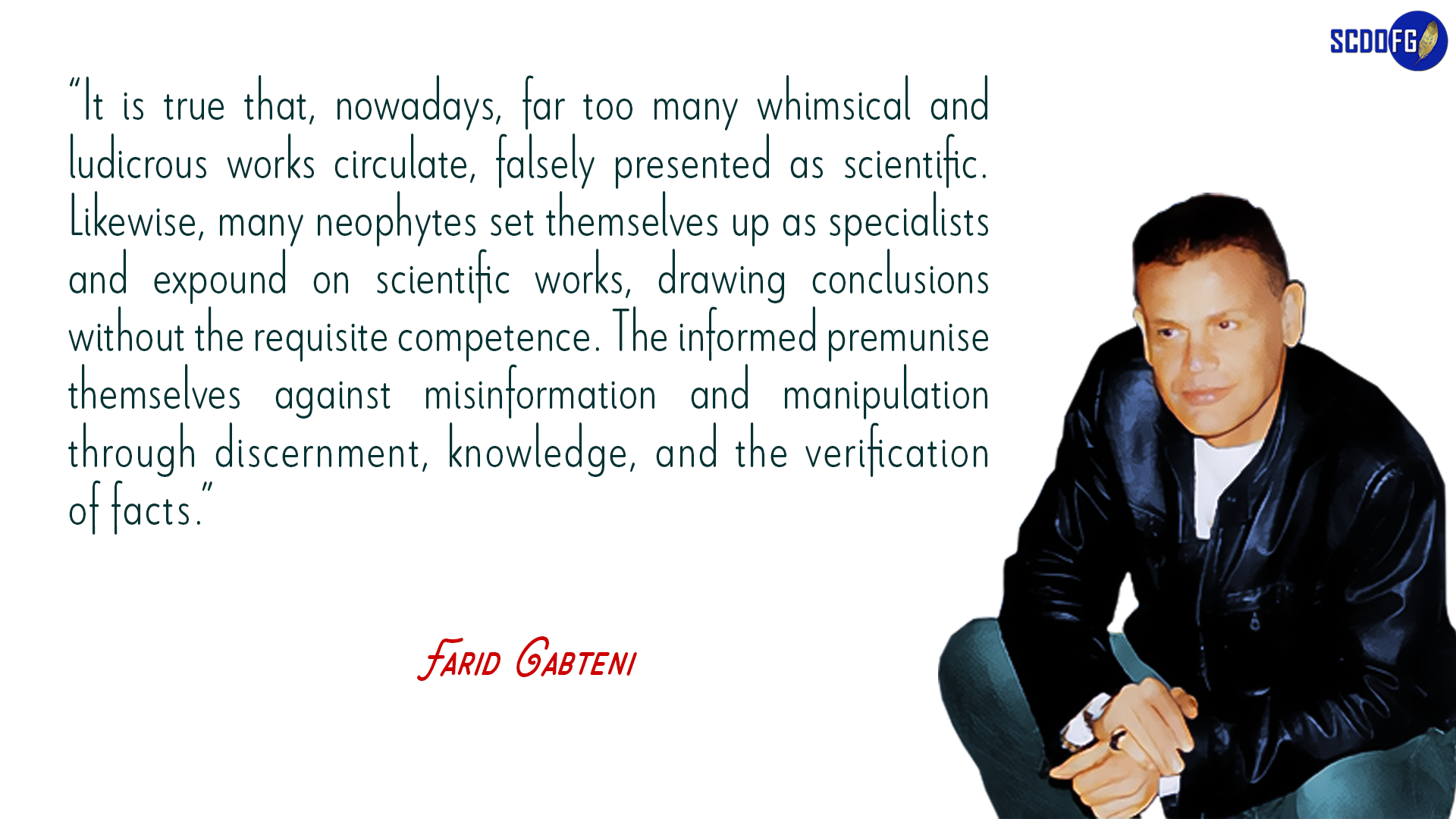
“It is true that, nowadays, far too many whimsical and ludicrous works circulate, falsely presented as scientific. Likewise, many neophytes set themselves up as specialists and expound on scientific works, drawing conclusions without the requisite competence. The informed premunise themselves against misinformation and manipulation through discernment, knowledge, and the verification of facts.” — Farid Abbes Raja Gabteni
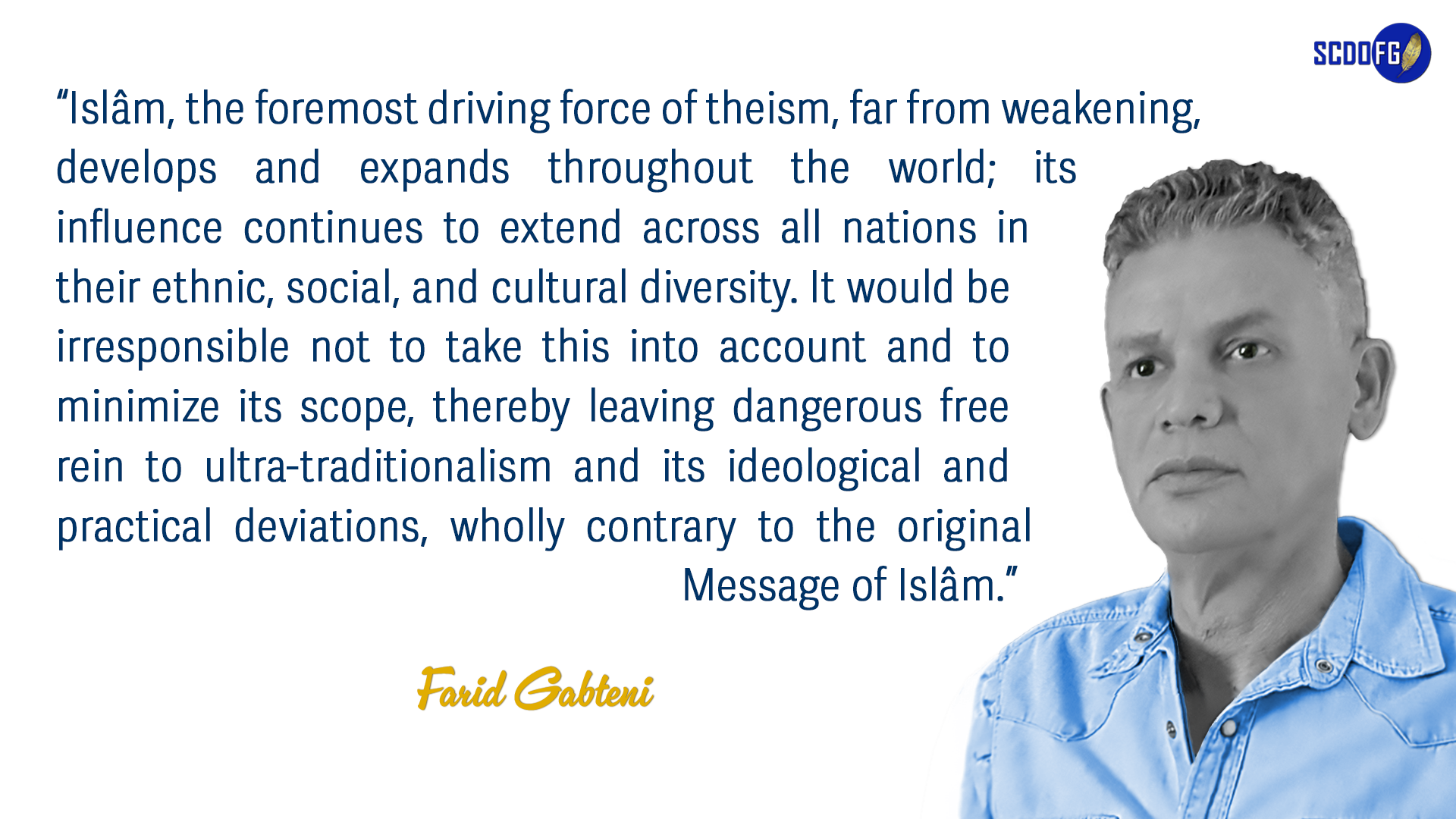
“Islâm, the foremost driving force of theism, far from weakening, develops and expands throughout the world; its influence continues to extend across all nations in their ethnic, social, and cultural diversity. It would be irresponsible not to take this into account and to minimize its scope, thereby leaving dangerous free rein to ultra-traditionalism and its ideological and practical deviations, wholly contrary to the original Message of Islâm.” — Farid Abbes Raja Gabteni
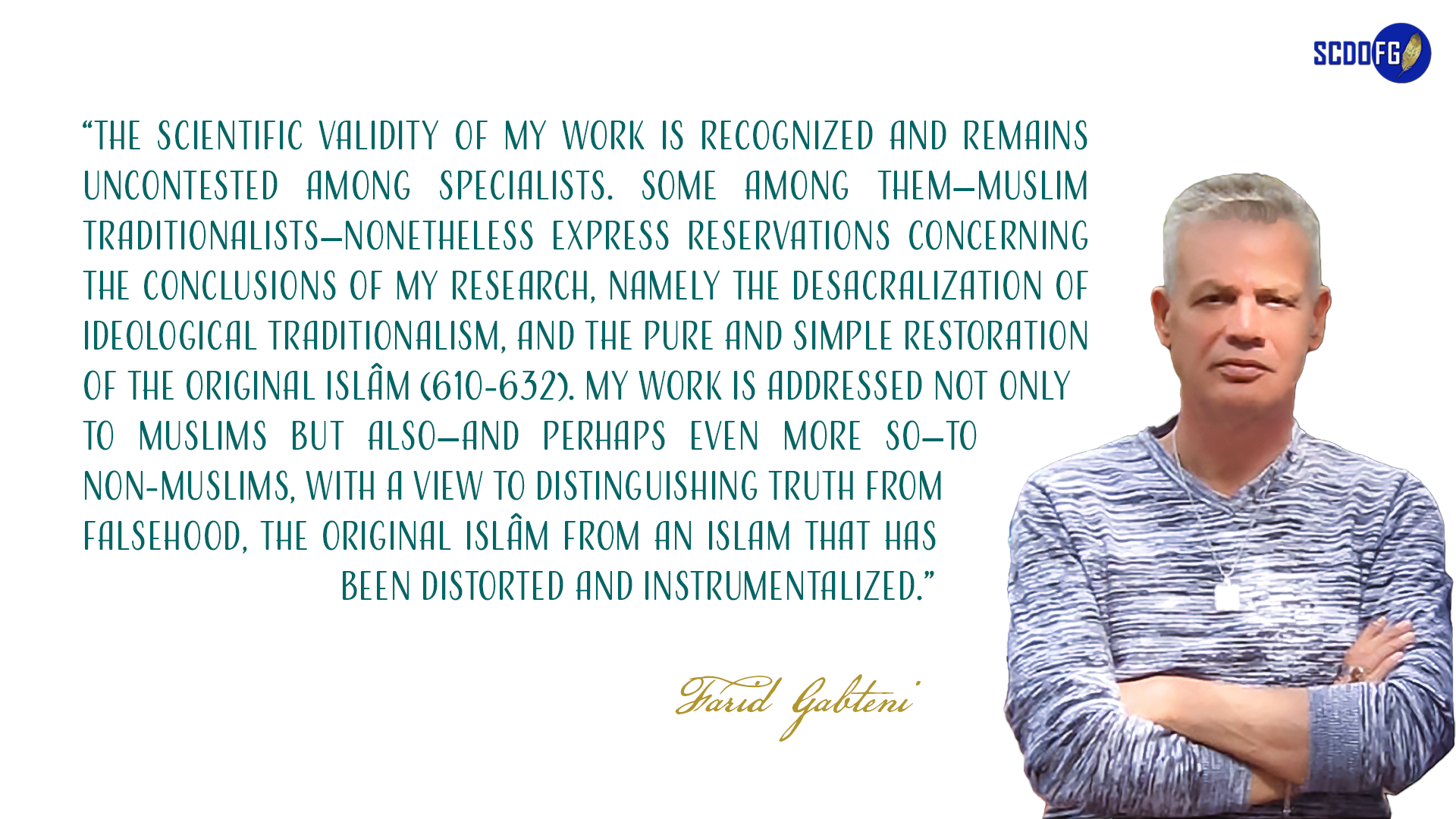
« The scientific validity of my work is recognized and remains uncontested among specialists. Some among them—Muslim traditionalists—nonetheless express reservations concerning the conclusions of my research, namely the desacralization of ideological traditionalism, and the pure and simple restoration of the original Islâm (610-632). My work is addressed not only to Muslims but also—and perhaps even more so—to non-Muslims, with a view to distinguishing truth from falsehood, the original Islâm from an islam that has been distorted and instrumentalized. » — Farid Abbes Raja Gabteni
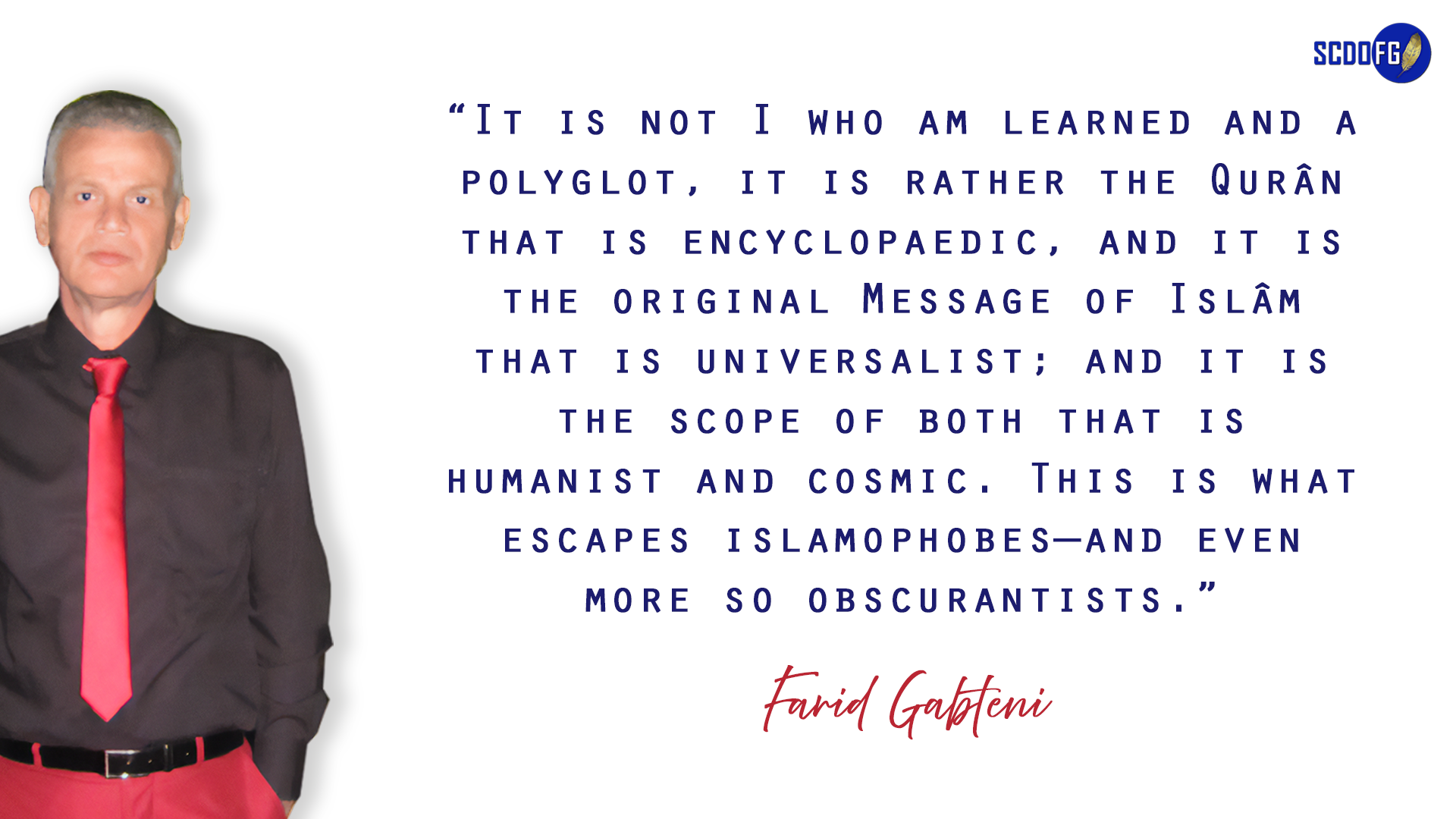
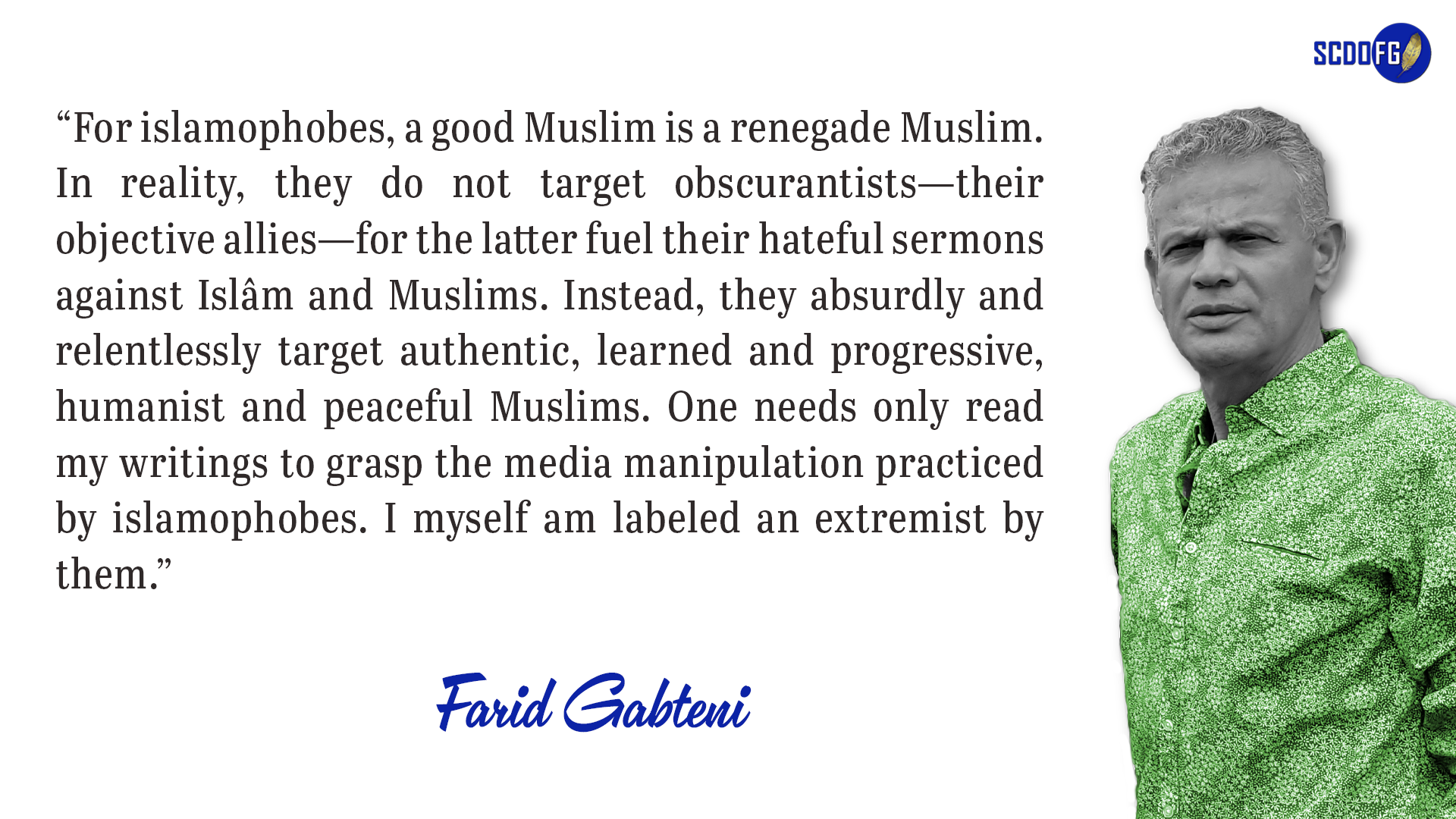
“It is not I who am learned and a polyglot, it is rather the Qurân that is encyclopaedic, and it is the original Message of Islâm that is universalist; and it is the scope of both that is humanist and cosmic. This is what escapes islamophobes—and even more so obscurantists.” Farid Gabteni
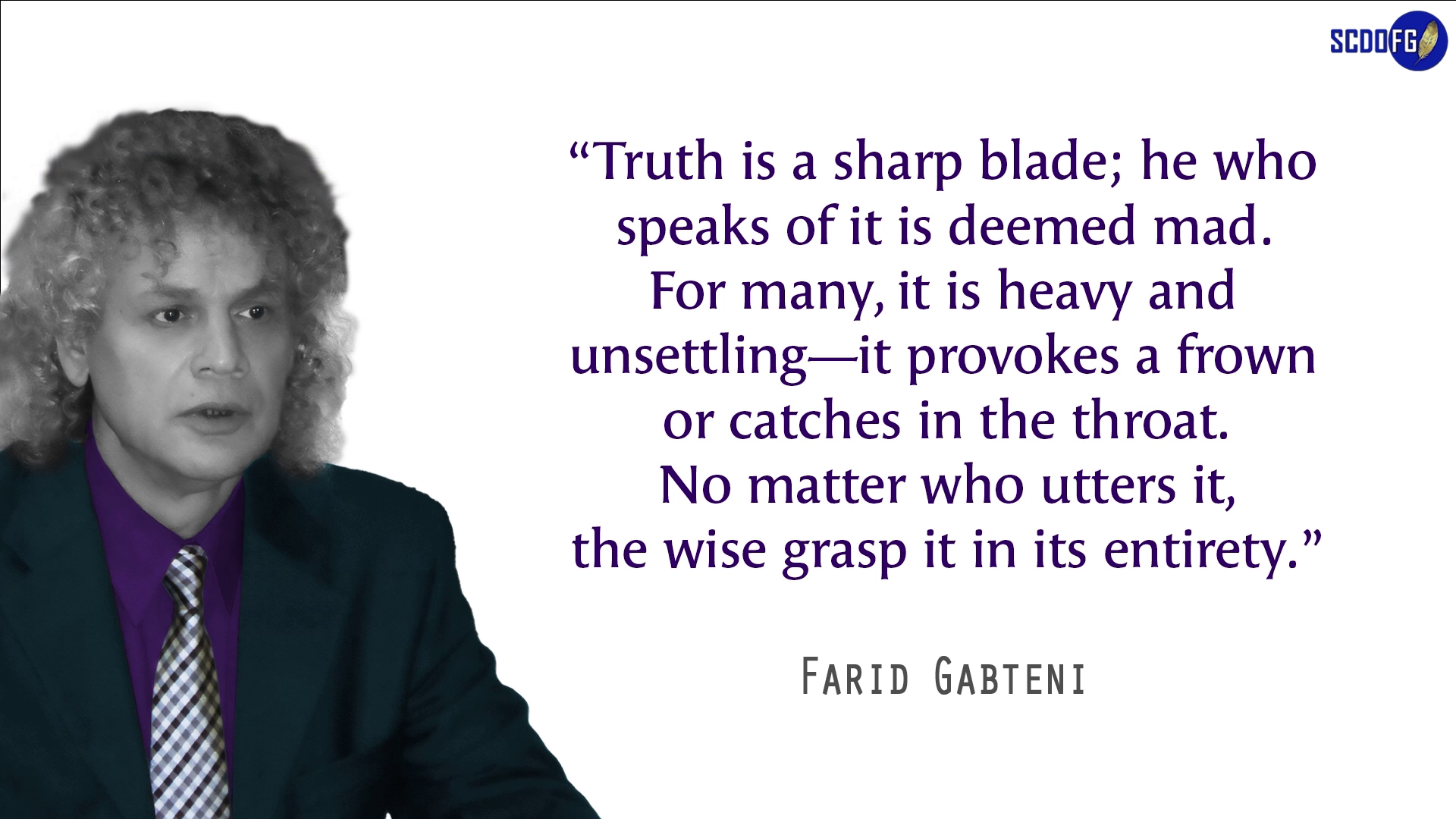
« Truth is a sharp blade; he who speaks of it is deemed mad. For many, it is heavy and unsettling—it provokes a frown or catches in the throat. No matter who utters it, the wise grasp it in its entirety. » — Farid Abbes Raja Gabteni
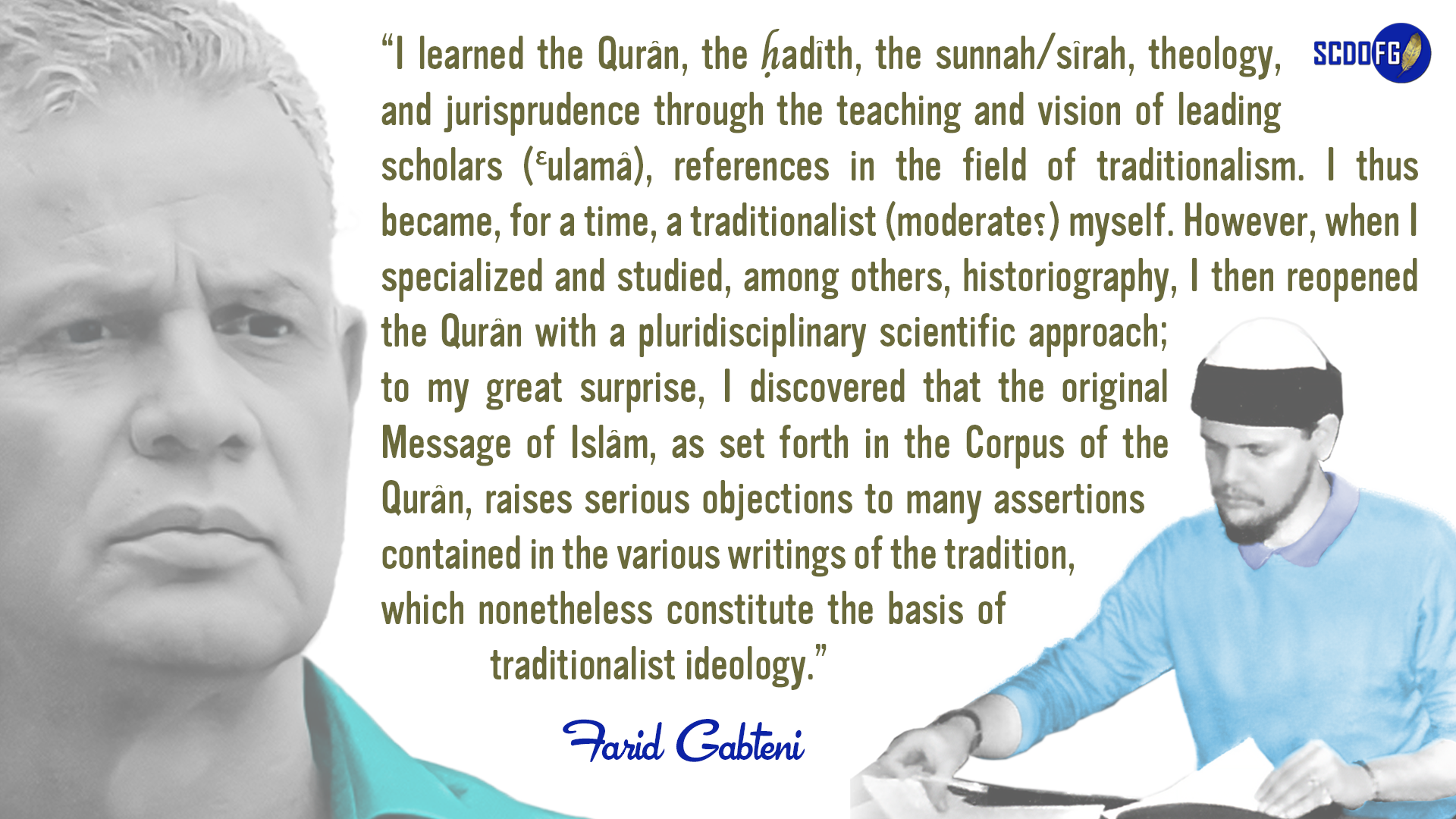
“I learned the Qurân, the ḥadîth, the sunnah/sîrah, theology, and jurisprudence through the teaching and vision of leading scholars (عulamâ), references in the field of traditionalism. I thus became, for a time, a traditionalist (moderate؟) myself. However, when I specialized and studied, among others, historiography, I then reopened the Qurân with a pluridisciplinary scientific approach; to my great surprise, I discovered that the original Message of Islâm, as set forth in the Corpus of the Qurân, raises serious objections to many assertions contained in the various writings of the tradition, which nonetheless constitute the basis of traditionalist ideology.” Farid Gabteni
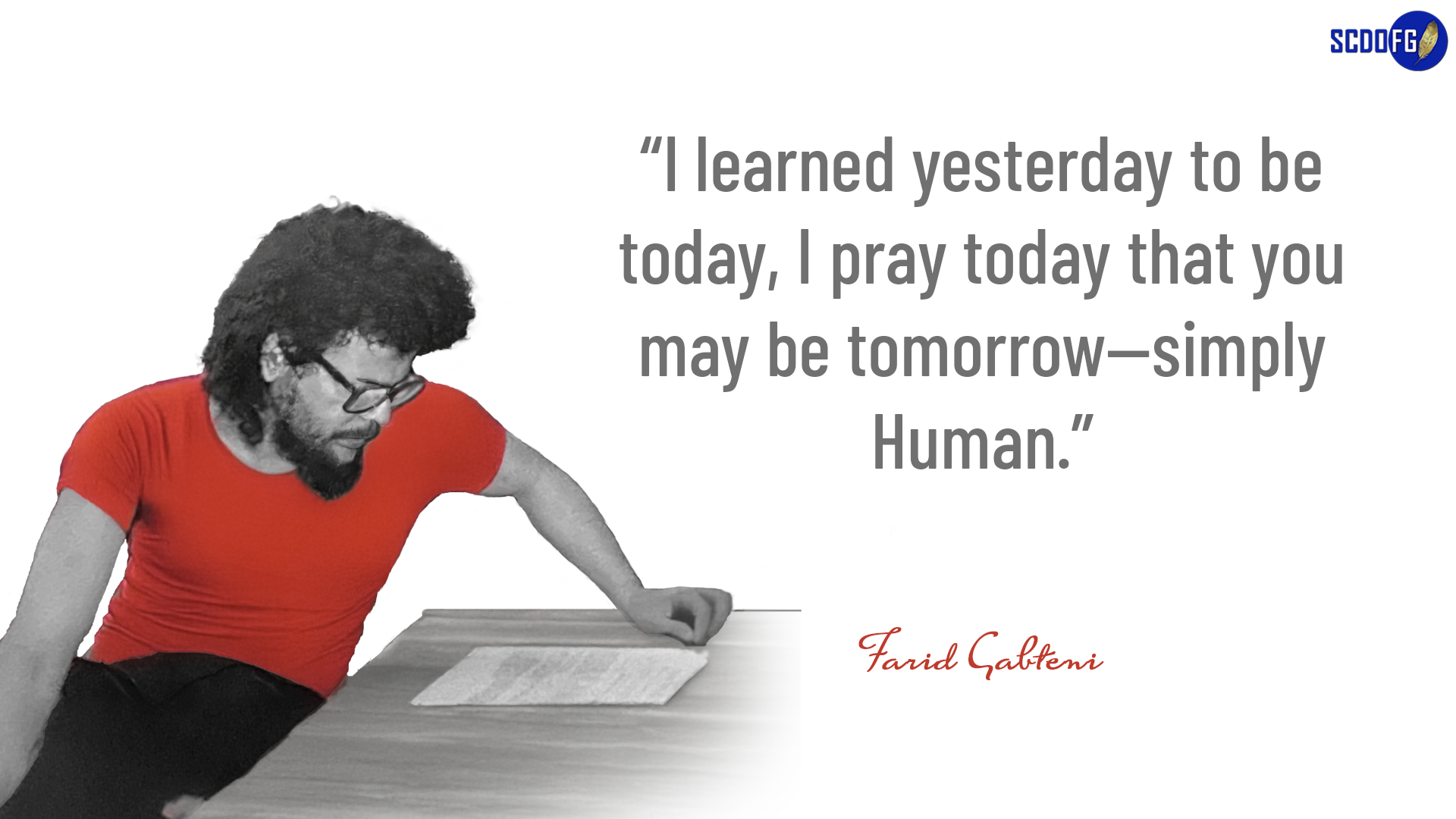
“I learned yesterday to be today, I pray today that you may be tomorrow—simply Human.” — Farid Abbes Raja Gabteni
“‘(…) This day I have Complemented for you your creance (religion) and Perfected upon you My Grace, and I have Approved for you the Pacification (Islâm), creditor (religiosity) (…)’ (Qurân / Chapter 5, verse 3). This verse is the last to have been revealed, the closing point of the Revelation. Islâm, the first and last revealed religion, was from that day complete and approved as such. Any addition subsequent to this revelation stems from the various circumstances of Muslim history, and cannot be regarded as part of the canon of Islâm. To maintain the opposite is to assert that the Religion was not complemented at the revelation of this verse, in contradiction to what the verse itself affirms.” Farid Gabteni
« Study the past and the present, learn through science and knowledge, observe the heavens, the stars, the earth, the sea, life and death, every thing—small and great. Then you will know—you will know Him—you will then bear witness that there is no god but God; and you will know how and why to live. » — Farid Abbes Raja Gabteni
“A religion grounded in righteous and beautiful deed, in the middle way and in moderation, Islâm is the religion of science and of the knowledge of God through His Creation. One of the elements—and not the least—that distinguishes the Qurân from earlier revelations is its sustained emphasis on science and knowledge. Indeed, the very first word revealed to Muhammad was: ‘Iqra’! (Read!)’.” Farid Gabteni
“As for the first human being designated as such, it is Âdam; and the first time he is mentioned in the Qurân, God declares: ‘And He made Known to Âdam the names, all of them. (…)’ (Qurân / Chapter 2, verse 31). It is thus evident that, in the Qurân, the beginning of the human being is bound to knowledge. The first thing Âdam received from God was the knowledge of all the names, and the first command addressed by God to Muhammad was: ‘Read!’. The Message of God to mankind—from the beginning, through Muhammad, and until the end of time—is this: Read, learn, know God’s creation, so as to know God and act accordingly—rightly and with kindness—for you will be judged.” Farid Gabteni
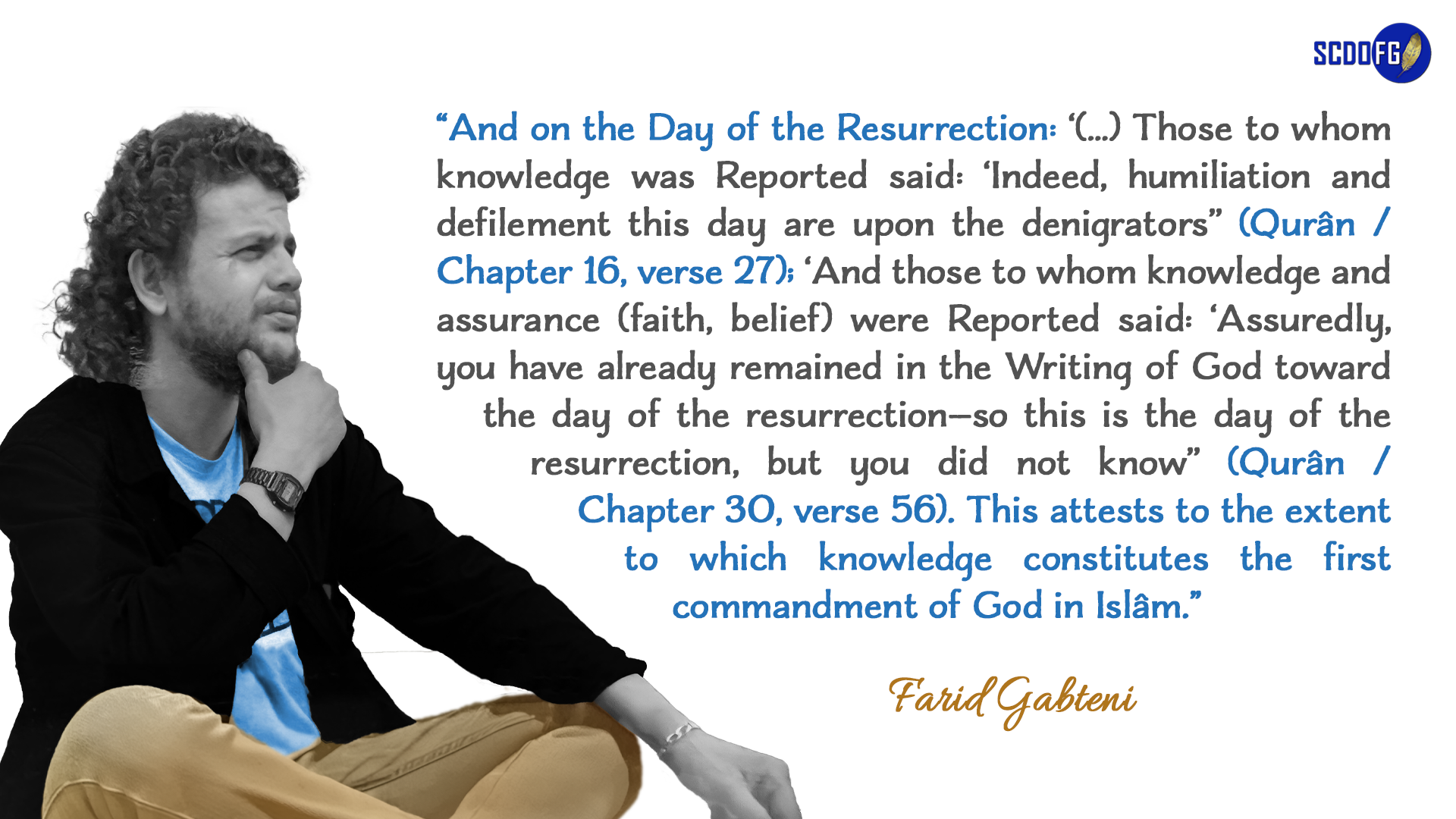
“And on the Day of the Resurrection: ‘(…) Those to whom knowledge was Reported said: ‘Indeed, humiliation and defilement this day are upon the denigrators’’ (Qurân/Chapter 16, verse 27); ‘And those to whom knowledge and assurance (faith, belief) were Reported said: ‘Assuredly, you have already remained in the Writing of God toward the day of the resurrection—so this is the day of the resurrection, but you did not know’’ (Qurân/Chapter 30, verse 56). This attests to the extent to which knowledge constitutes the first commandment of God in Islâm.” Farid Gabteni
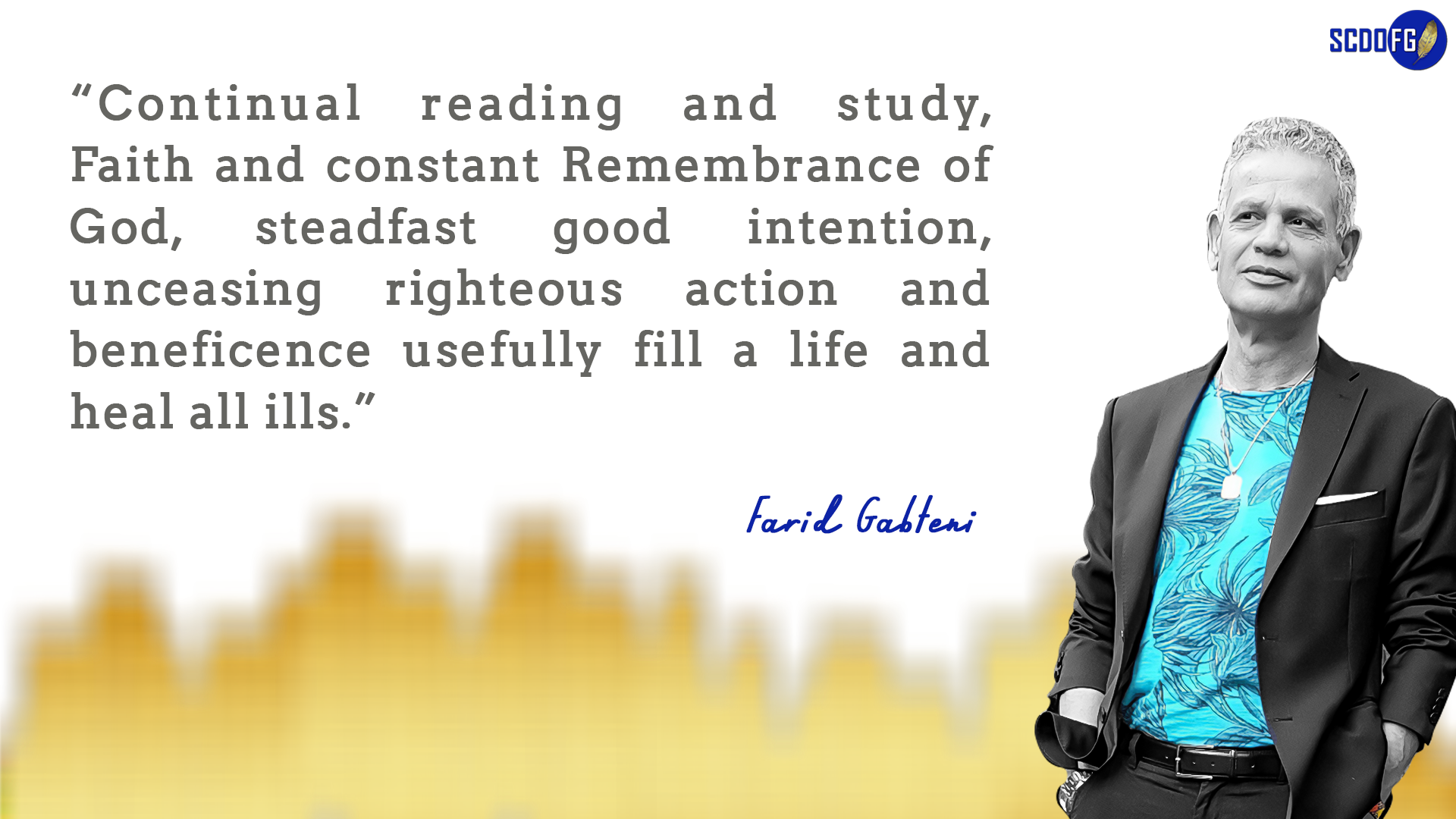
« Continual reading and study, Faith and constant Remembrance of God, steadfast good intention, unceasing righteous action and beneficence usefully fill a life and heal all ills. » — Farid Abbes Raja Gabteni
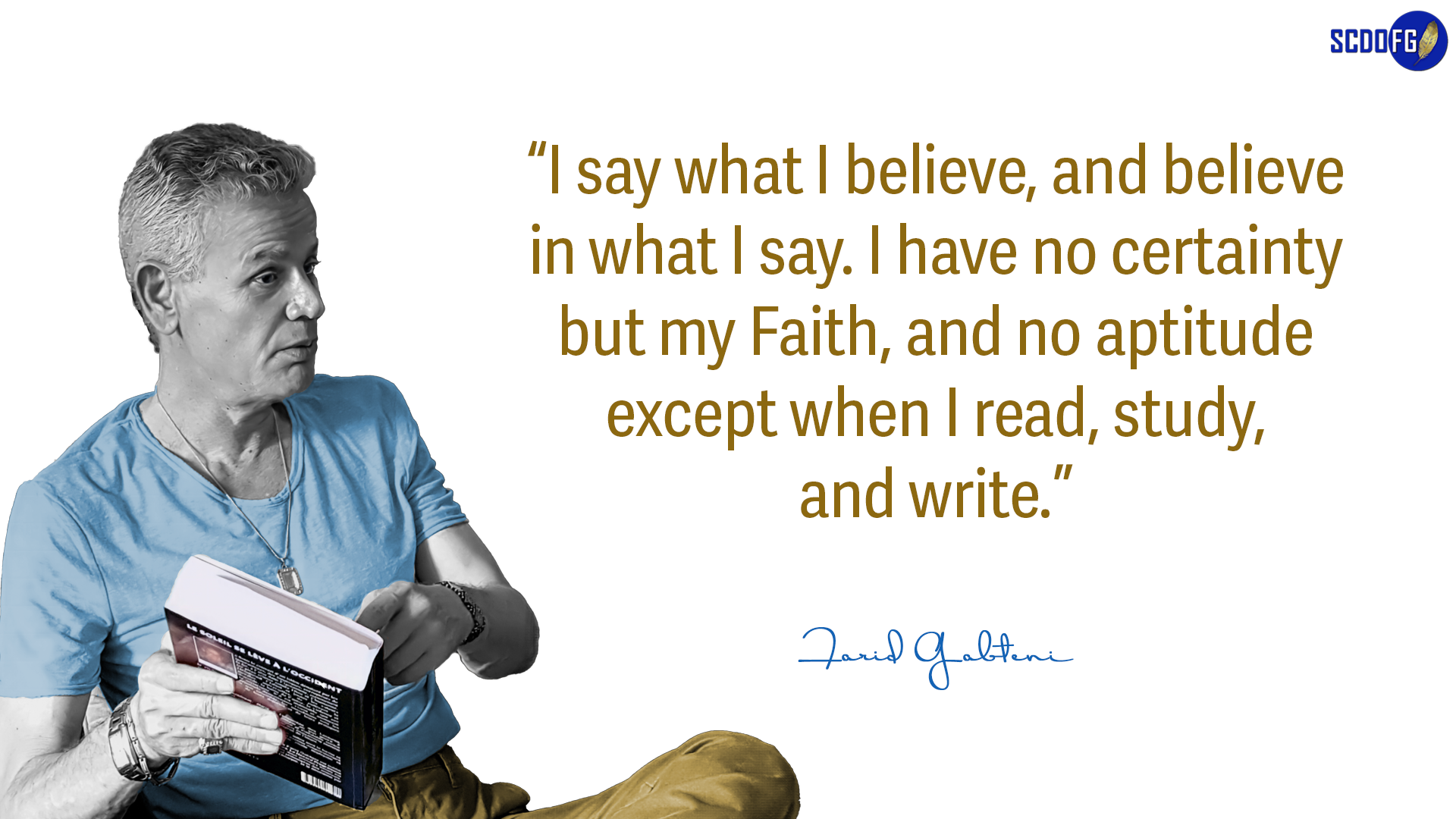
« I say what I believe, and believe in what I say. I have no certainty but my Faith, and no aptitude except when I read, study, and write » — Farid Abbes Raja Gabteni
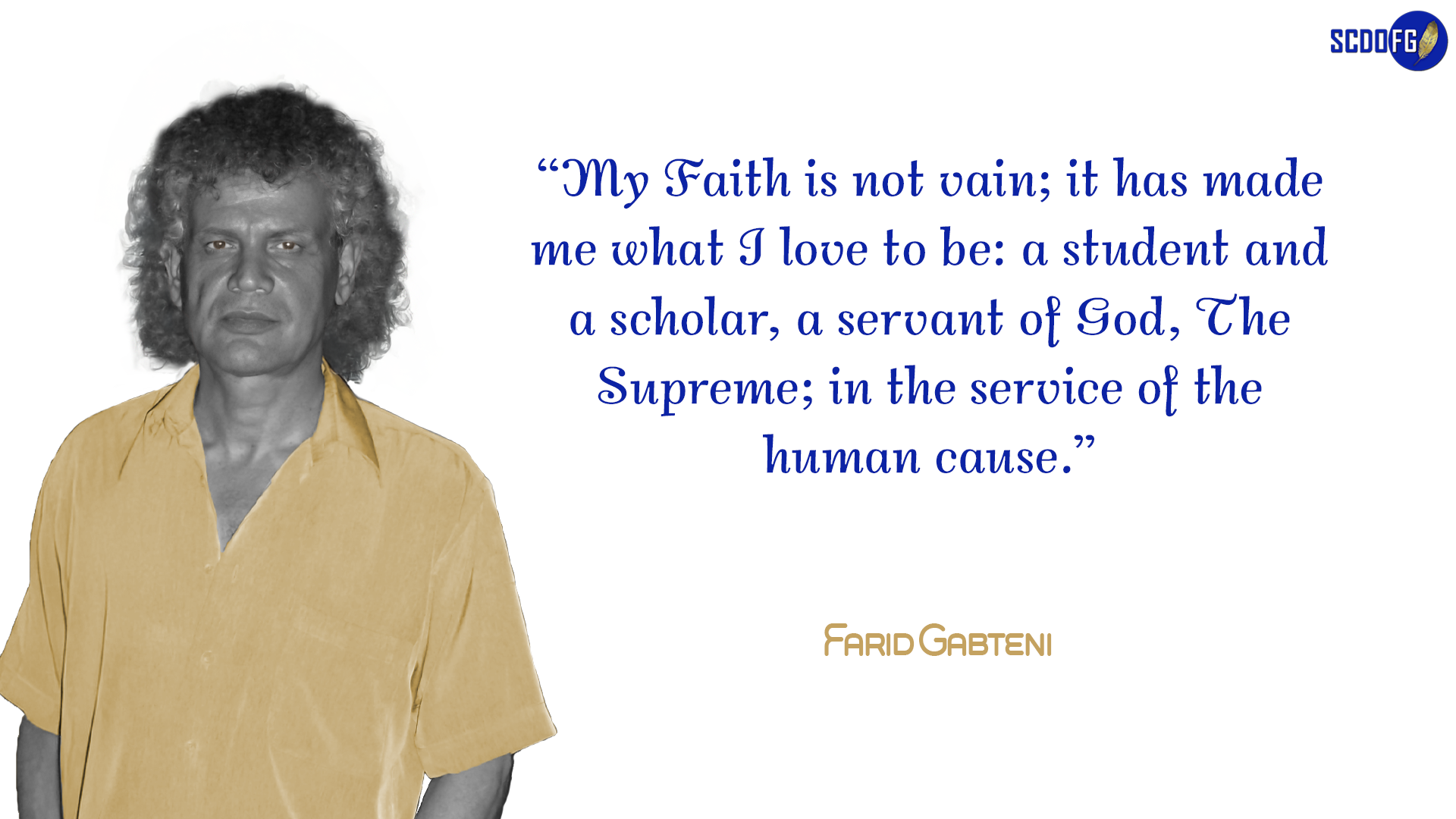
« My Faith is not vain; it has made me what I love to be: a student and a scholar, a servant of God, The Supreme; in the service of the human cause. » — Farid Abbes Raja Gabteni
« Directing one’s attention and reflection to what one says, what one hears, and what one sees, is to become conscious of things, of oneself, and of others. Deciphering rightly beyond what one says, what one hears, and what one sees, is to become conscious of the totality of things, of oneself, and of others. Beyond the two wholes resides The True, The Ineffable Real. » — Farid Abbes Raja Gabteni
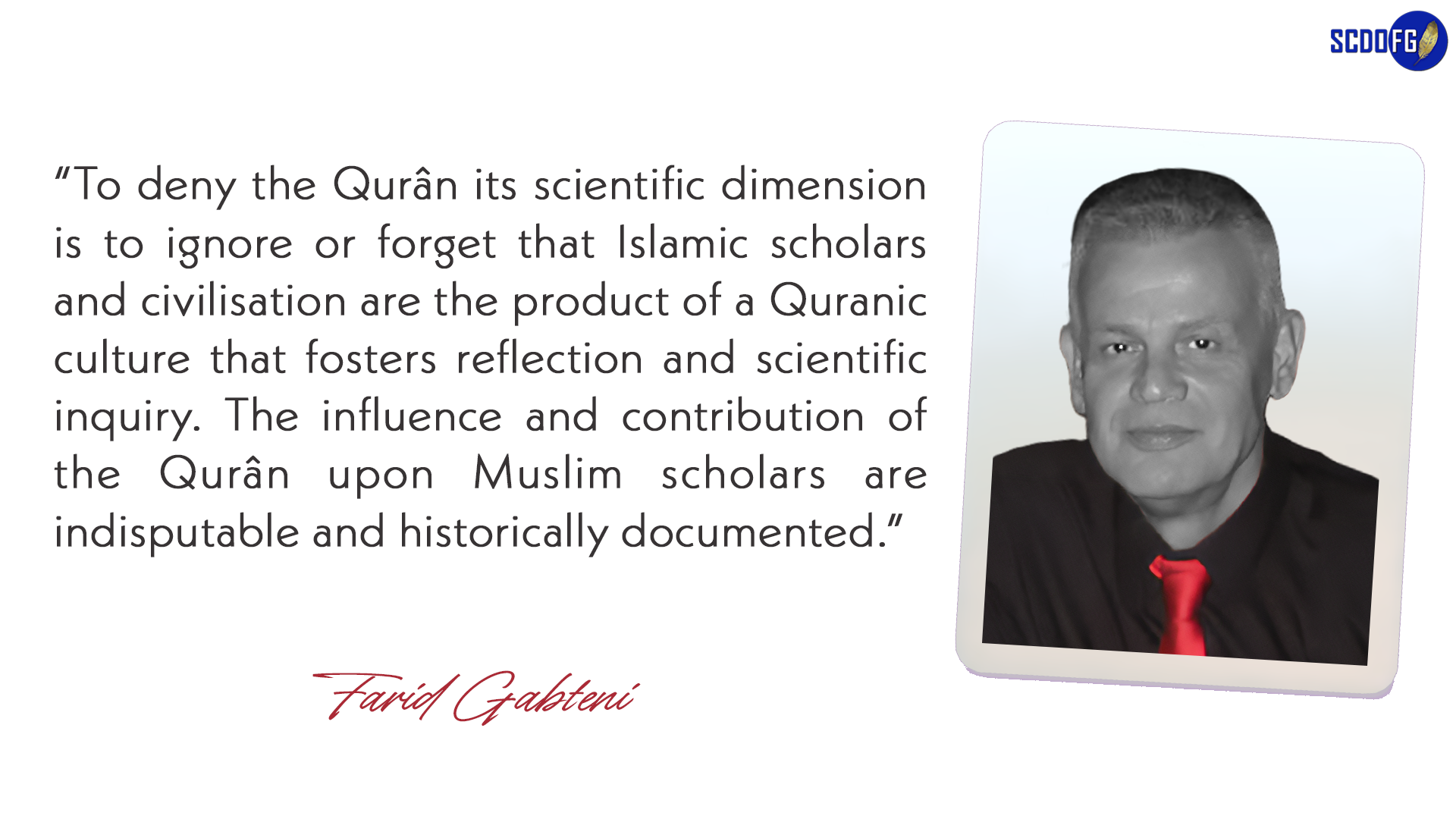
“To deny the Qurân its scientific dimension is to ignore or forget that Islamic scholars and civilisation are the product of a Quranic culture that fosters reflection and scientific inquiry. The influence and contribution of the Qurân upon Muslim scholars are indisputable and historically documented.” Farid Gabteni
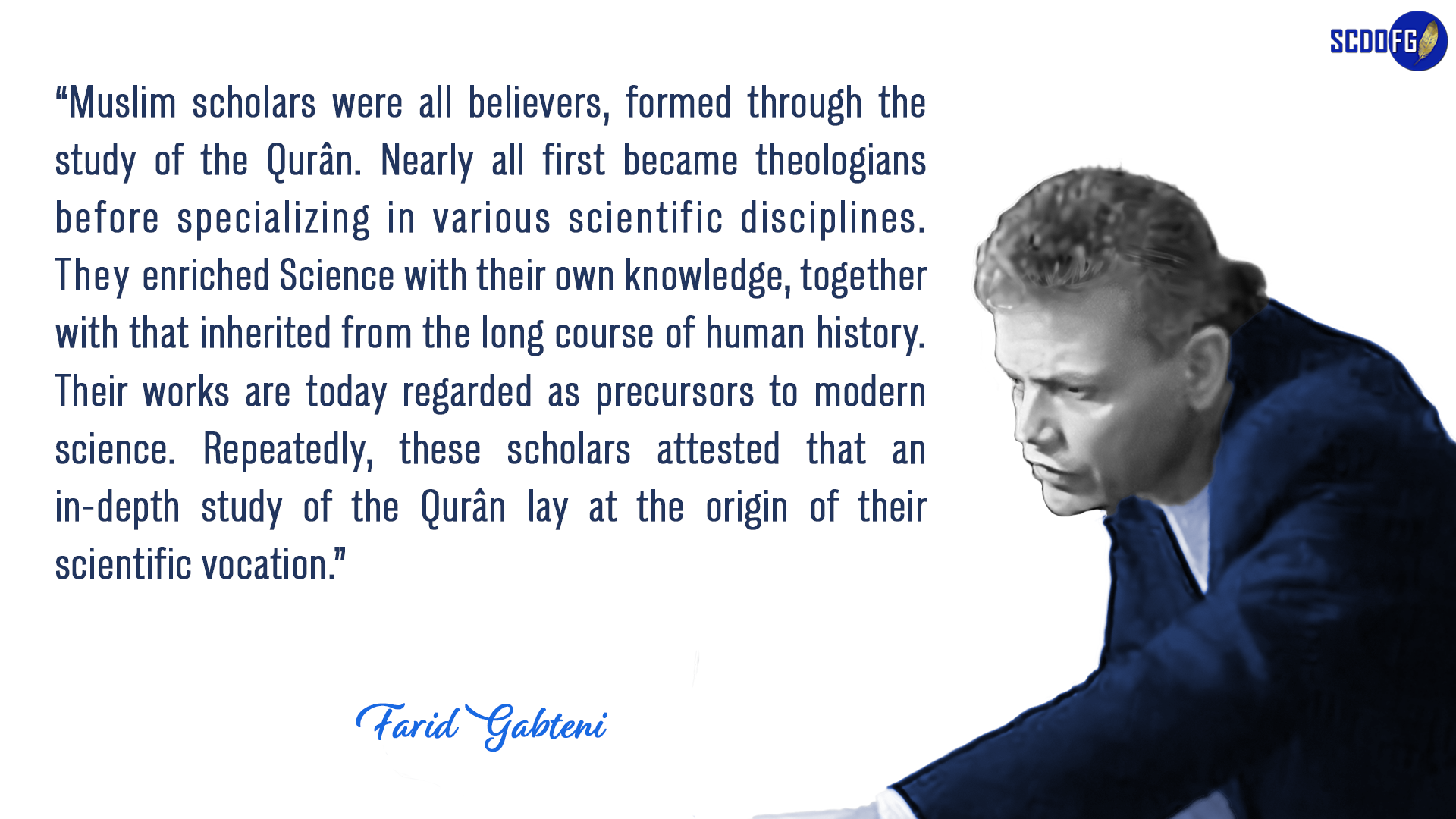
« Muslim scholars were all believers, formed through the study of the Qurân. Nearly all first became theologians before specializing in various scientific disciplines. They enriched Science with their own knowledge, together with that inherited from the long course of human history. Their works are today regarded as precursors to modern science. Repeatedly, these scholars attested that an in-depth study of the Qurân lay at the origin of their scientific vocation. » — Farid Abbes Raja Gabteni
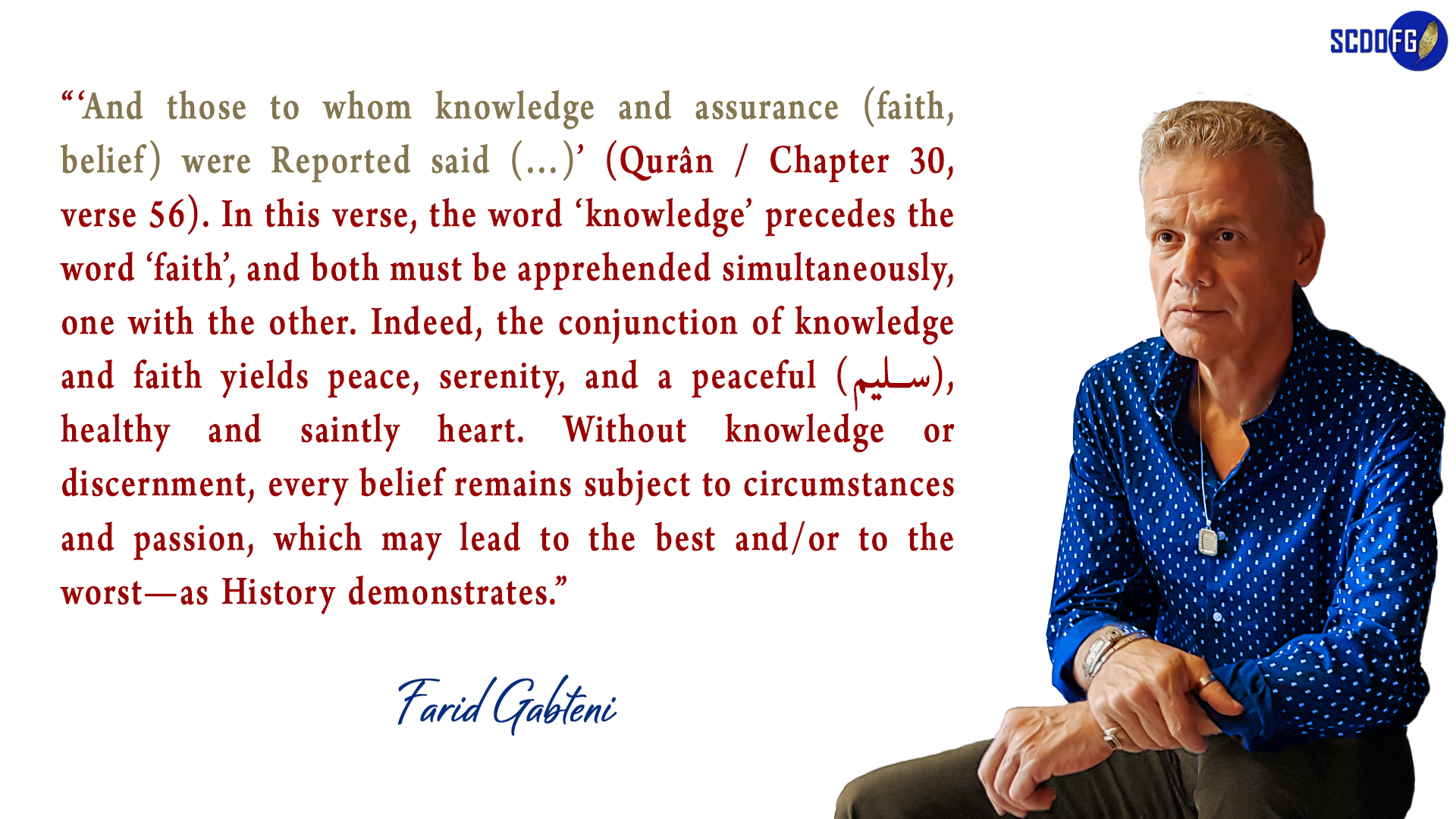
“‘And those to whom knowledge and assurance (faith, belief) were Reported said (…)’ (Qurân/Chapter 30, verse 56). In this verse, the word ‘knowledge’ precedes the word ‘faith’, and both must be apprehended simultaneously, one with the other. Indeed, the conjunction of knowledge and faith yields peace, serenity, and a peaceful (سليم), healthy and saintly heart. Without knowledge or discernment, every belief remains subject to circumstances and passion, which may lead to the best and/or to the worst—as History demonstrates.” Farid Gabteni
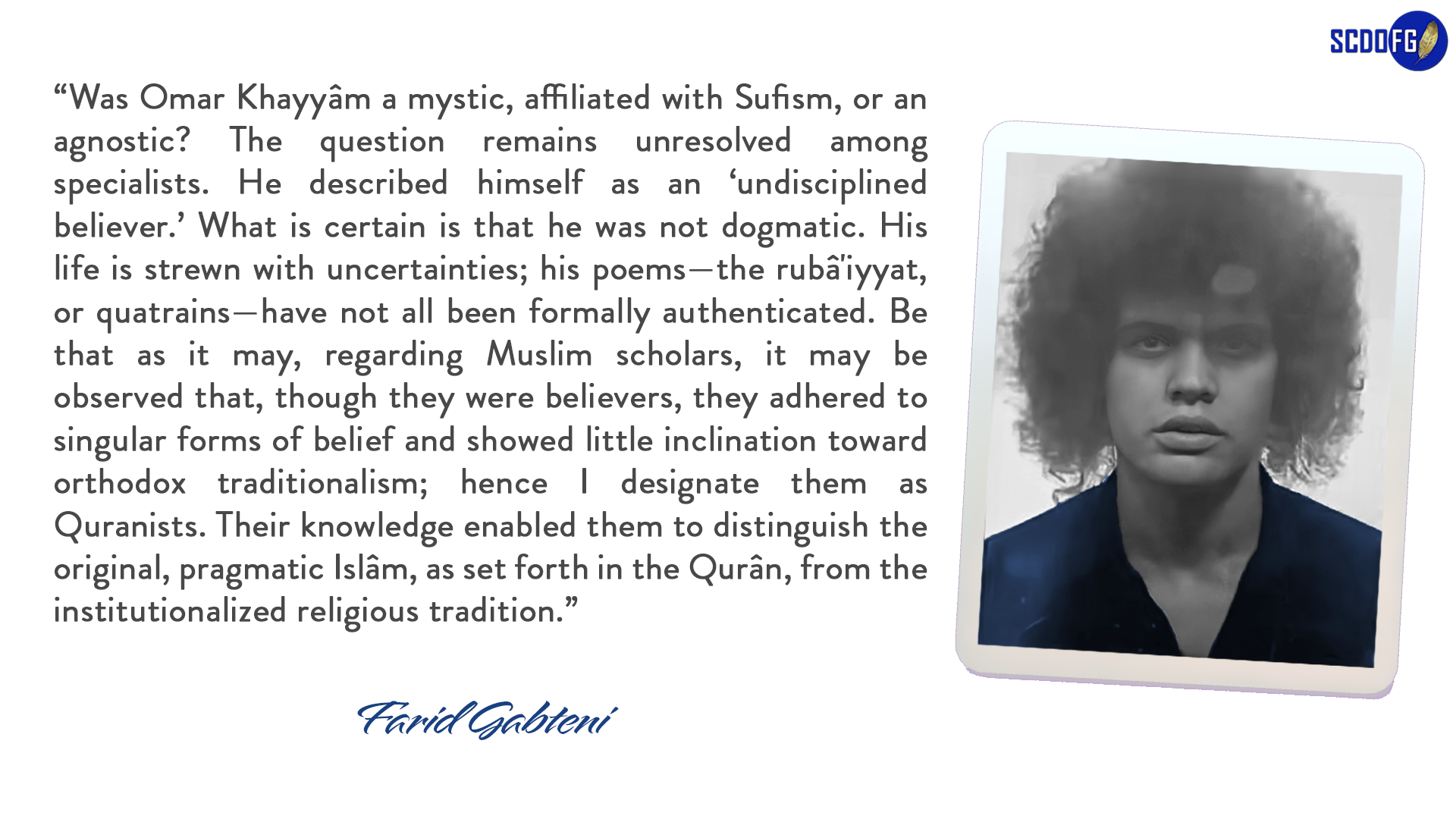
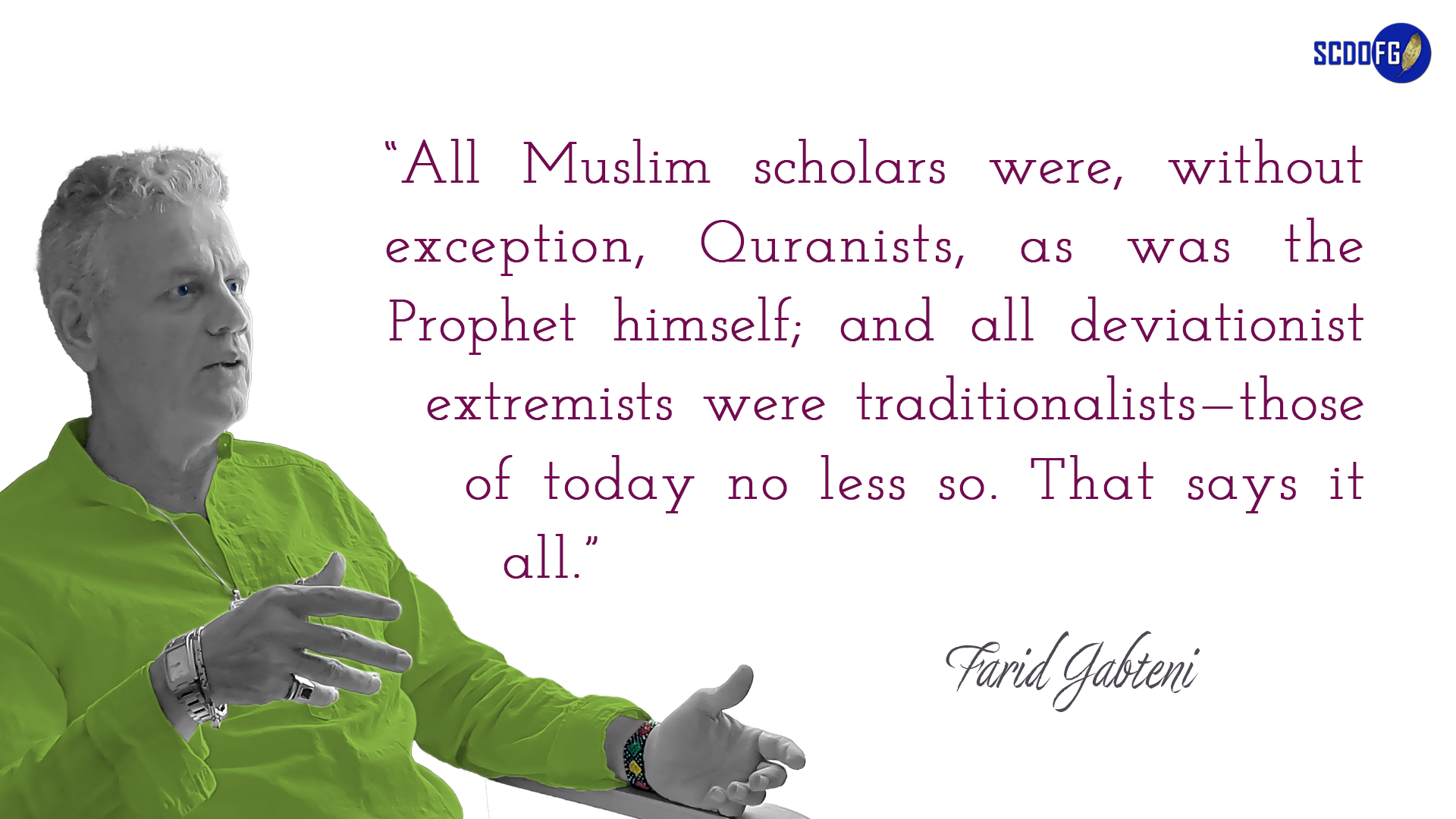
« Was Omar Khayyâm a mystic, affiliated with Sufism, or an agnostic? The question remains unresolved among specialists. He described himself as an ‘undisciplined believer.’ What is certain is that he was not dogmatic. His life is strewn with uncertainties; his poems—the rubâ’iyyat, or quatrains—have not all been formally authenticated. Be that as it may, regarding Muslim scholars, it may be observed that, though they were believers, they adhered to singular forms of belief and showed little inclination toward orthodox traditionalism; hence I designate them as Quranists. Their knowledge enabled them to distinguish the original, pragmatic Islâm, as set forth in the Qurân, from the institutionalized religious tradition. » — Farid Abbes Raja Gabteni
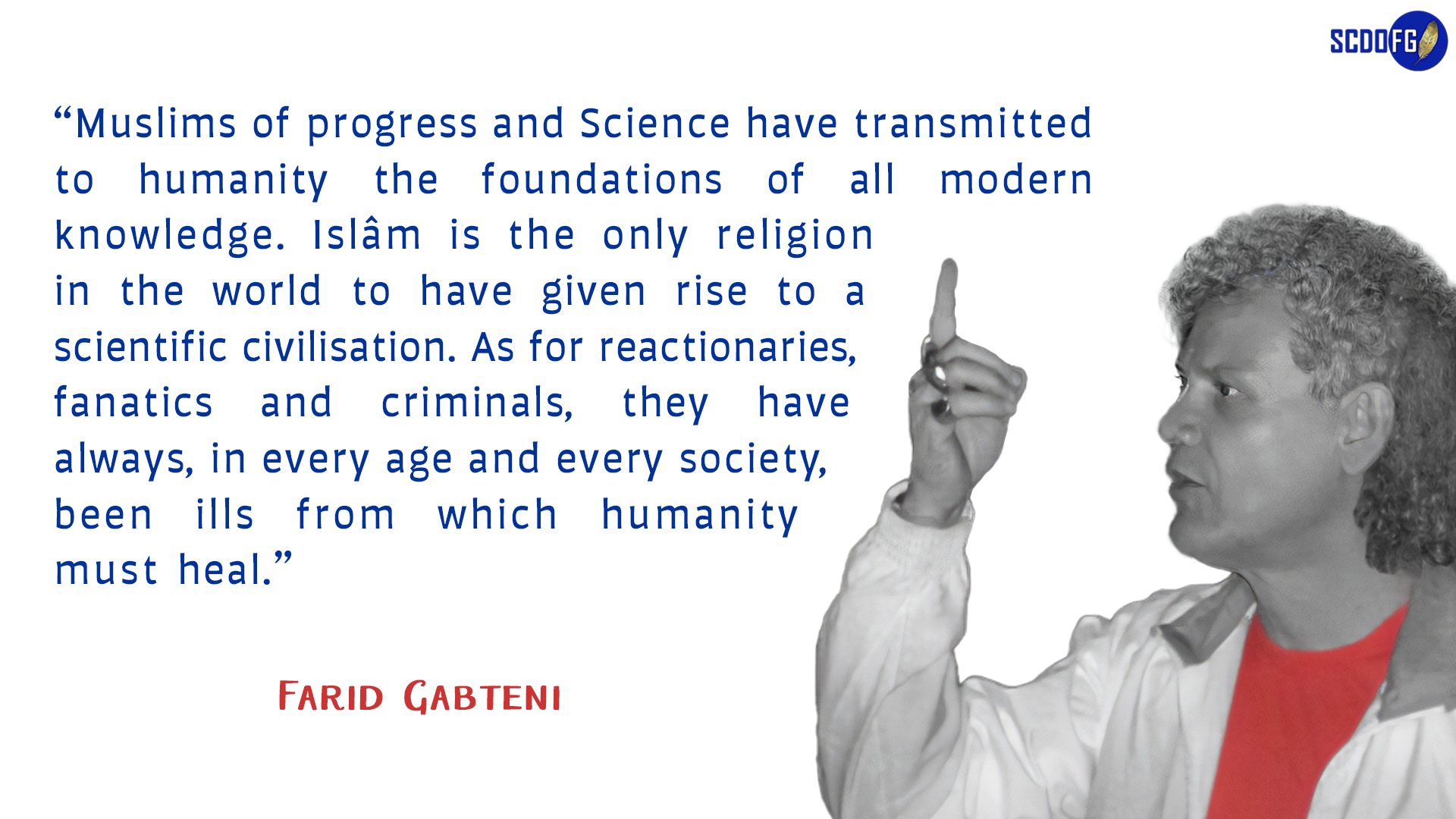
“Muslims of progress and Science have transmitted to humanity the foundations of all modern knowledge. Islâm is the only religion in the world to have given rise to a scientific civilisation. As for reactionaries, fanatics and criminals, they have always, in every age and every society, been ills from which humanity must heal.” Farid Gabteni
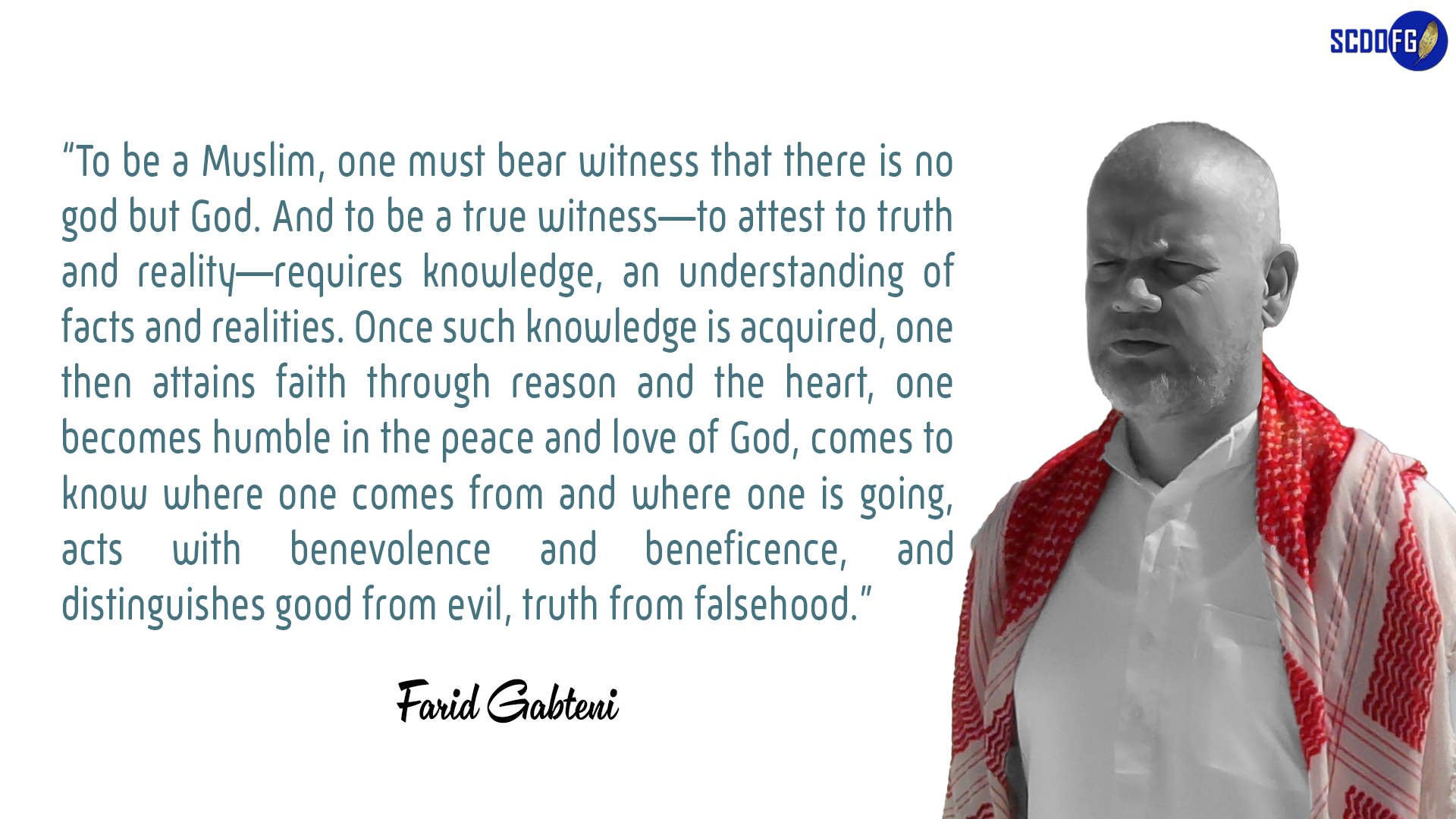
“To be a Muslim, one must bear witness that there is no god but God. And to be a true witness—to attest to truth and reality—requires knowledge, an understanding of facts and realities. Once such knowledge is acquired, one then attains faith through reason and the heart, one becomes humble in the peace and love of God, comes to know where one comes from and where one is going, acts with benevolence and beneficence, and distinguishes good from evil, truth from falsehood.” Farid Gabteni
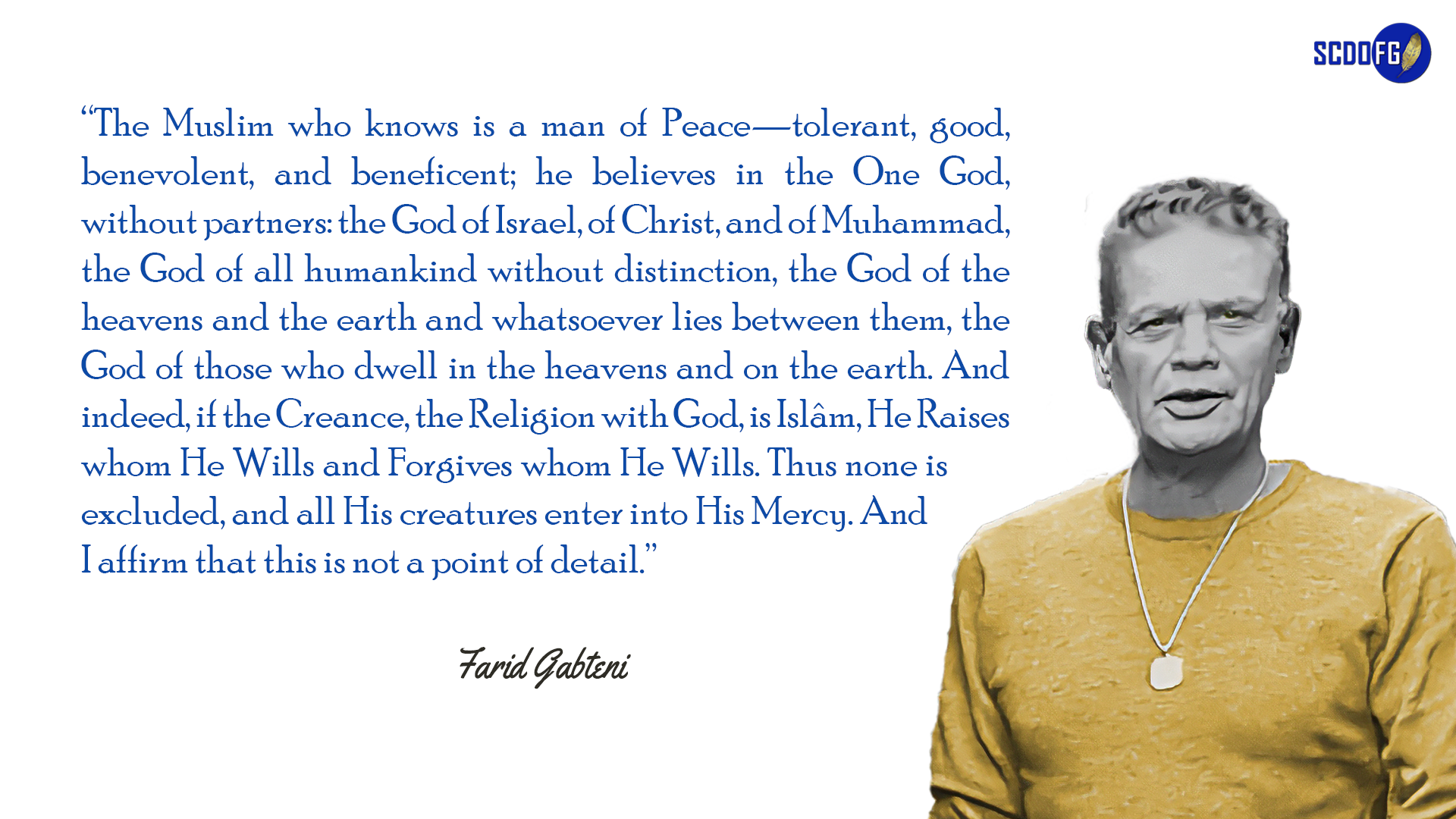
« The Muslim who knows is a man of Peace—tolerant, good, benevolent, and beneficent; he believes in the One God, without partners: the God of Israel, of Christ, and of Muhammad, the God of all humankind without distinction, the God of the heavens and the earth and whatsoever lies between them, the God of those who dwell in the heavens and on the earth. And indeed, if the Creance, the Religion with God, is Islâm, He Raises whom He Wills and Forgives whom He Wills. Thus none is excluded, and all His creatures enter into His Mercy. And I affirm that this is not a point of detail. » — Farid Abbes Raja Gabteni
« The history of philosophy teaches us that thinkers express themselves and use words with great attention to the sense and meaning they convey—both etymologically and timelessly. This process—which calls for subtlety while rejecting ambiguity—is essential to ideation and the establishment of an explicit theoretical foundation as a form of critical reflection. » — Farid Abbes Raja Gabteni
« Throughout my book, I demonstrate, by means of numerous examples, that the Qurân emphasizes and encourages reflection, reasoning, and the pursuit of knowledge—thereby leading to the knowledge of God. The Qurân is not a law in itself but a Revelation; it is Religion insofar as it establishes a relationship between man and the Divine Order, that of a Higher Reality, expressed through Knowledge, Faith, Benevolence, Beneficence, the Enjoining of good, the Avoidance of evil, Pacification and Peace. Such is the original Message of Islâm. » — Farid Abbes Raja Gabteni
« The Truth, nothing but the Truth, the whole Truth, I only want and seek the True of the Truth; whatever the consequences. » — Farid Abbes Raja Gabteni
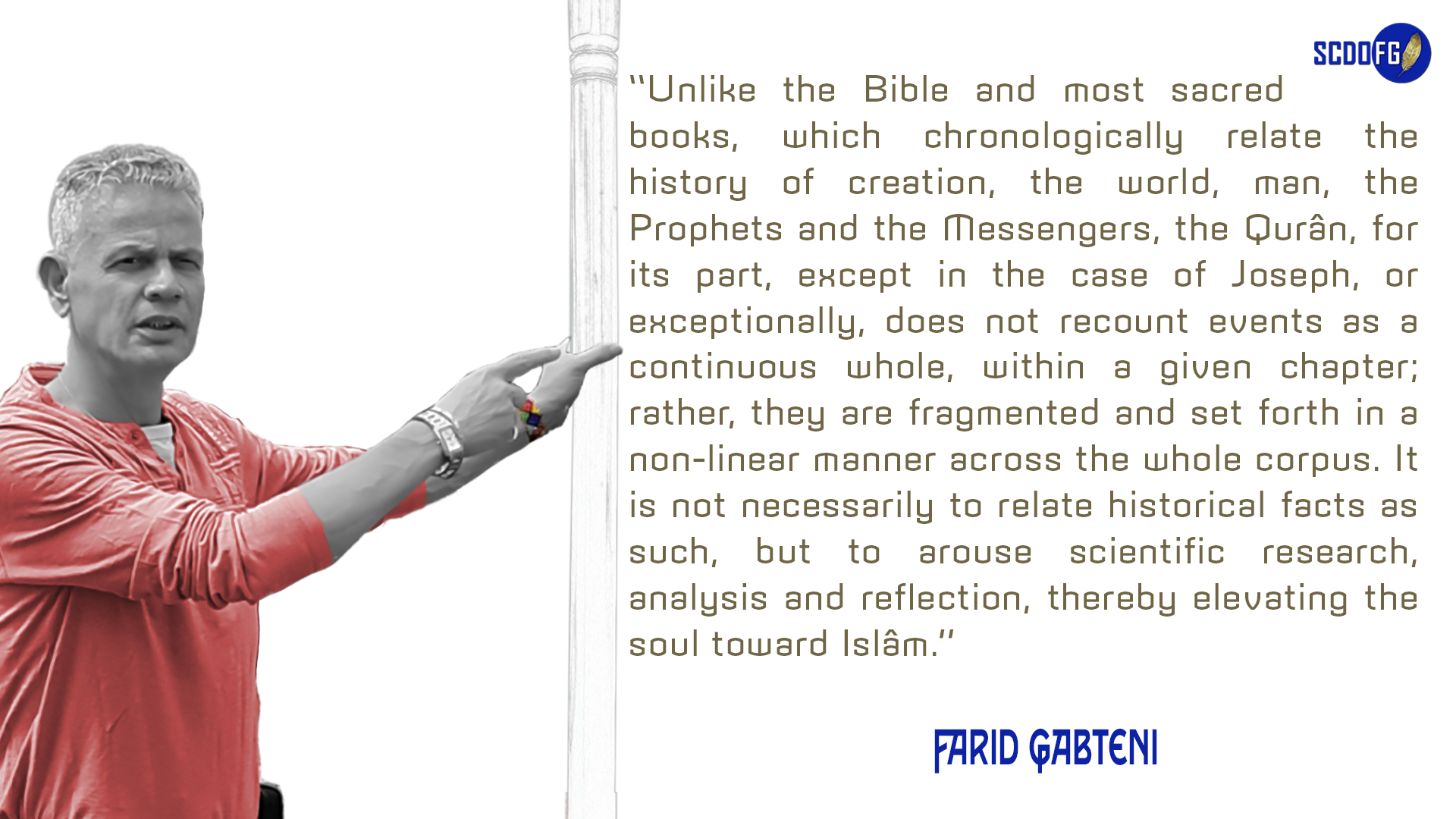
“Unlike the Bible and most sacred books, which chronologically relate the history of creation, the world, man, the Prophets and the Messengers, the Qurân, for its part, except in the case of Joseph, or exceptionally, does not recount events as a continuous whole, within a given chapter; rather, they are fragmented and set forth in a non-linear manner across the whole corpus. It is not necessarily to relate historical facts as such, but to arouse scientific research, analysis and reflection, thereby elevating the soul toward Islâm.” Farid Gabteni
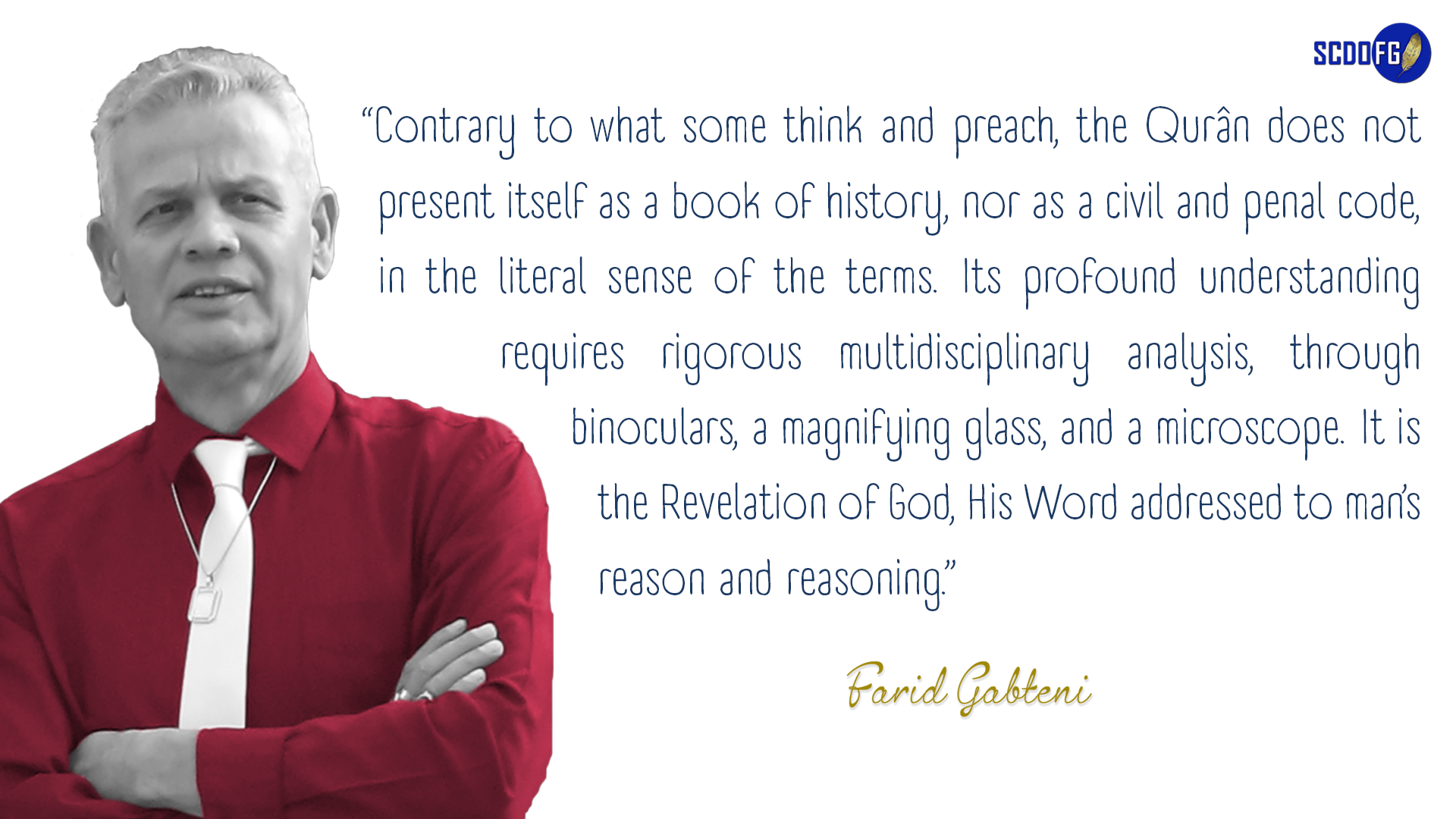
“Contrary to what some think and preach, the Qurân does not present itself as a book of history, nor as a civil and penal code, in the literal sense of the terms. Its profound understanding requires rigorous multidisciplinary analysis, through binoculars, a magnifying glass, and a microscope. It is the Revelation of God, His Word addressed to man’s reason and reasoning.” Farid Gabteni
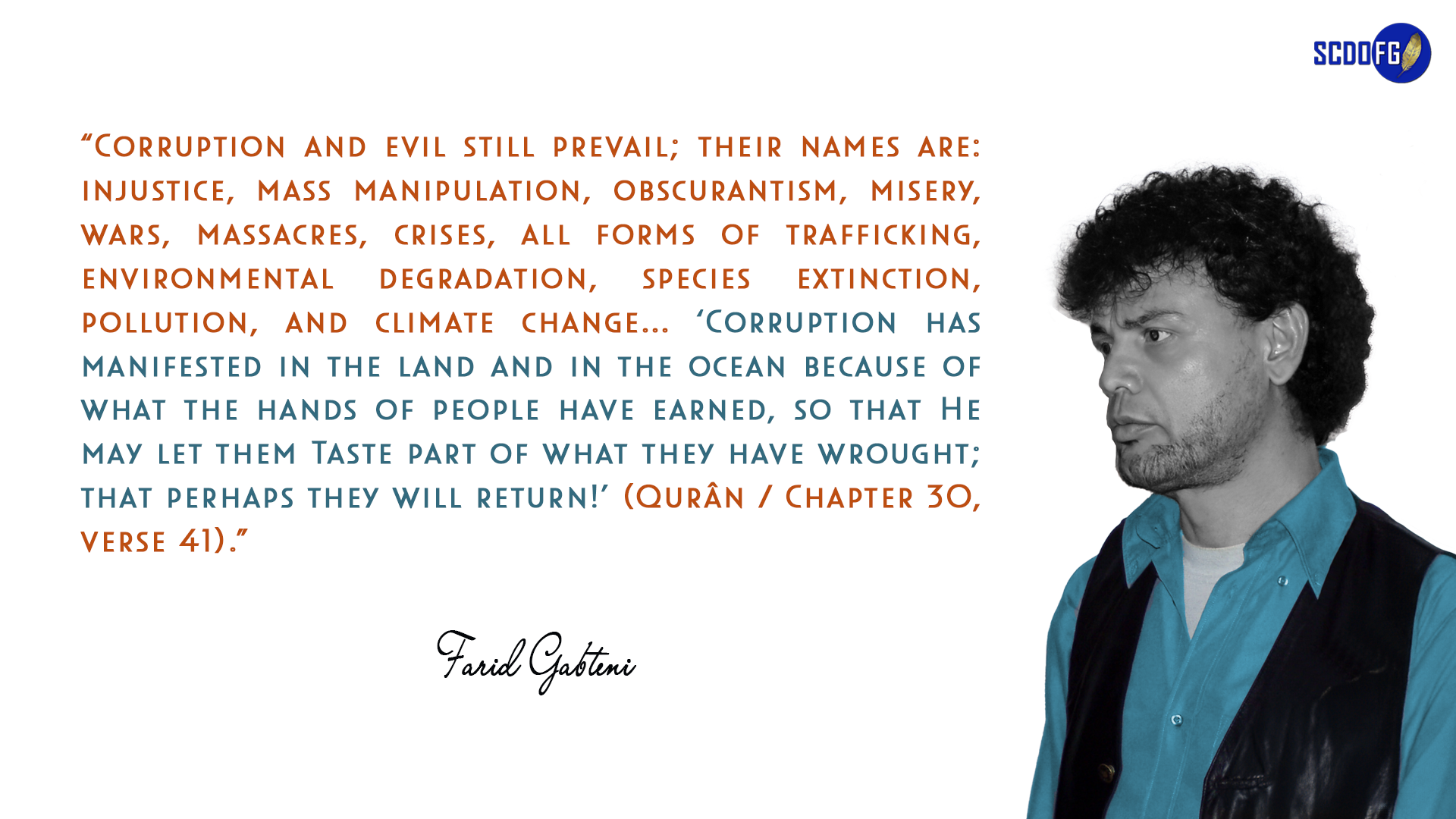
“Corruption and evil still prevail; their names are: injustice, mass manipulation, obscurantism, misery, wars, massacres, crises, all forms of trafficking, environmental degradation, species extinction, pollution, and climate change… ‘Corruption has manifested in the land and in the ocean because of what the hands of people have earned, so that He may let them Taste part of what they have wrought; that perhaps they will return!’ (Qurân/Chapter 30, verse 41).” Farid Gabteni
« I’m in pain, I suffer from my powerlessness in the face of so much misfortune in the world. I am ashamed of those who—powerful and wealthy—claim to be my friends, take little political action and do not allocate at least one fifth of their budgets to contribute to eradicating poverty and misery. Said. » — Farid Abbes Raja Gabteni
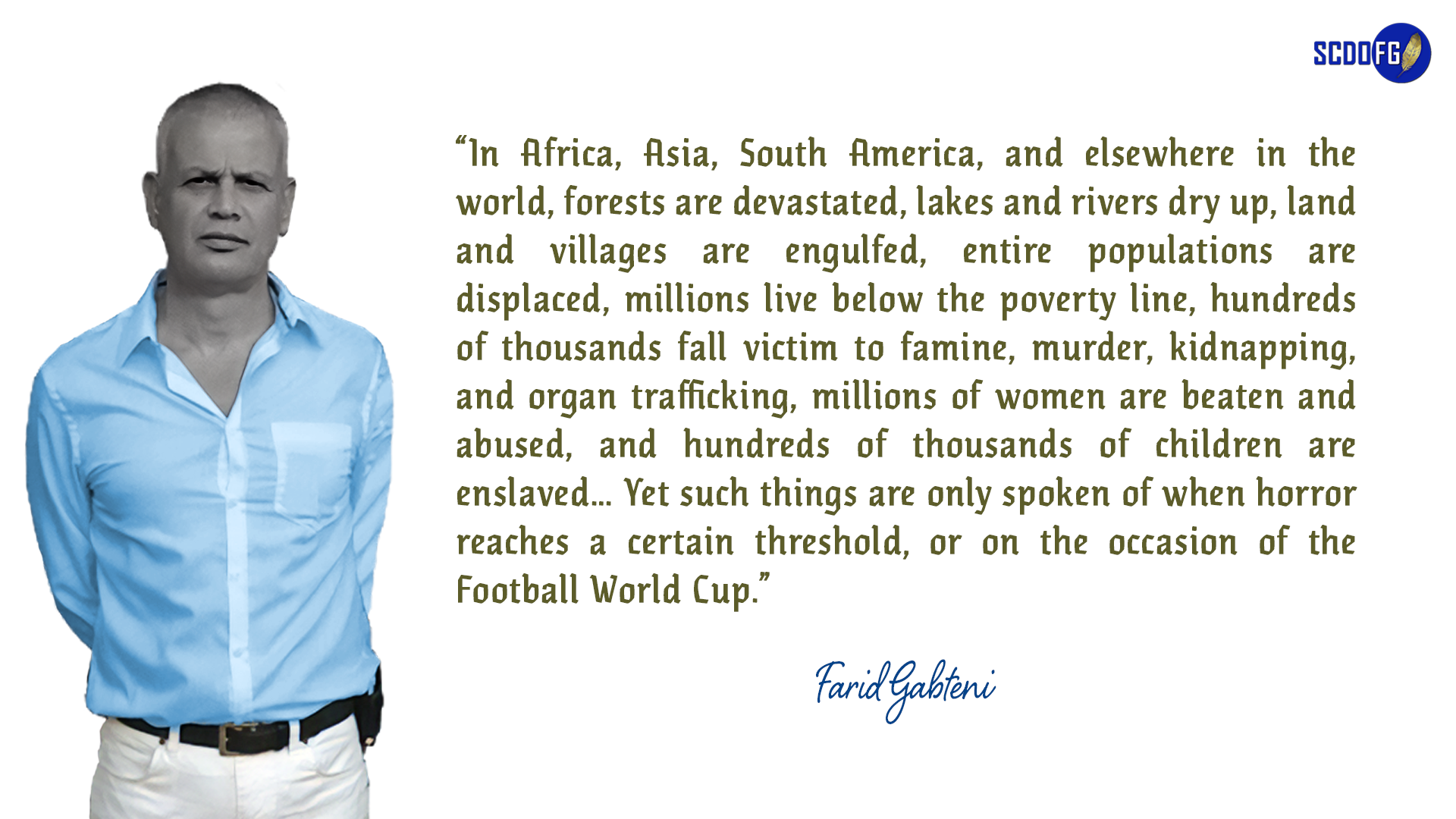
“In Africa, Asia, South America, and elsewhere in the world, forests are devastated, lakes and rivers dry up, land and villages are engulfed, entire populations are displaced, millions live below the poverty line, hundreds of thousands fall victim to famine, murder, kidnapping, and organ trafficking, millions of women are beaten and abused, and hundreds of thousands of children are enslaved… Yet such things are only spoken of when horror reaches a certain threshold‚ or on the occasion of the Football World Cup.” Farid Gabteni
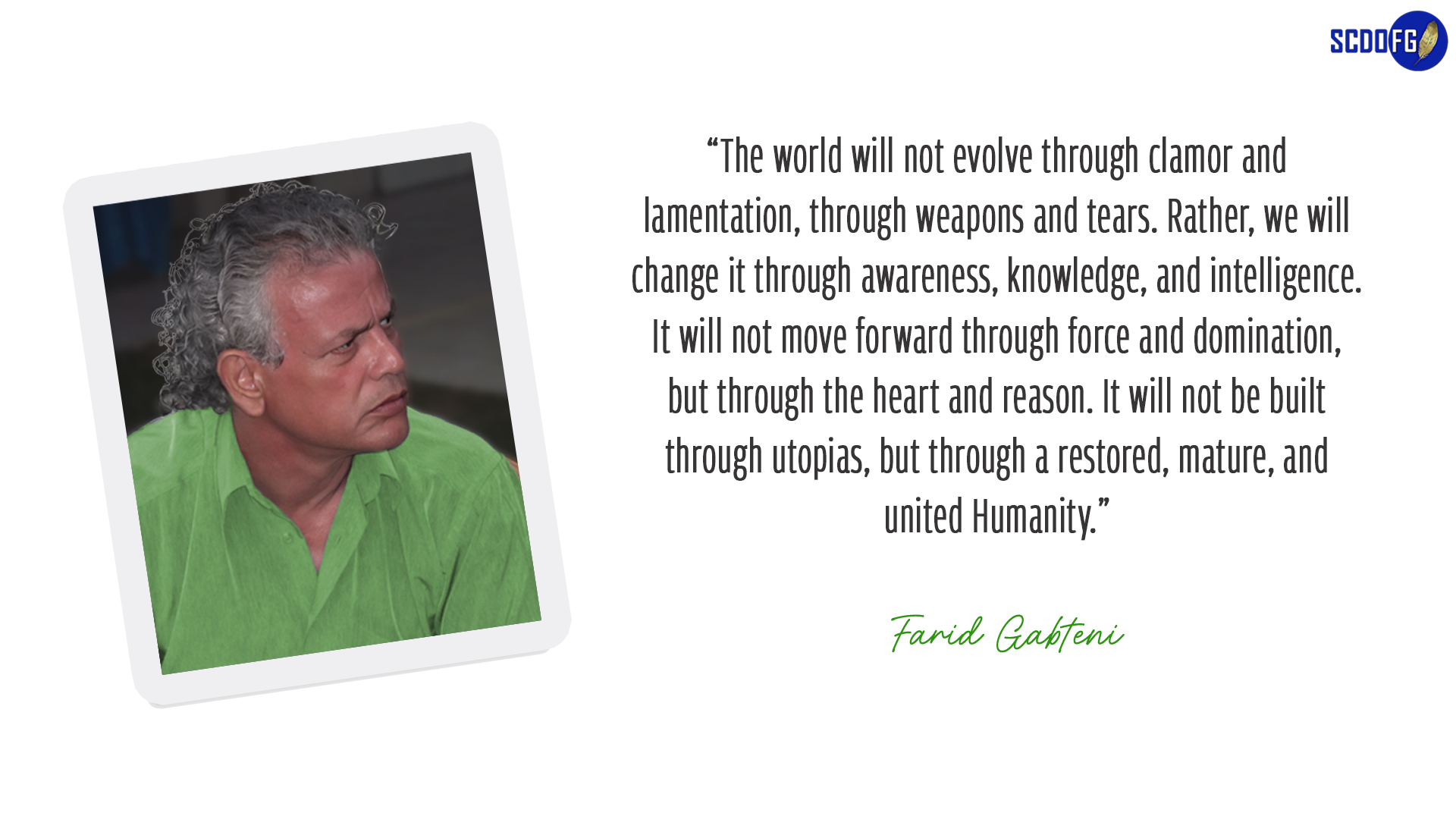
« The world will not evolve through clamor and lamentation, through weapons and tears. Rather, we will change it through awareness, knowledge, and intelligence. It will not move forward through force and domination, but through the heart and reason. It will not be built through utopias, but through a restored, mature, and united Humanity. » — Farid Abbes Raja Gabteni
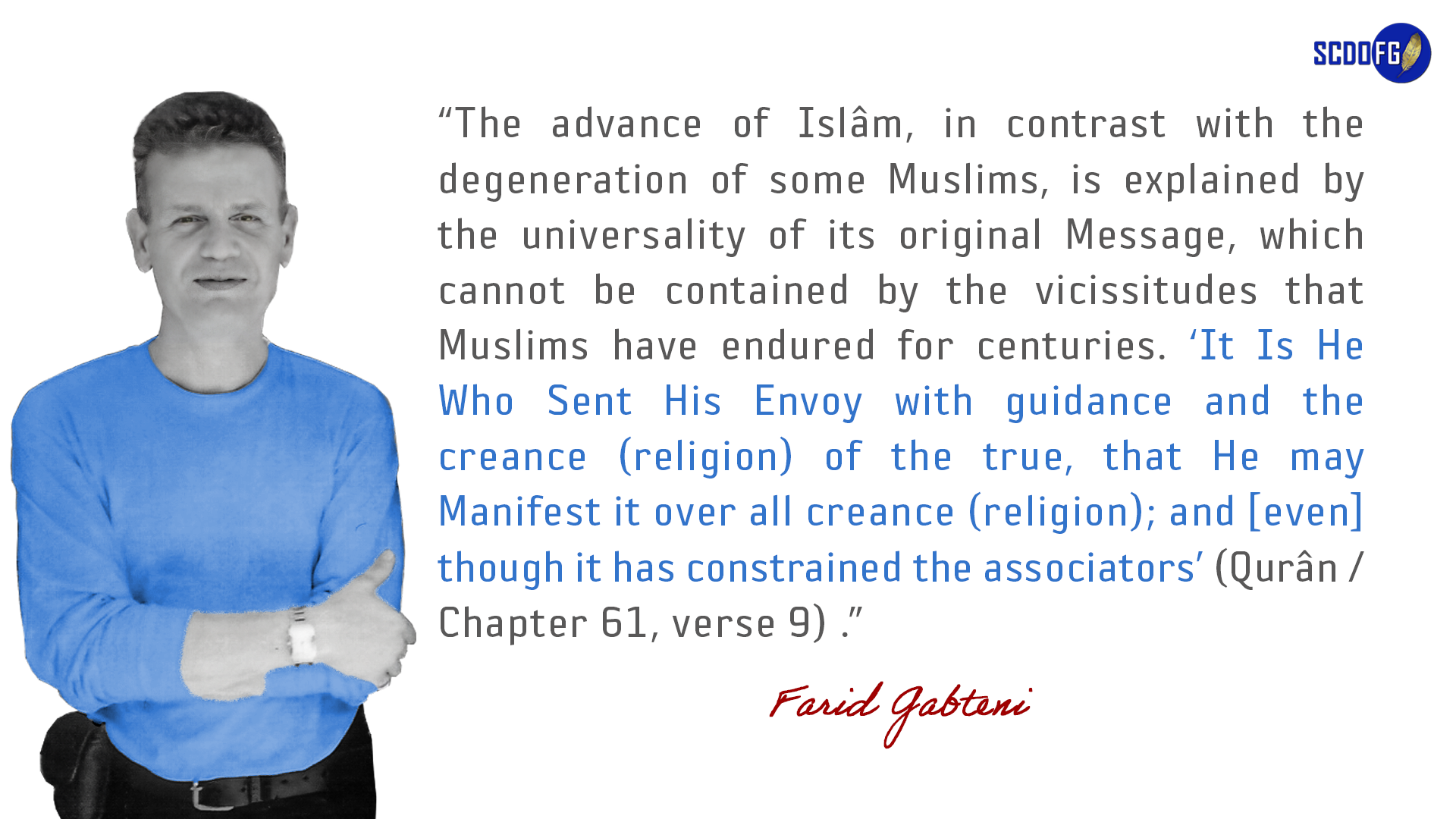
“The advance of Islâm, in contrast with the degeneration of some Muslims, is explained by the universality of its original Message, which cannot be contained by the vicissitudes that Muslims have endured for centuries. ‘It Is He Who Sent His Envoy with guidance and the creance (religion) of the true, that He may Manifest it over all creance (religion); and [even] though it has constrained the associators’ (Qurân/Chapter 61, verse 9).” Farid Gabteni
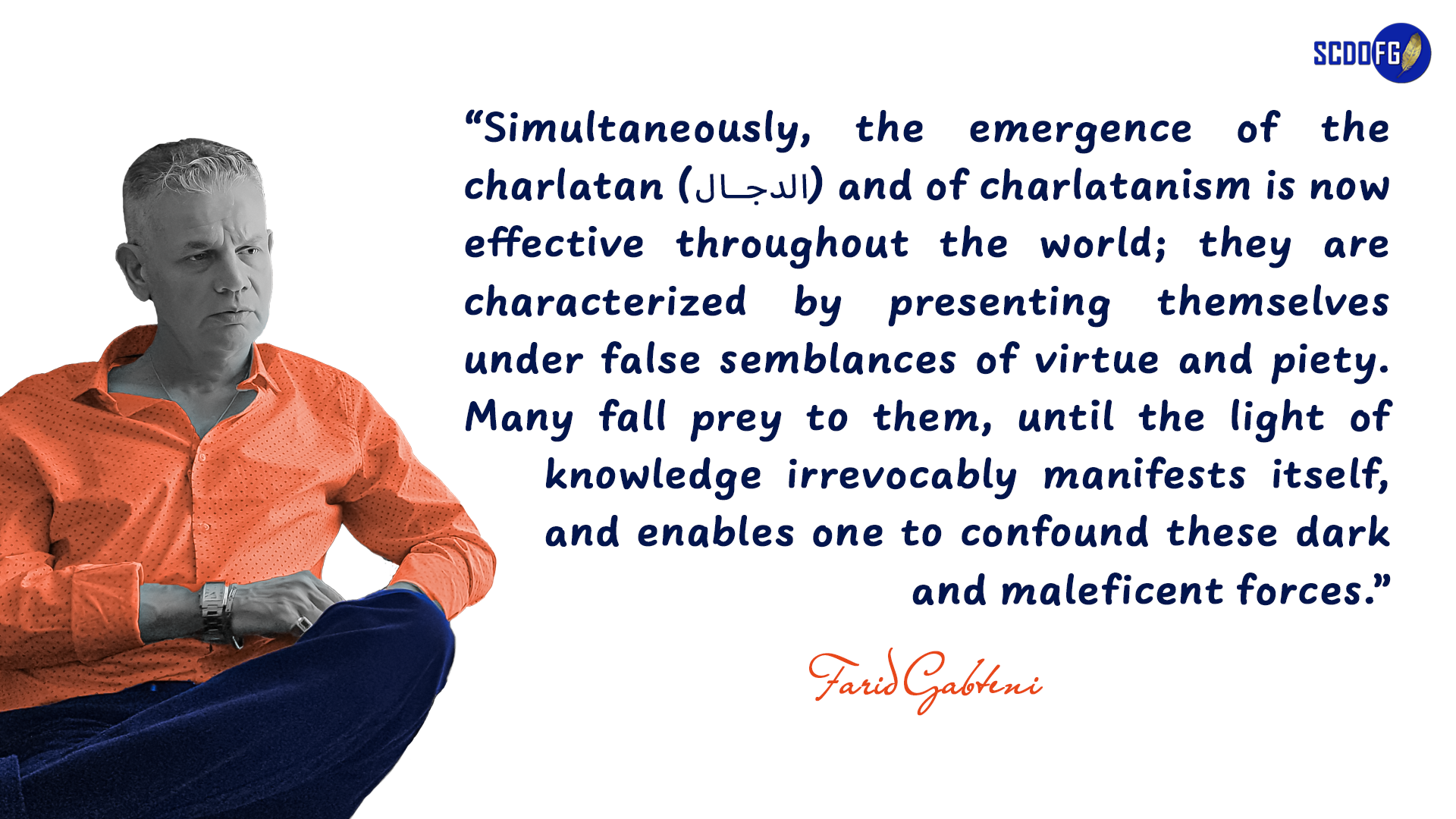
“Simultaneously, the emergence of the charlatan (الدجال) and of charlatanism is now effective throughout the world; they are characterized by presenting themselves under false semblances of virtue and piety. Many fall prey to them, until the light of knowledge irrevocably manifests itself, and enables one to confound these dark and maleficent forces.” Farid Gabteni
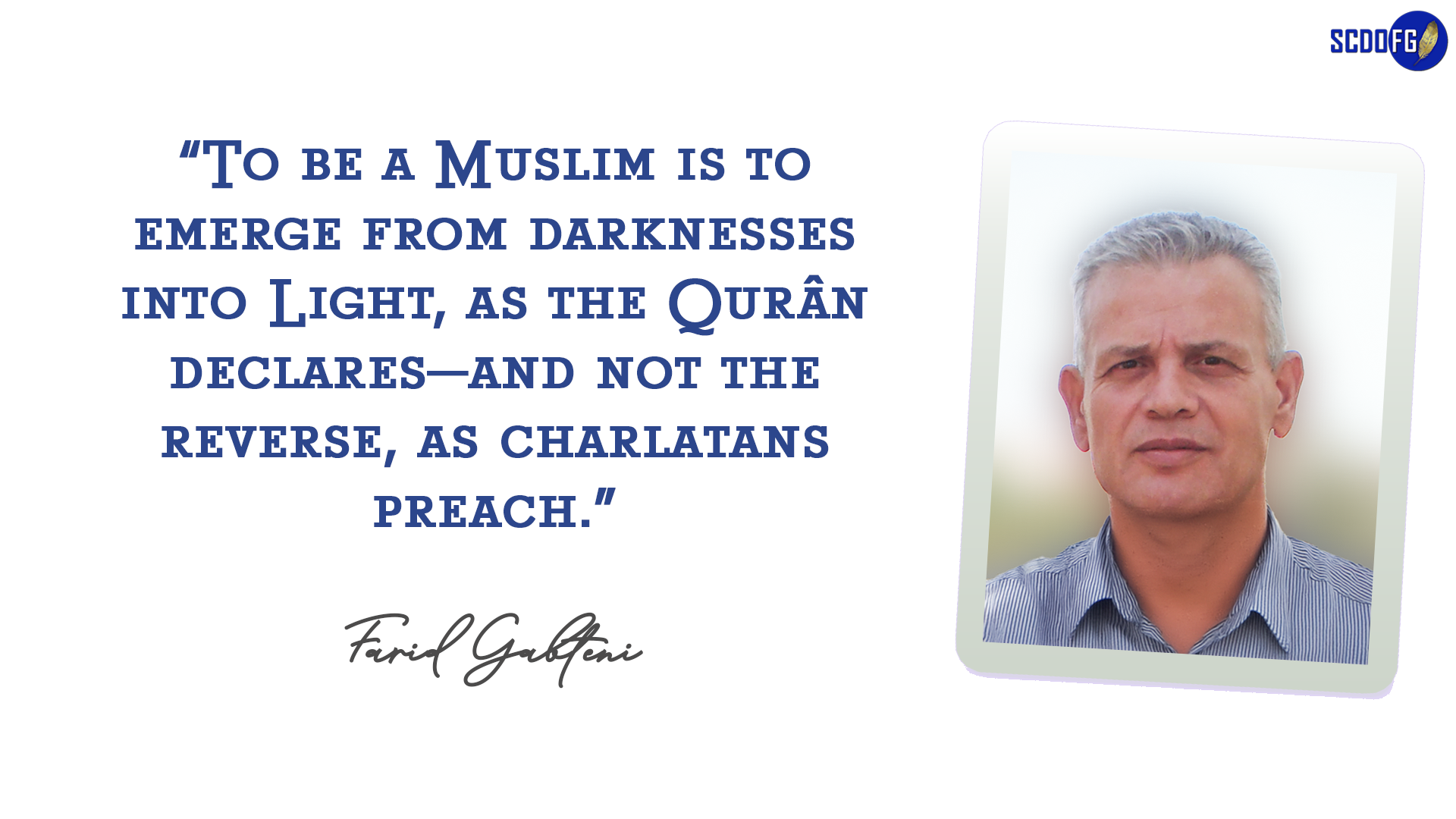
“To be a Muslim is to emerge from darknesses into Light, as the Qurân declares—and not the reverse, as charlatans preach.” — Farid Abbes Raja Gabteni
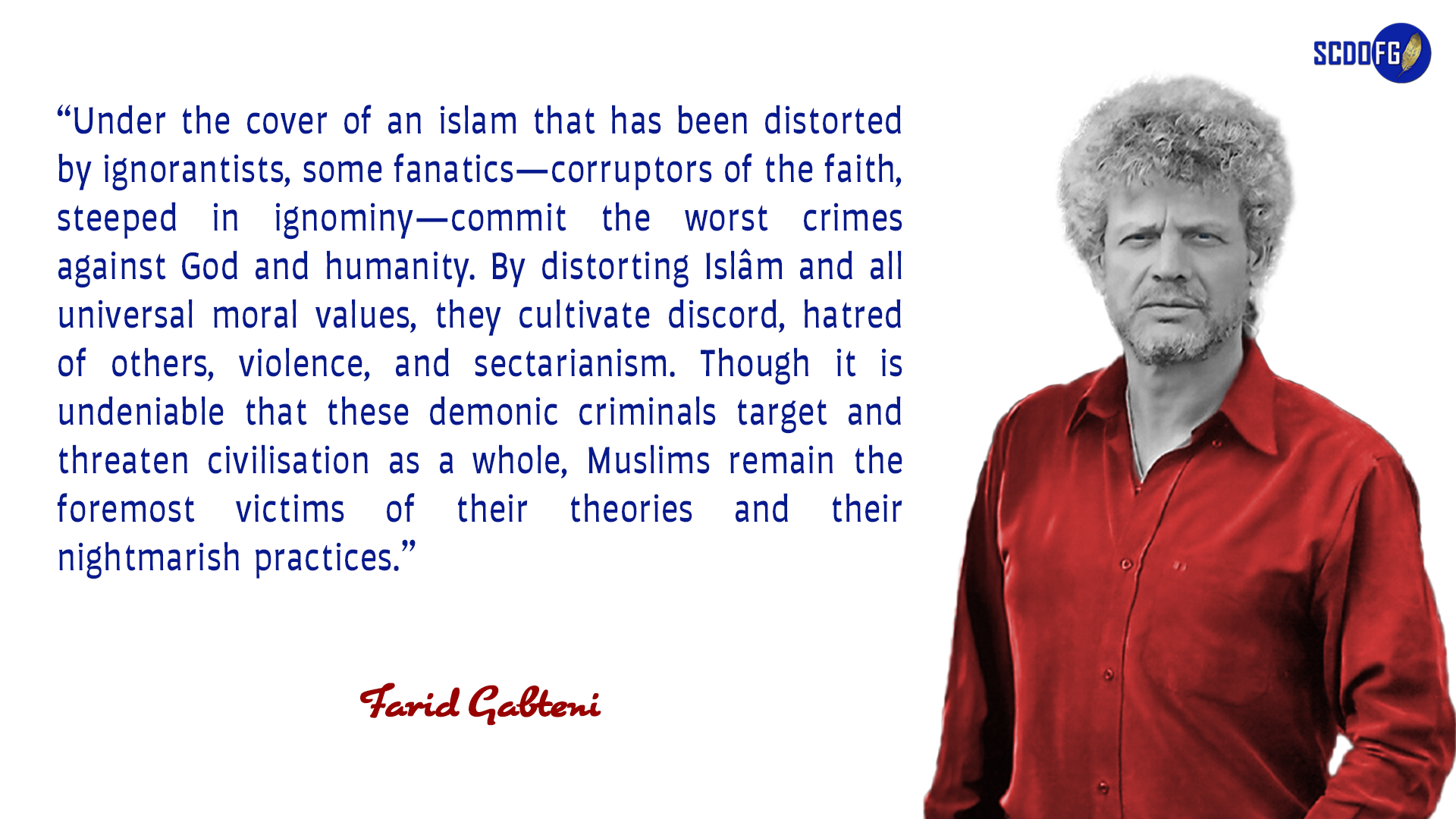
“Under the cover of an islam that has been distorted by ignorantists, some fanatics—corruptors of the faith, steeped in ignominy—commit the worst crimes against God and humanity. By distorting Islâm and all universal moral values, they cultivate discord, hatred of others, violence, and sectarianism. Though it is undeniable that these demonic criminals target and threaten civilisation as a whole, Muslims remain the foremost victims of their theories and their nightmarish practices.” Farid Gabteni
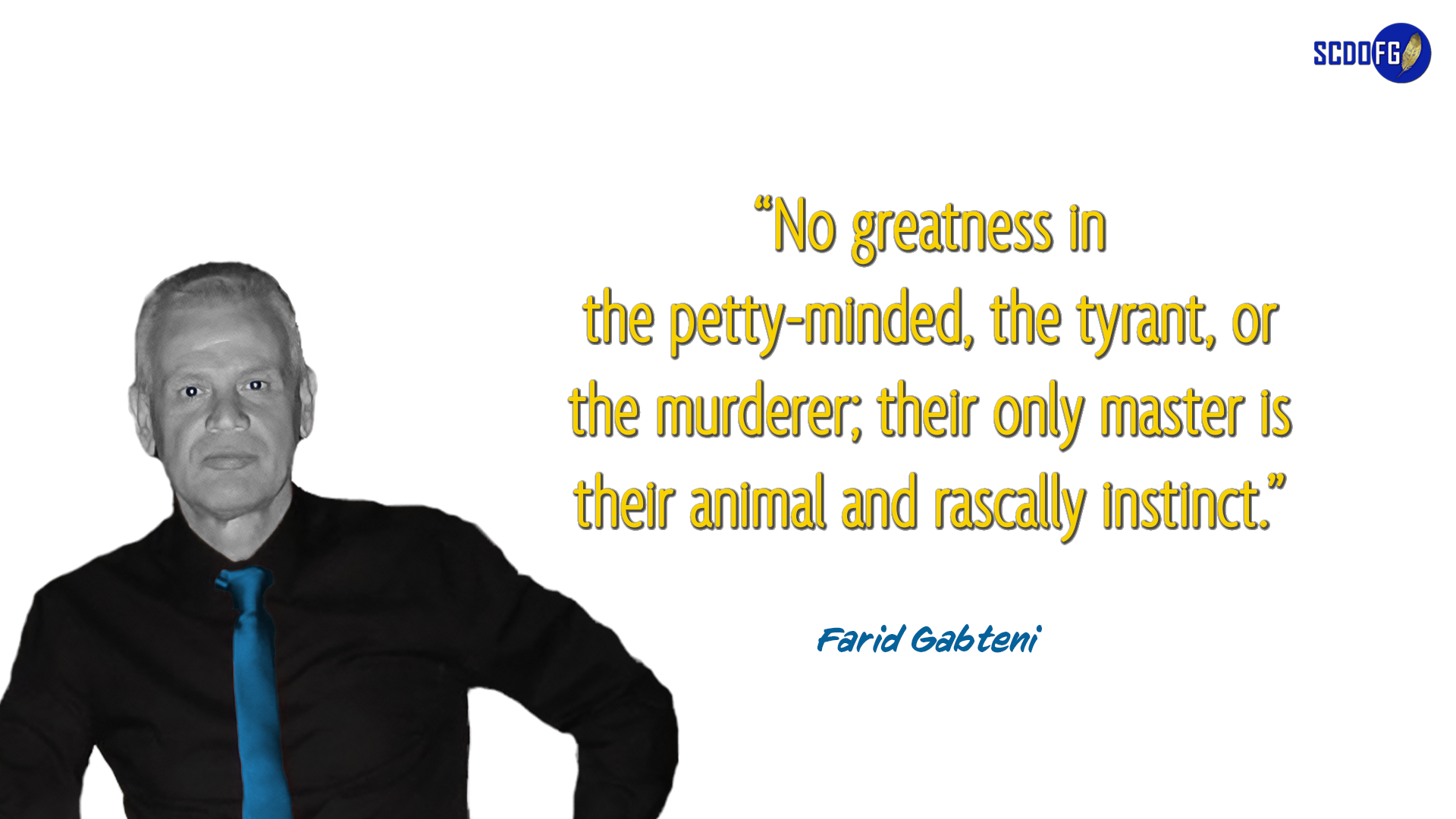
« No greatness in the petty-minded, the tyrant, or the murderer; their only master is their animal and rascally instinct. » — Farid Abbes Raja Gabteni
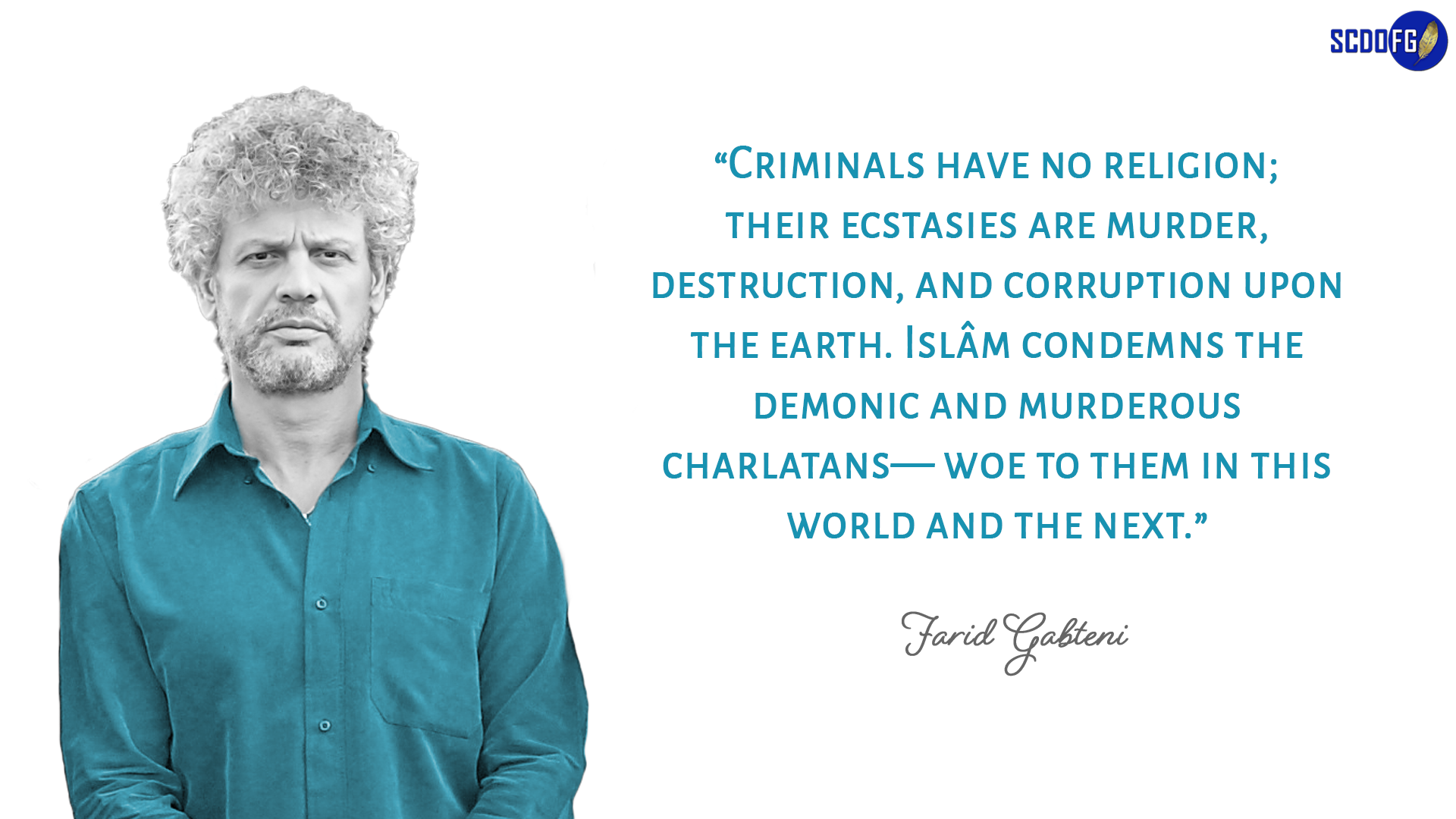
« Criminals have no religion; their ecstasies are murder, destruction, and corruption upon the earth. Islâm condemns the demonic and murderous charlatans—woe to them in this world and the next. » — Farid Abbes Raja Gabteni
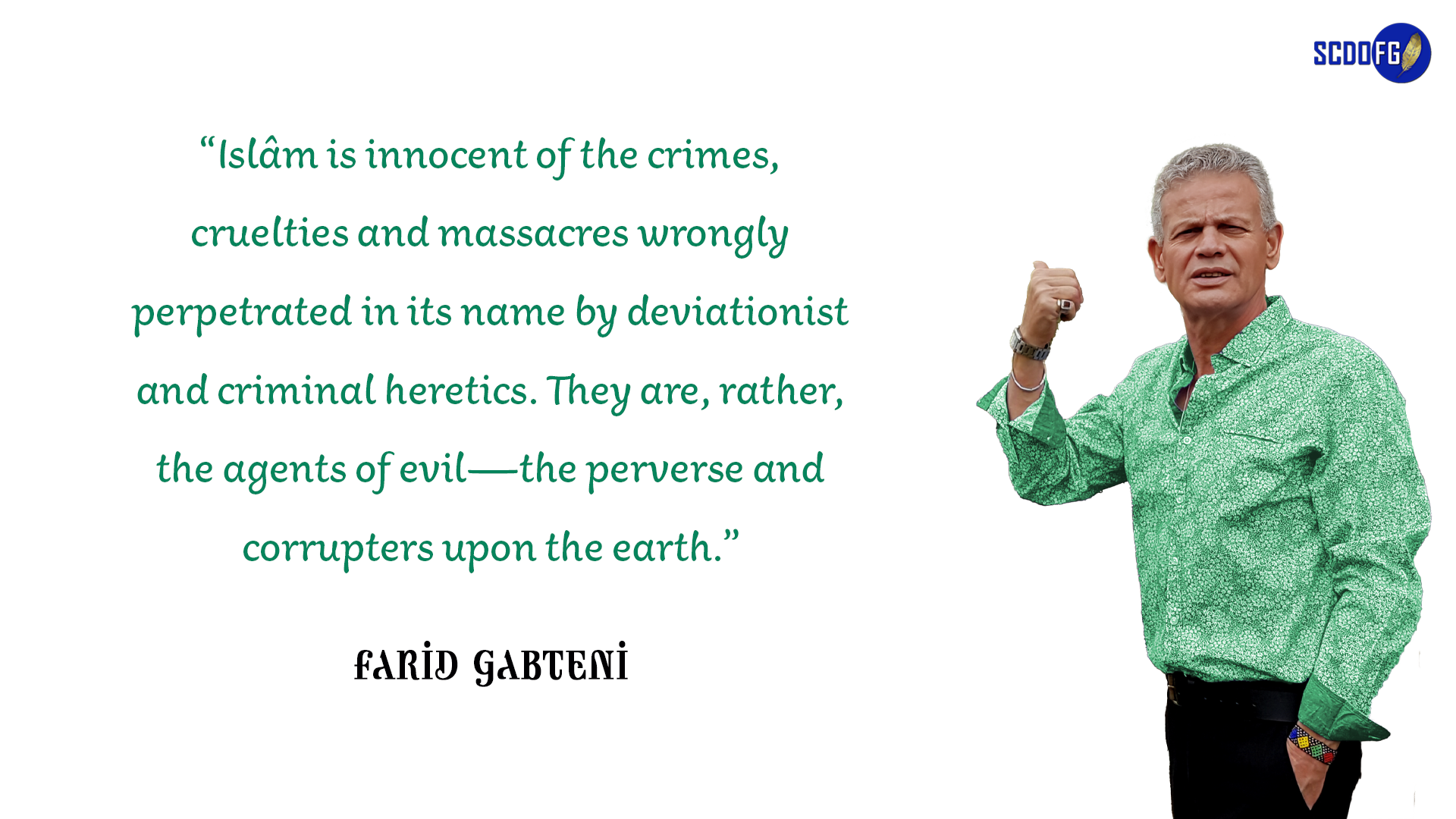
« Islâm is innocent of the crimes, cruelties and massacres wrongly perpetrated in its name by deviationist and criminal heretics. They are, rather, the agents of evil—the perverse and corrupters upon the earth. » — Farid Abbes Raja Gabteni
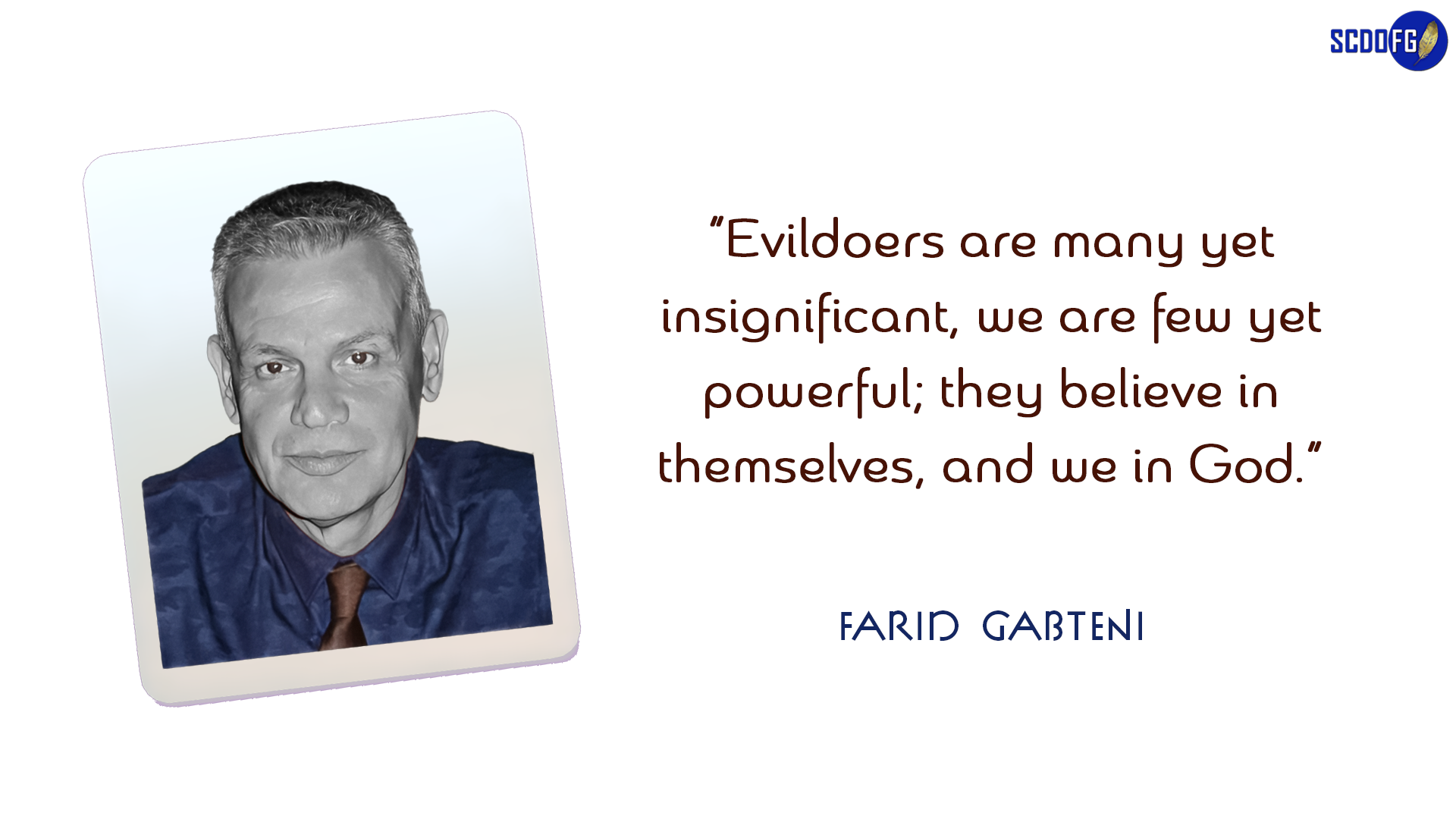
« Evildoers are many yet insignificant, we are few yet powerful; they believe in themselves, and we in God » — Farid Abbes Raja Gabteni
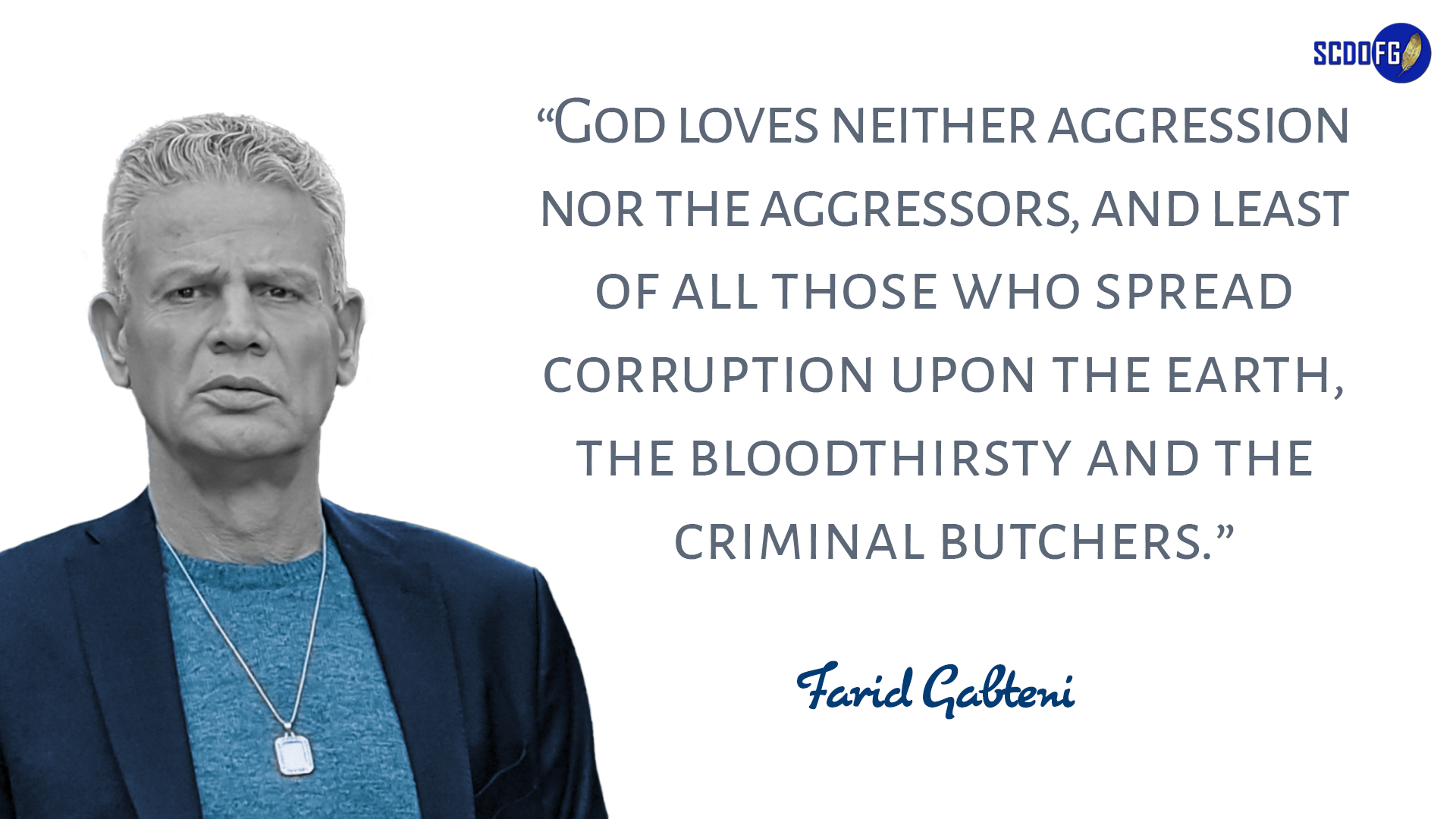
« God loves neither aggression nor the aggressors, and least of all those who spread corruption upon the earth, the bloodthirsty and the criminal butchers. » — Farid Abbes Raja Gabteni
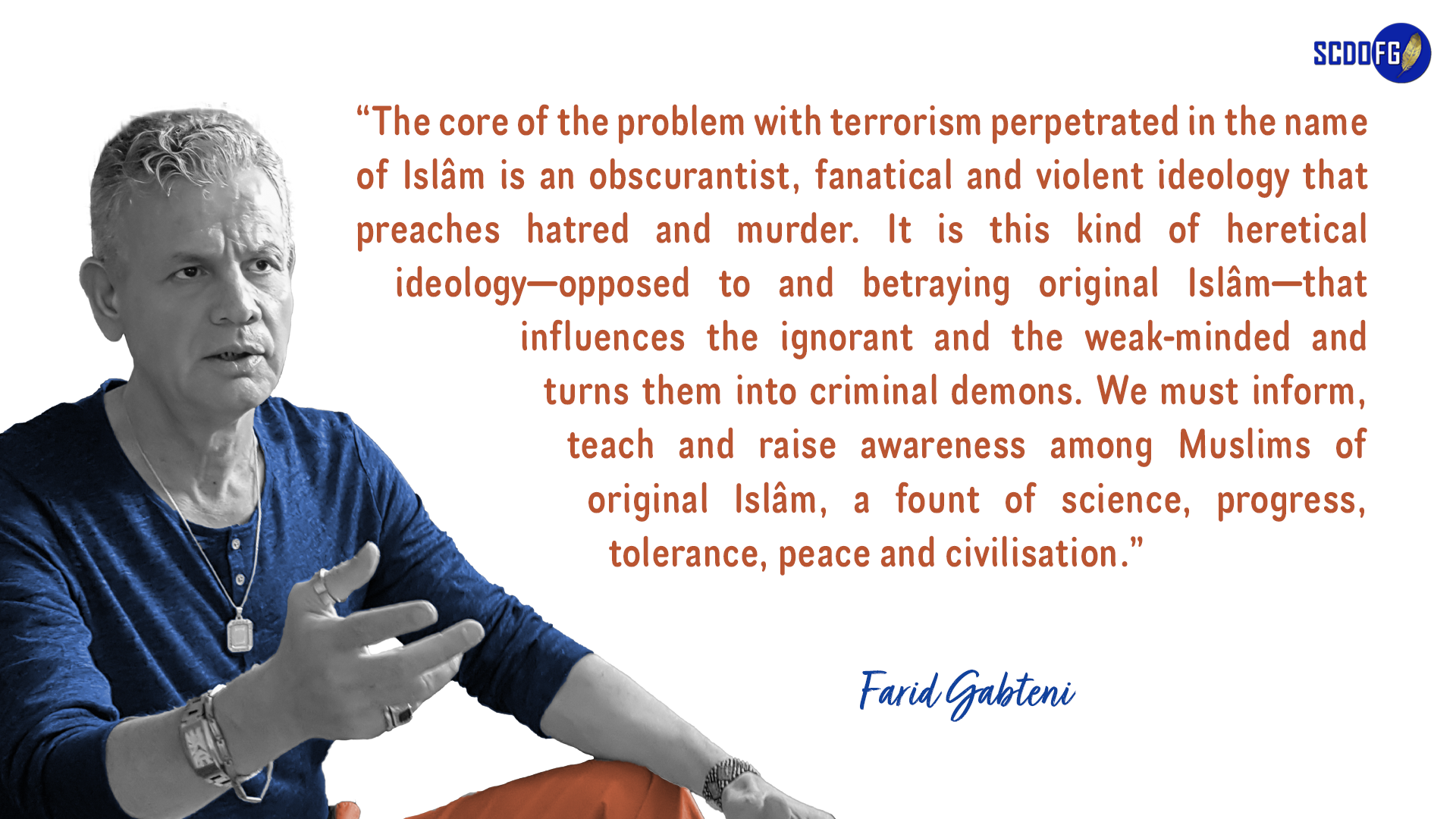
“The core of the problem with terrorism perpetrated in the name of Islâm is an obscurantist, fanatical and violent ideology that preaches hatred and murder. It is this kind of heretical ideology—opposed to and betraying original Islâm—that influences the ignorant and the weak-minded and turns them into criminal demons. We must inform, teach and raise awareness among Muslims of original Islâm, a fount of science, progress, tolerance, peace and civilisation.” Farid Gabteni
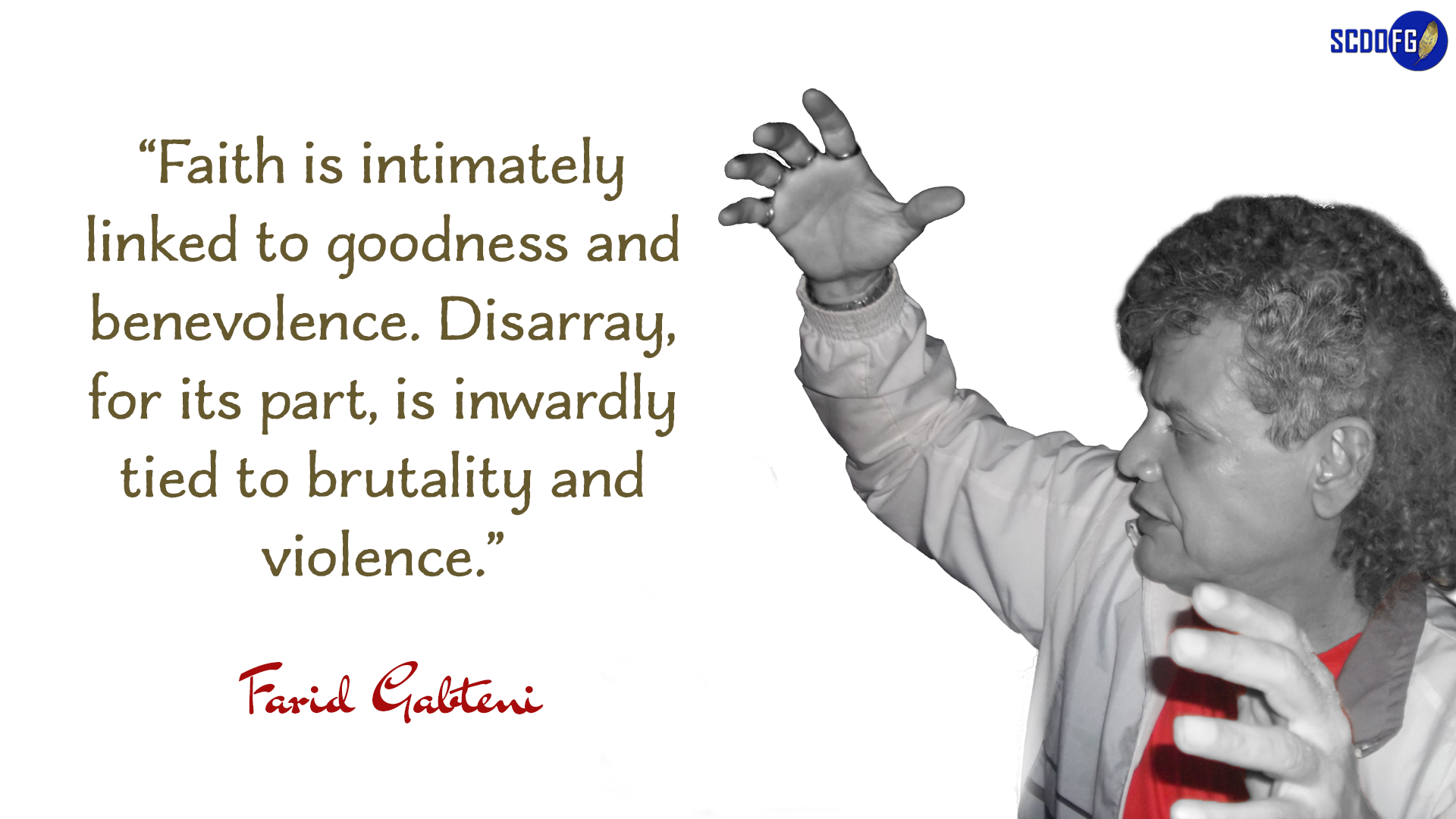
« Faith is intimately linked to goodness and benevolence. Disarray, for its part, is inwardly tied to brutality and violence » — Farid Abbes Raja Gabteni
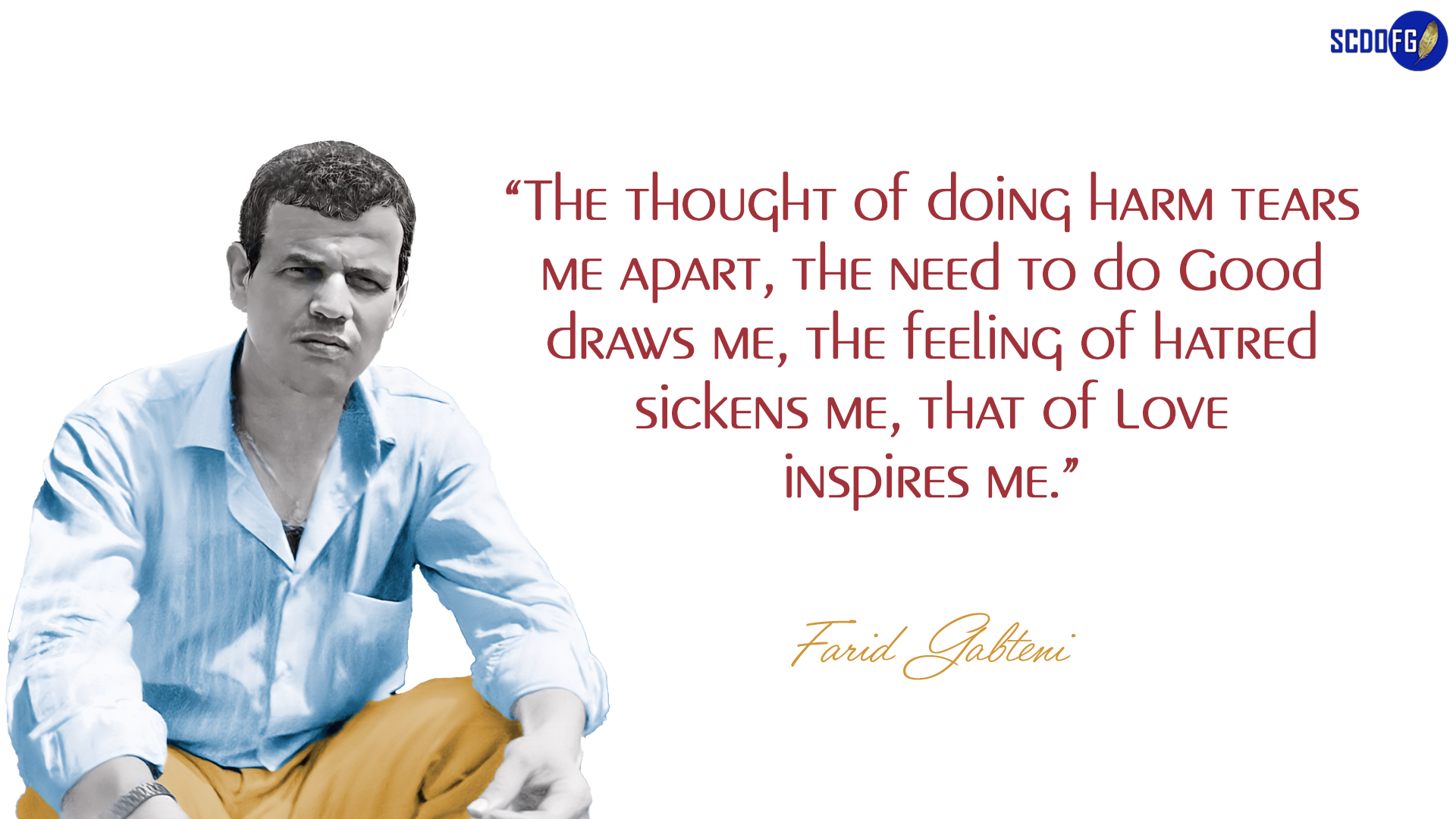
« The thought of doing harm tears me apart, the need to do Good draws me, the feeling of hatred sickens me, that of Love inspires me. » — Farid Abbes Raja Gabteni
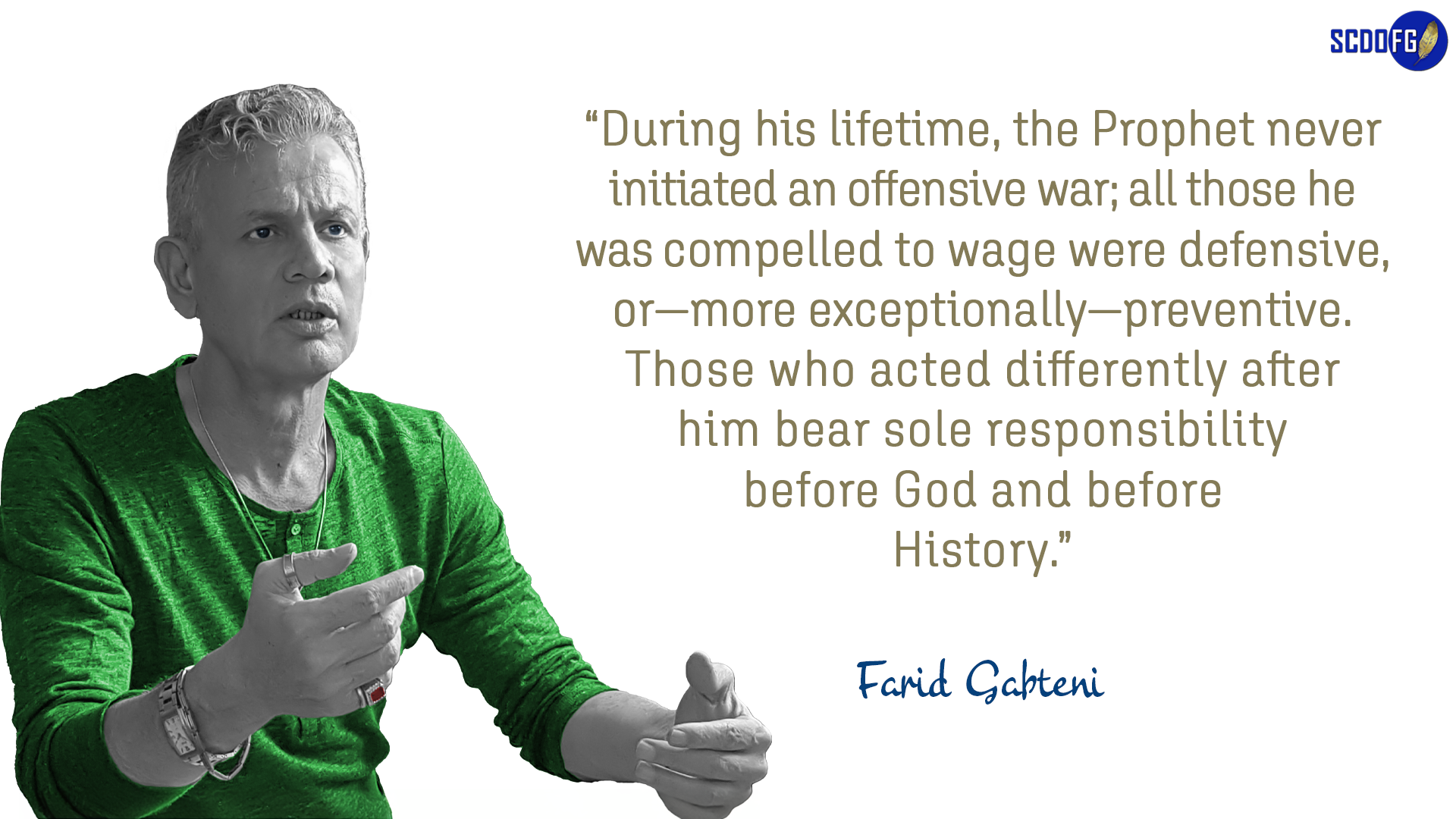
« During his lifetime, the Prophet never initiated an offensive war; all those he was compelled to wage were defensive, or—more exceptionally—preventive. Those who acted differently after him bear sole responsibility before God and before History. » — Farid Abbes Raja Gabteni
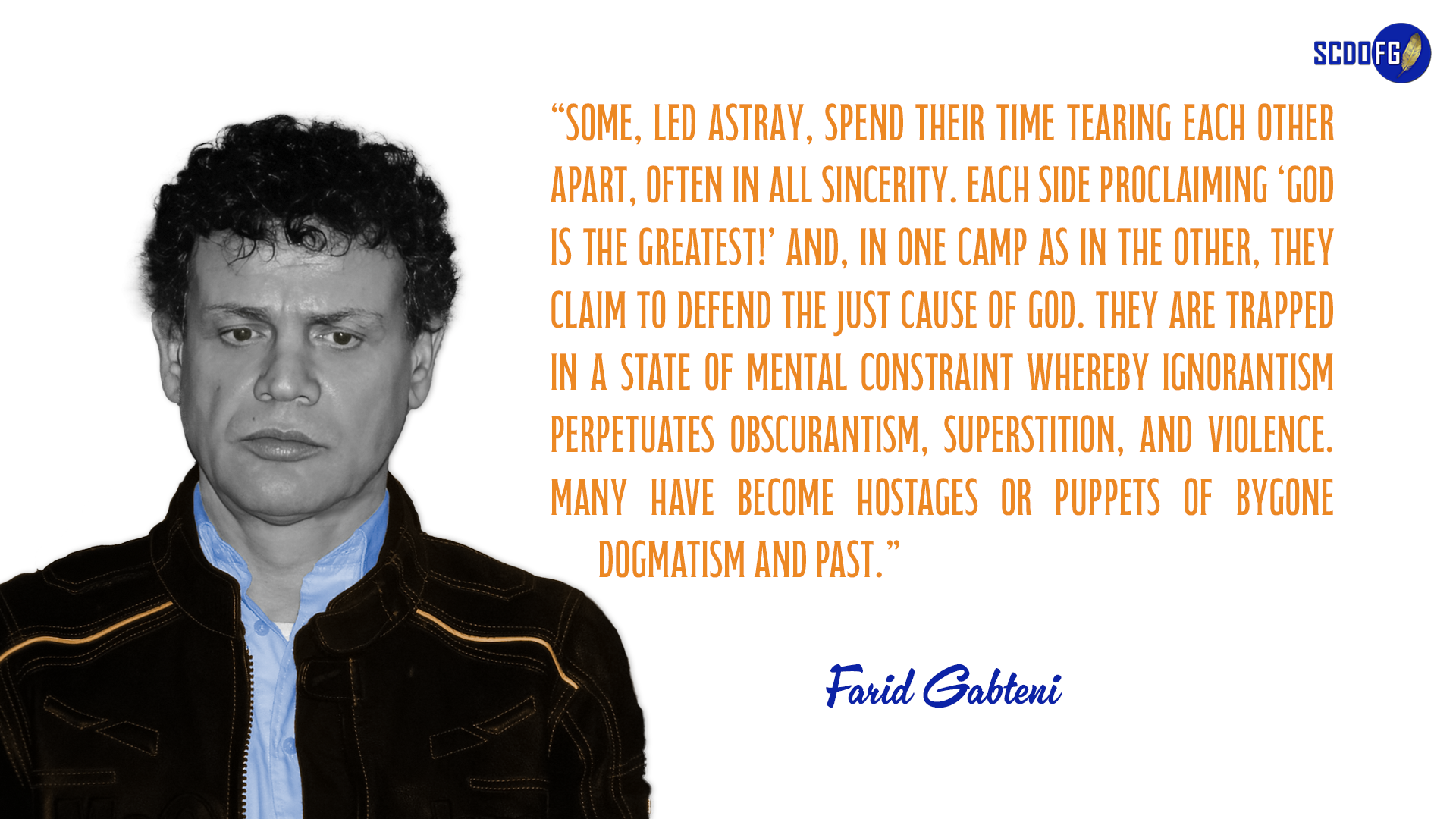
“Some, led astray, spend their time tearing each other apart, often in all sincerity. Each side proclaiming ‘God Is The Greatest!’ and, in one camp as in the other, they claim to defend the just cause of God. They are trapped in a state of mental constraint whereby ignorantism perpetuates obscurantism, superstition, and violence. Many have become hostages or puppets of bygone dogmatism and past.” Farid Gabteni
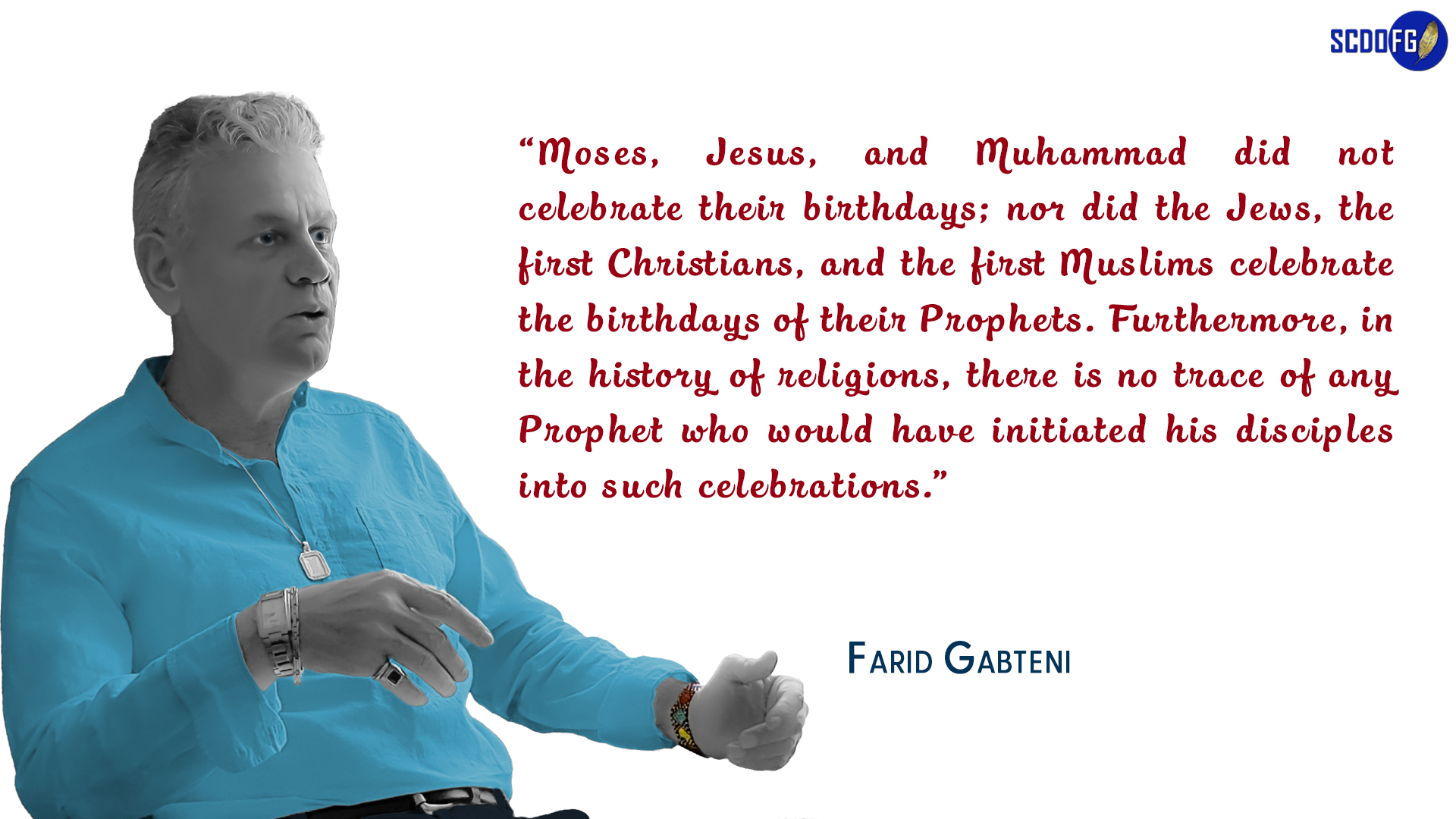
“Moses, Jesus, and Muhammad did not celebrate their birthdays; nor did the Jews, the first Christians, and the first Muslims celebrate the birthdays of their Prophets. Furthermore, in the history of religions, there is no trace of any Prophet who would have initiated his disciples into such celebrations.” Farid Gabteni
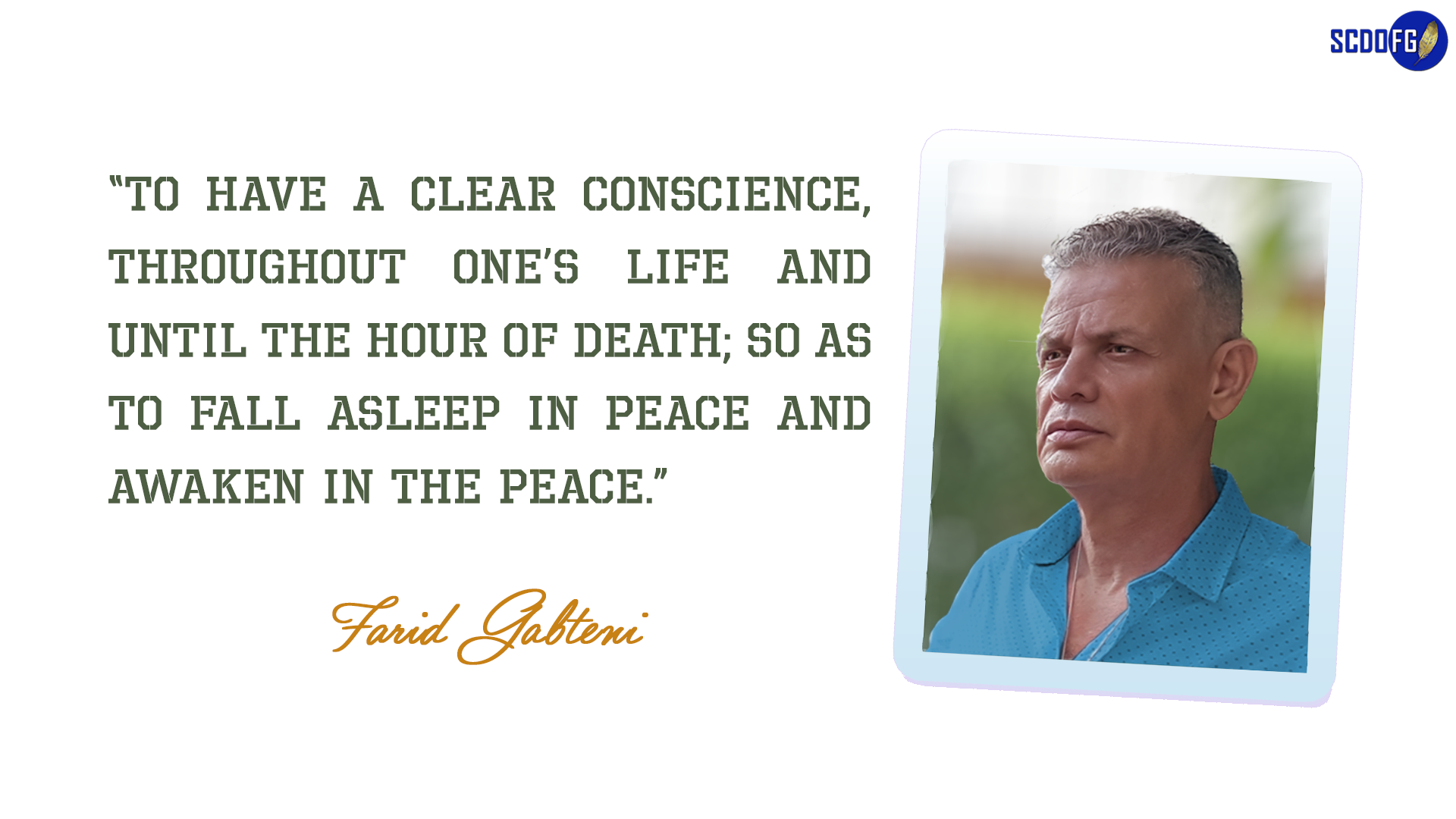
« To have a clear conscience, throughout one’s life and until the hour of death; so as to fall asleep in peace and awaken in The Peace. » — Farid Abbes Raja Gabteni
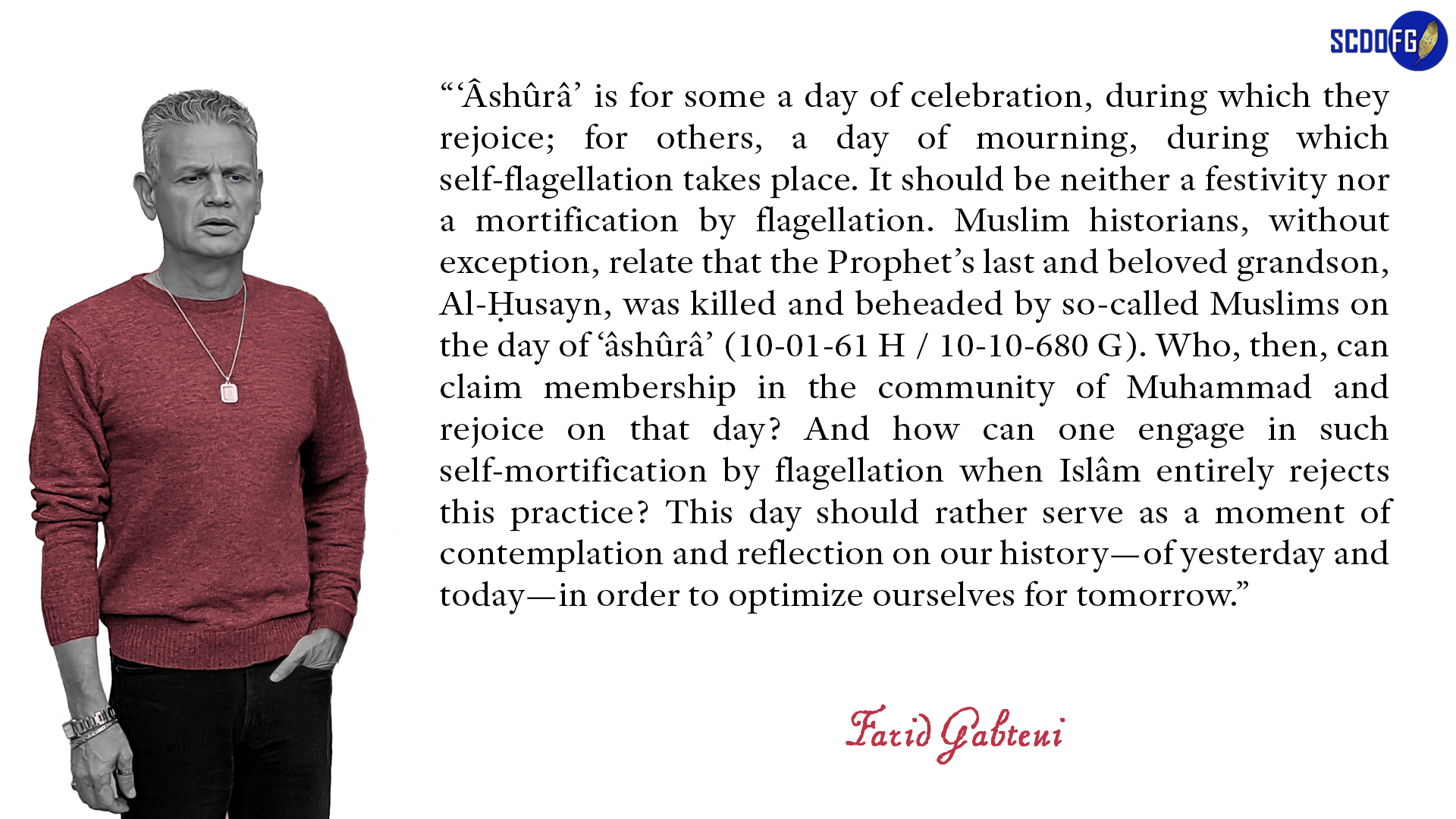
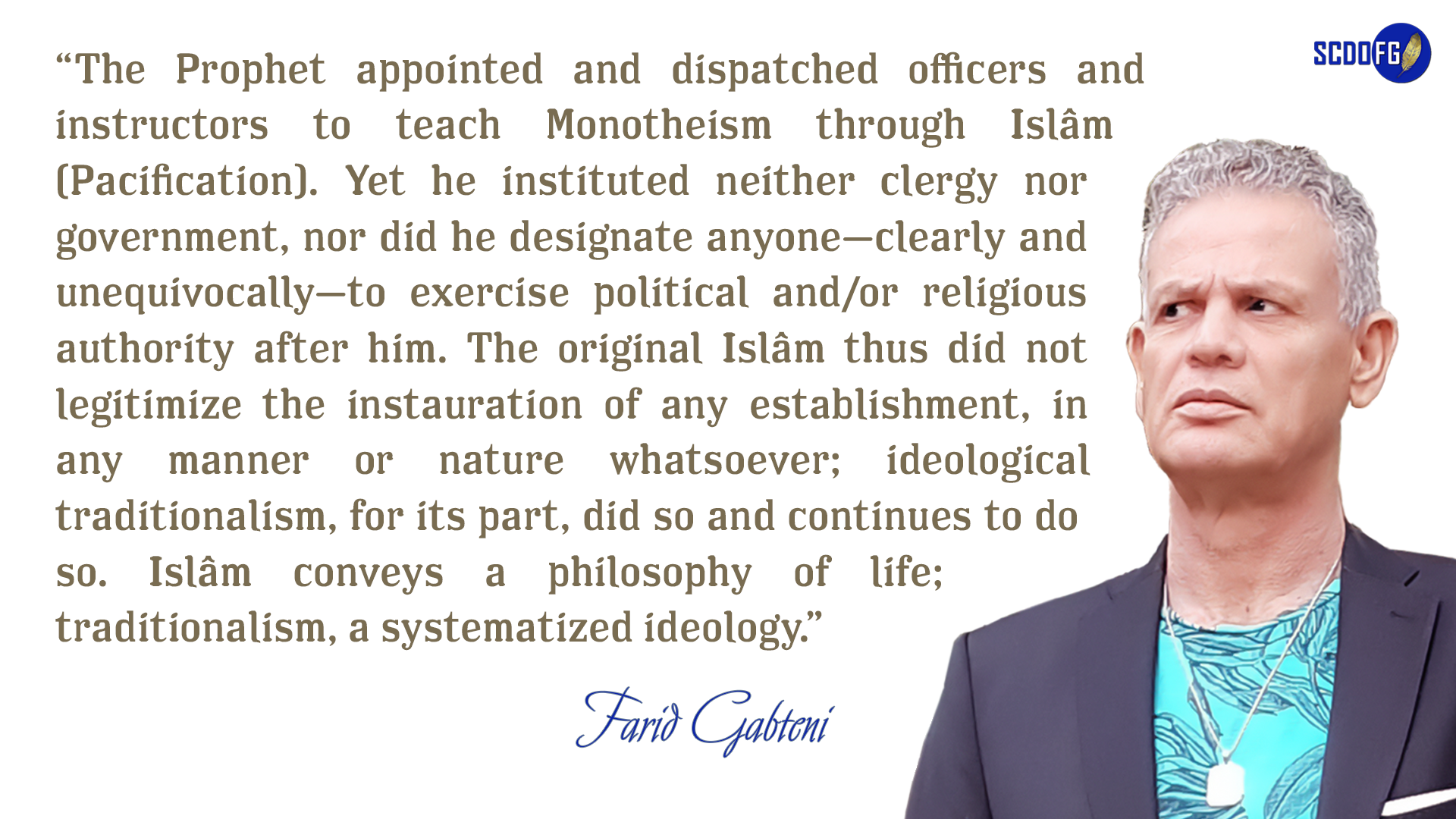
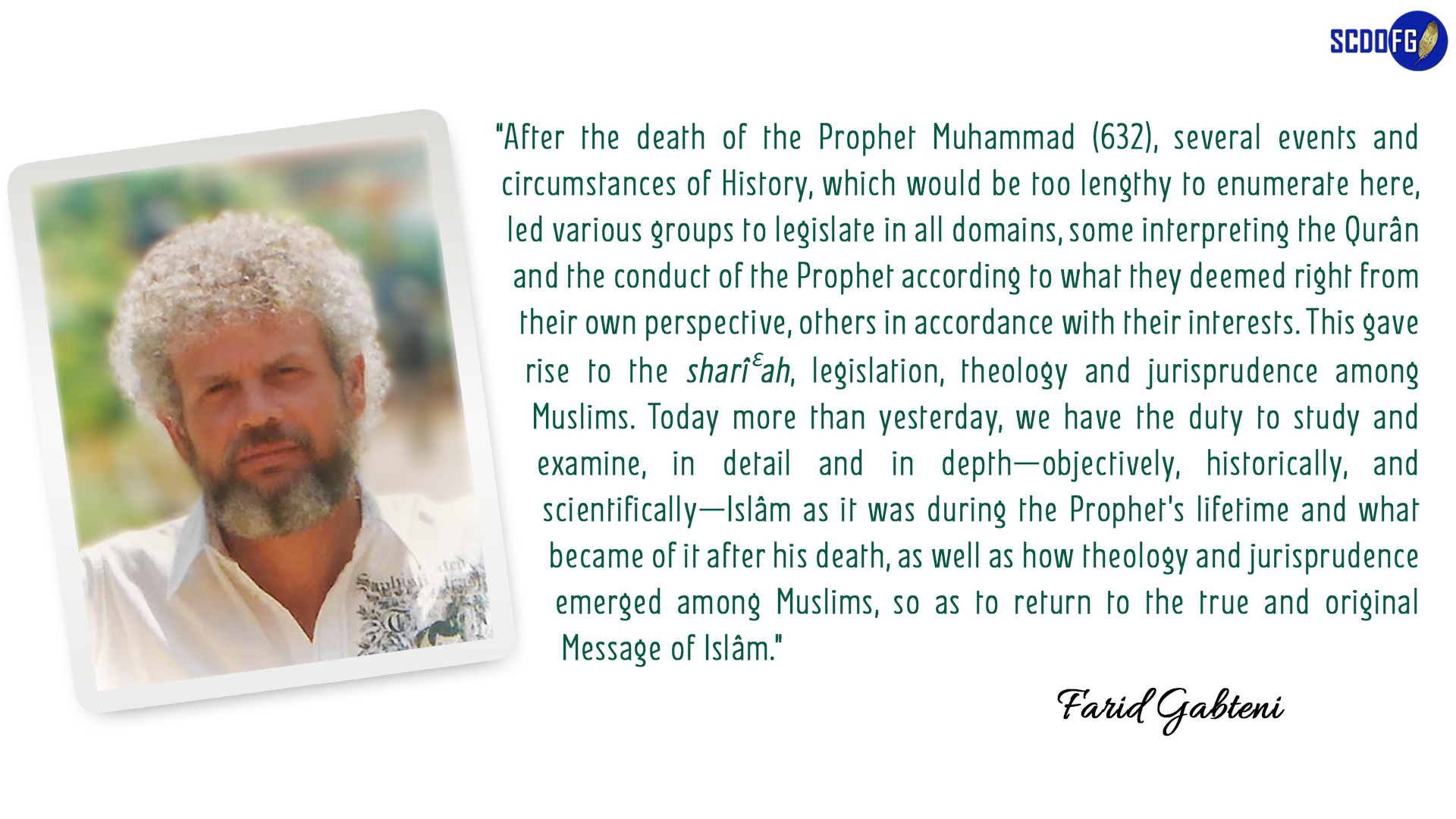
« After the death of the Prophet Muhammad (632), several events and circumstances of History, which would be too lengthy to enumerate here, led various groups to legislate in all domains, some interpreting the Qurân and the conduct of the Prophet according to what they deemed right from their own perspective, others in accordance with their interests. This gave rise to the sharîعah, legislation, theology and jurisprudence among Muslims. Today more than yesterday, we have the duty to study and examine, in detail and in depth—objectively, historically, and scientifically—Islâm as it was during the Prophet’s lifetime and what became of it after his death, as well as how theology and jurisprudence emerged among Muslims, so as to return to the true and original Message of Islâm. » — Farid Abbes Raja Gabteni
« God Taught the human the names—all of them (Qurân / Chapter 2, v. 31)—to analyze, reflect, discern, and legislate accordingly. The only sharîεah (Law, Legislation) of God, unchanging and inviolable, happens to be the laws of physics, unaltered and unalterable since the creation of the universe. Any other law is circumstantial of time, place, cause, and purpose. Ignoramuses and fanatics are, as illustrated in Qurân, chapter 7, verse 179: ‘(…) They have hearts, yet do not instruct themselves by them; they have eyes, yet do not see by them; they have ears, yet do not hear by them. Those are like cattle—rather, they are most-astray. Those are the heedless.' » — Farid Abbes Raja Gabteni
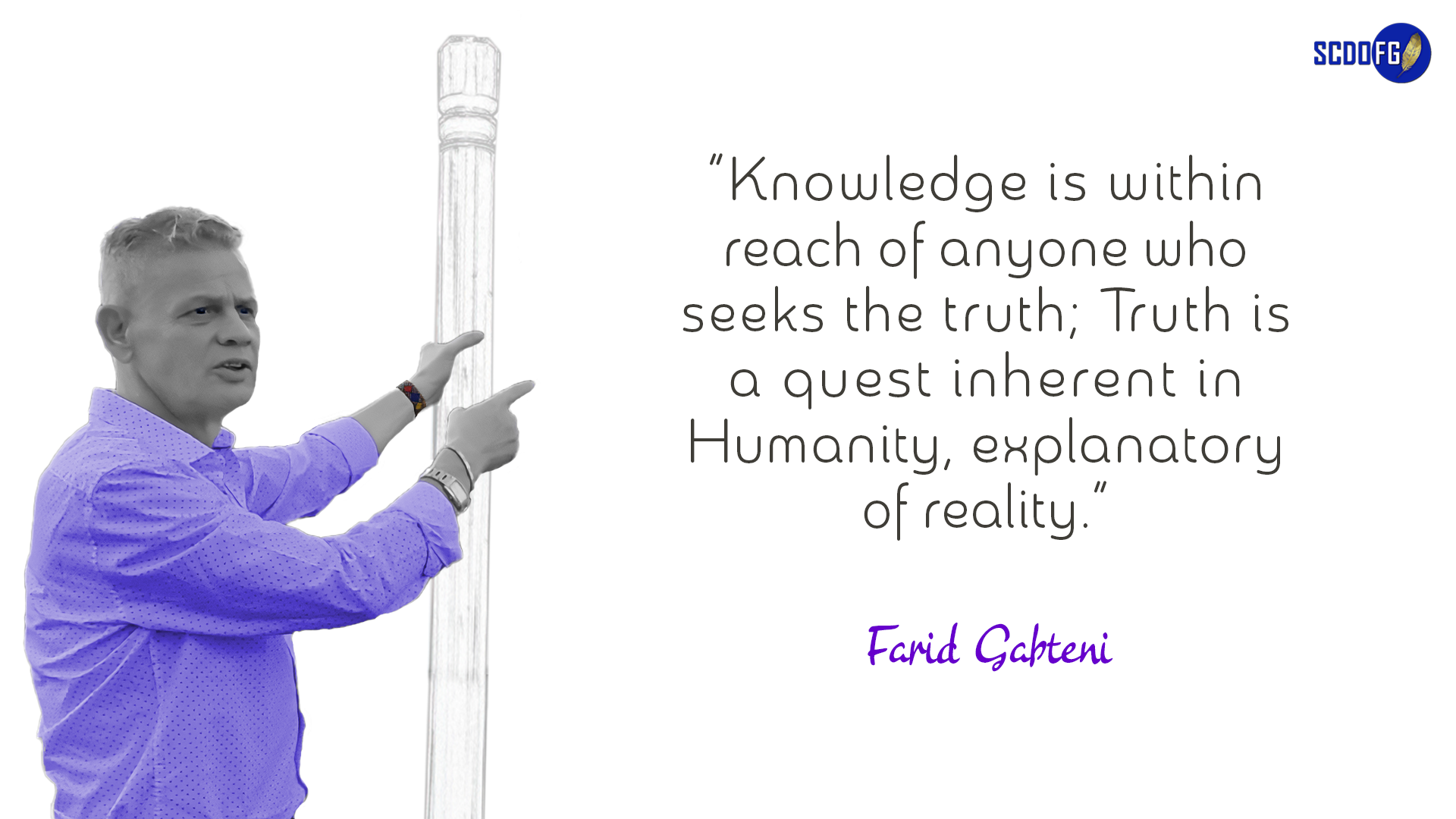
« Knowledge is within reach of anyone who seeks the truth; Truth is a quest inherent in Humanity, explanatory of reality. » — Farid Abbes Raja Gabteni
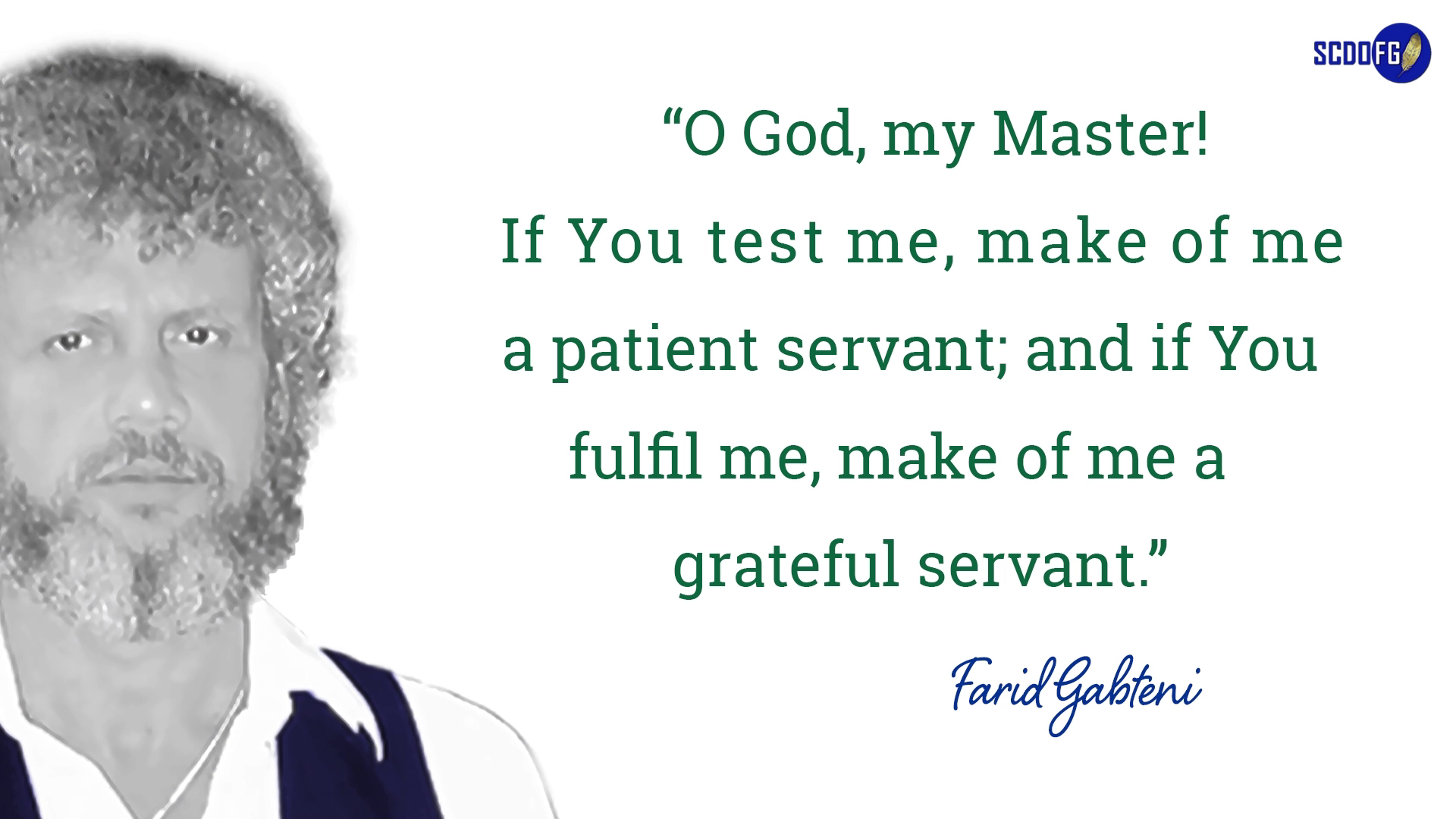
» O God, my Master! If You test me, make of me a patient servant; and if You fulfil me, make of me a grateful servant. » — Farid Abbes Raja Gabteni
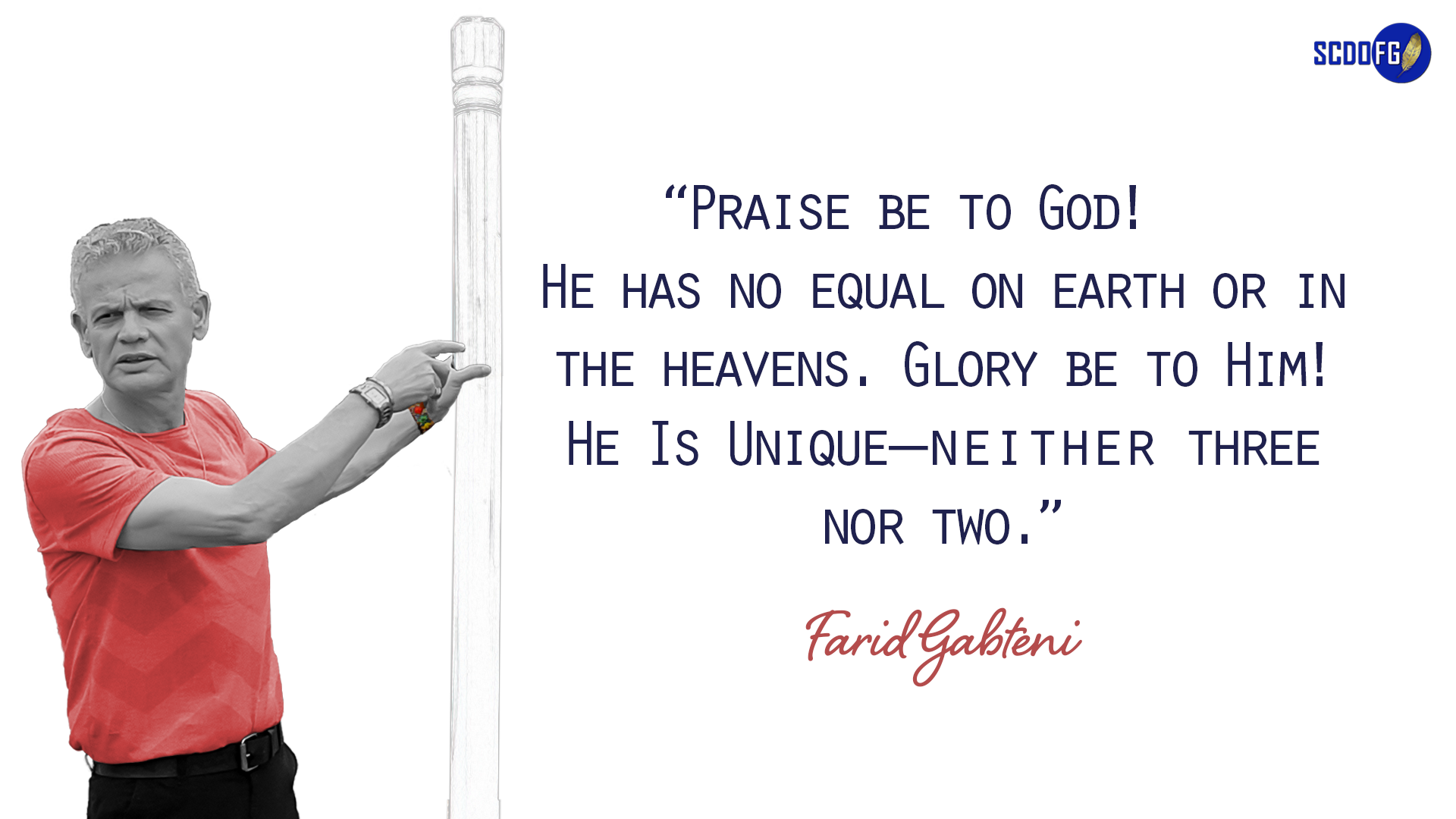
« Praise be to God! He has no equal on earth or in the heavens. Glory be to Him! He Is Unique—neither three nor two. » — Farid Abbes Raja Gabteni
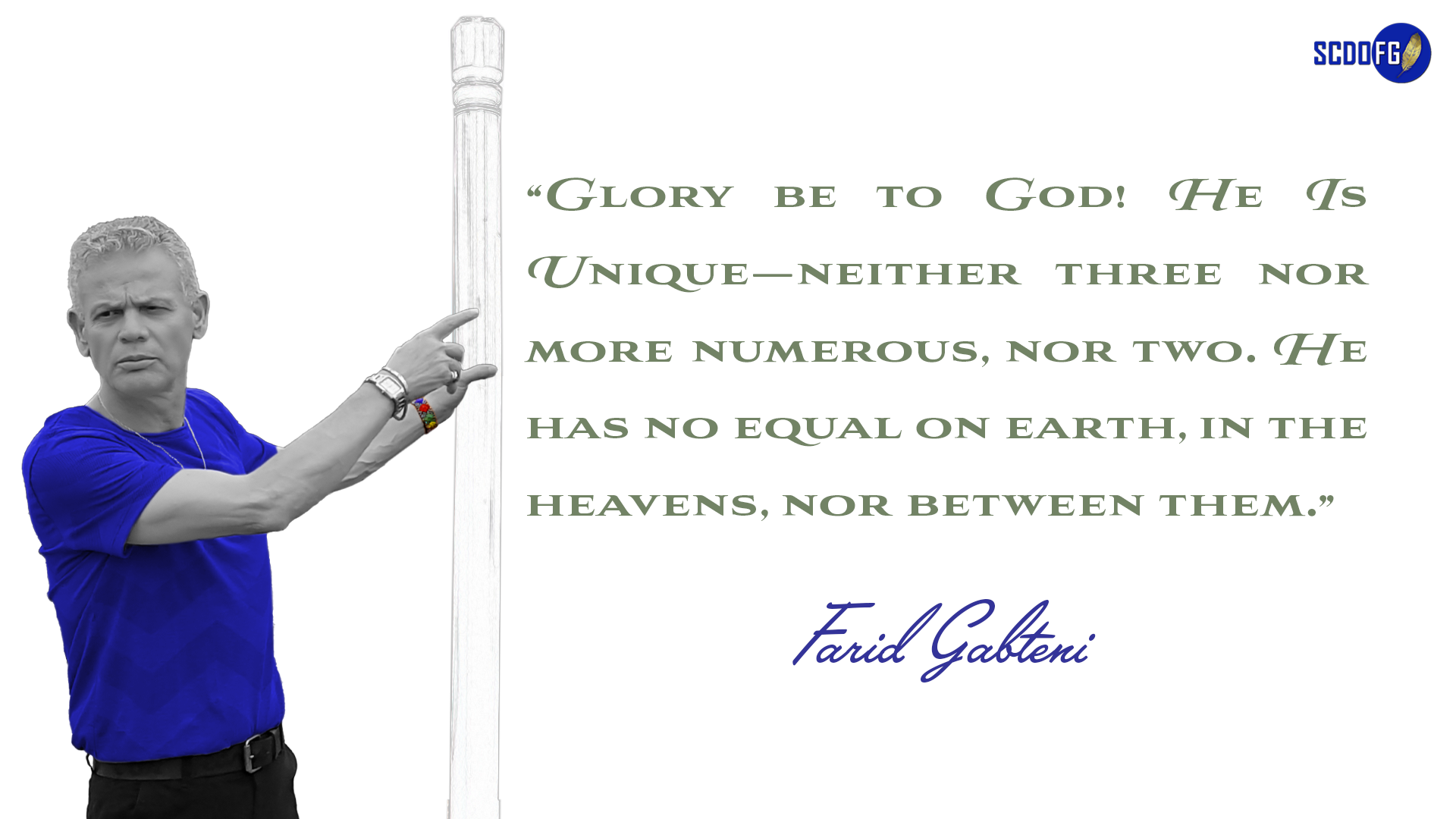
« Glory be to God! He Is Unique—neither three nor more numerous, nor two. He has no equal on earth, in the heavens, nor between them. » — Farid Abbes Raja Gabteni
» God Is Wise and All-Knowing. He Raises among the people those who seek His Forgiveness, who respect their oaths; God Sees and Hears them. » — Farid Abbes Raja Gabteni
« Lord, Cover with Your Peace Your Prophets and Messengers, and the righteous among Your Allies, who called to truth and called to patience. » — Farid Abbes Raja Gabteni
« For the Muslim who knows, only the Qurân is the Revelation of God, and thus Sacred; the rest is but human composition, and therefore fallible. The Qurân clearly affirms freedom of conscience and expression—I would even say freedom itself. Thus, when God Announced to the angels that He would form a successor (to what preceded) upon the earth, they retorted: ‘Do You Form therein one who causes corruption therein and spreads bloods? (…).’ God, far from reproaching them for such reflection, Responds to them and Justifies His Decision: ‘(…) Indeed, I Know what you do not know’ (chap. 2, v. 30). More than that, in the Qurân, the devil is even allowed to disobey God, to justify his disobedience, and to commit evil—at his own risk. For anyone who reflects, what I have just stated says it all about freedom. The Qurân as a whole illustrates, through many an example, freedom of conscience and expression. » — Farid Abbes Raja Gabteni
« Knowledge, conscience, reason, justice, and peace will triumph, sooner or later; these are ideals inherent in our existence. » — Farid Abbes Raja Gabteni
“The last countries to abolish slavery were so-called ‘Muslim’ countries, in total contradiction with the precepts of the Qurân and the Prophet’s conduct, which encourage the emancipation of slaves. Likewise, by transposing out of context certain Quranic verses—circumstantial of time, place, cause, and purpose—traditionalists preach that women should remain under male tutelage. By uncritically trusting their discourse, too many Muslims still lag behind in the emancipation of women. This, once again, stands in total contradiction with the Heart of the Qurân and the original Message of Islâm.” — Farid Abbes Raja Gabteni
“All human beings, men and women alike, are born and remain indispensably free and equal in dignity and rights before God, until the final judgement; the analytical reading of the Qurân as a whole leaves no doubt in this regard. Deviationist Muslim traditionalists, who define terms by distorting their meaning and wrenching them from their Quranic context, fare no better than their Jewish and Christian counterparts, who preach that woman was the first to commit the original sin—though they quote this verbatim from their Bibles (Genesis, Chapter 3, verse 6).” — Farid Abbes Raja Gabteni
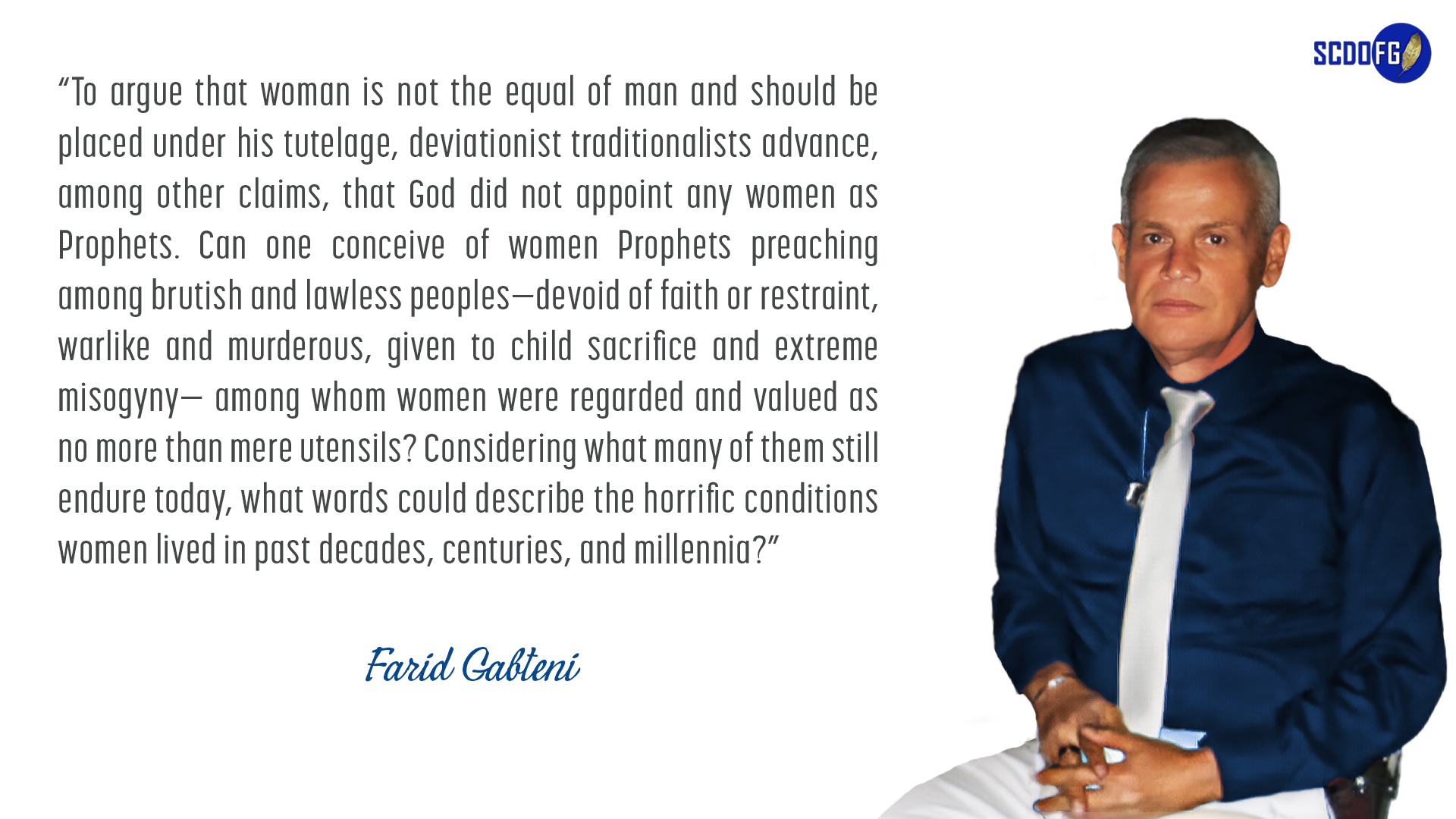
“To argue that woman is not the equal of man and should be placed under his tutelage, deviationist traditionalists advance, among other claims, that God did not appoint any women as Prophets. Can one conceive of women Prophets preaching among brutish and lawless peoples—devoid of faith or restraint, warlike and murderous, given to child sacrifice and extreme misogyny— among whom women were regarded and valued as no more than mere utensils? Considering what many of them still endure today, what words could describe the horrific conditions women lived in past decades, centuries, and millennia?” — Farid Abbes Raja Gabteni
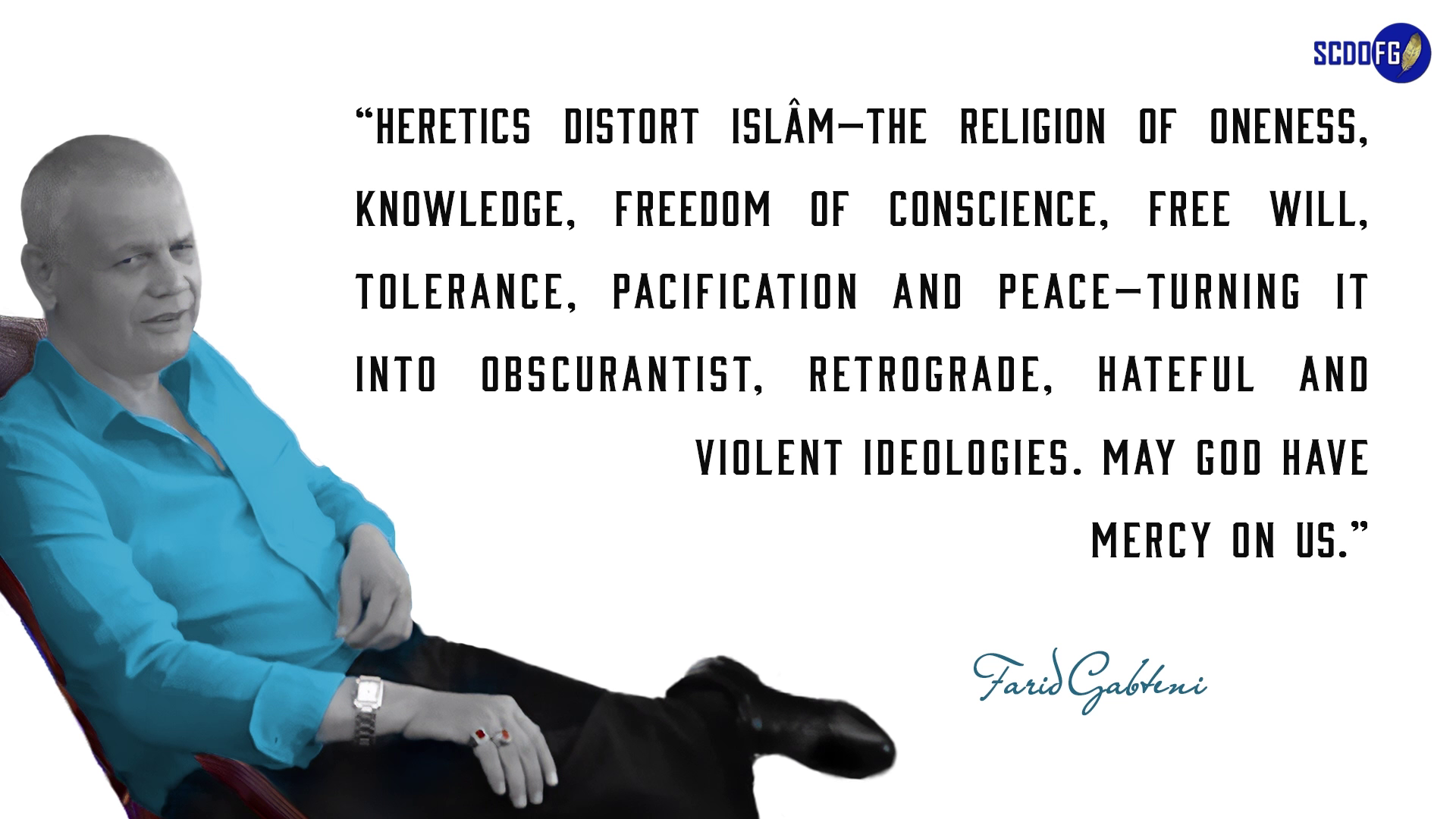
» Heretics have truncated Islâm, the religion of oneness, of knowledge, of freedom of conscience, of free will, of tolerance, of pacification and of Peace, to produce obscurantist, backward, hateful and violent ideologies. May God have Mercy on us. » — Farid Abbes Raja Gabteni
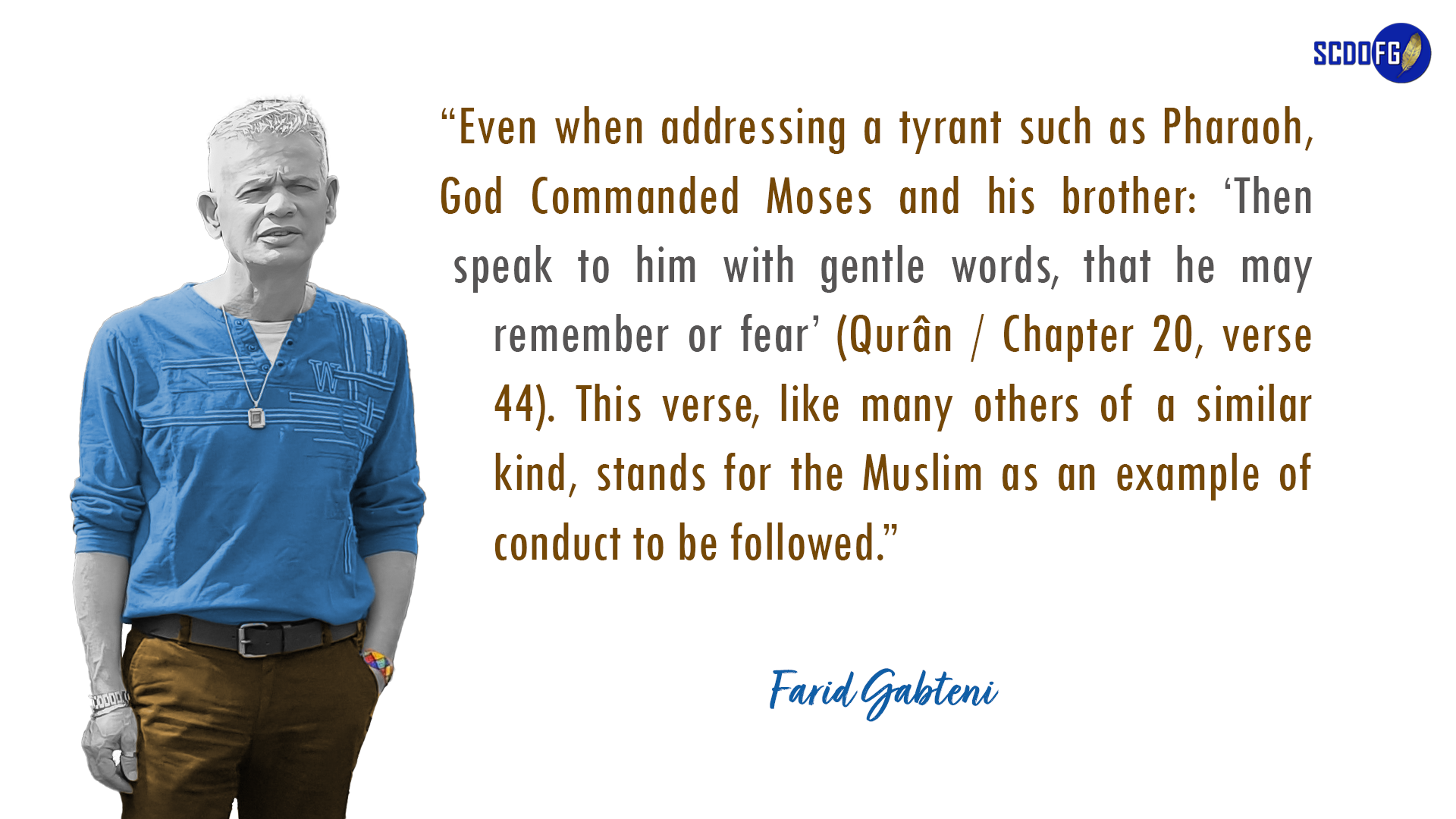
« Even when addressing a tyrant such as Pharaoh, God Commanded Moses and his brother: ‘Then speak to him with gentle words, that he may remember or fear’ (Qurân/Chapter 20, verse 44). This verse, like many others of a similar kind, stands for the Muslim as an example of conduct to be followed. » — Farid Abbes Raja Gabteni
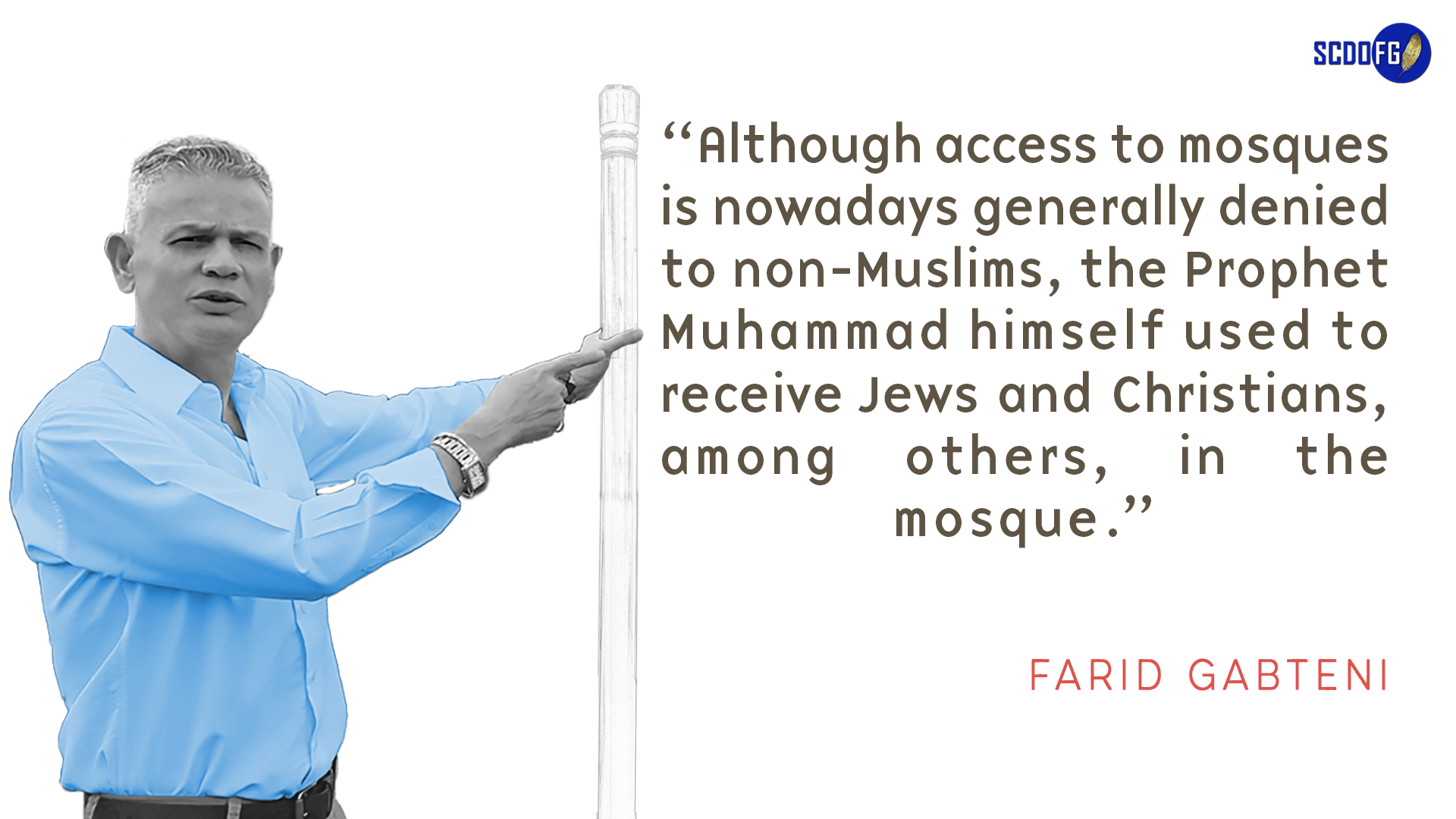
« Although access to mosques is nowadays generally denied to non-Muslims, the Prophet Muhammad himself used to receive Jews and Christians, among others, in the mosque. » — Farid Abbes Raja Gabteni
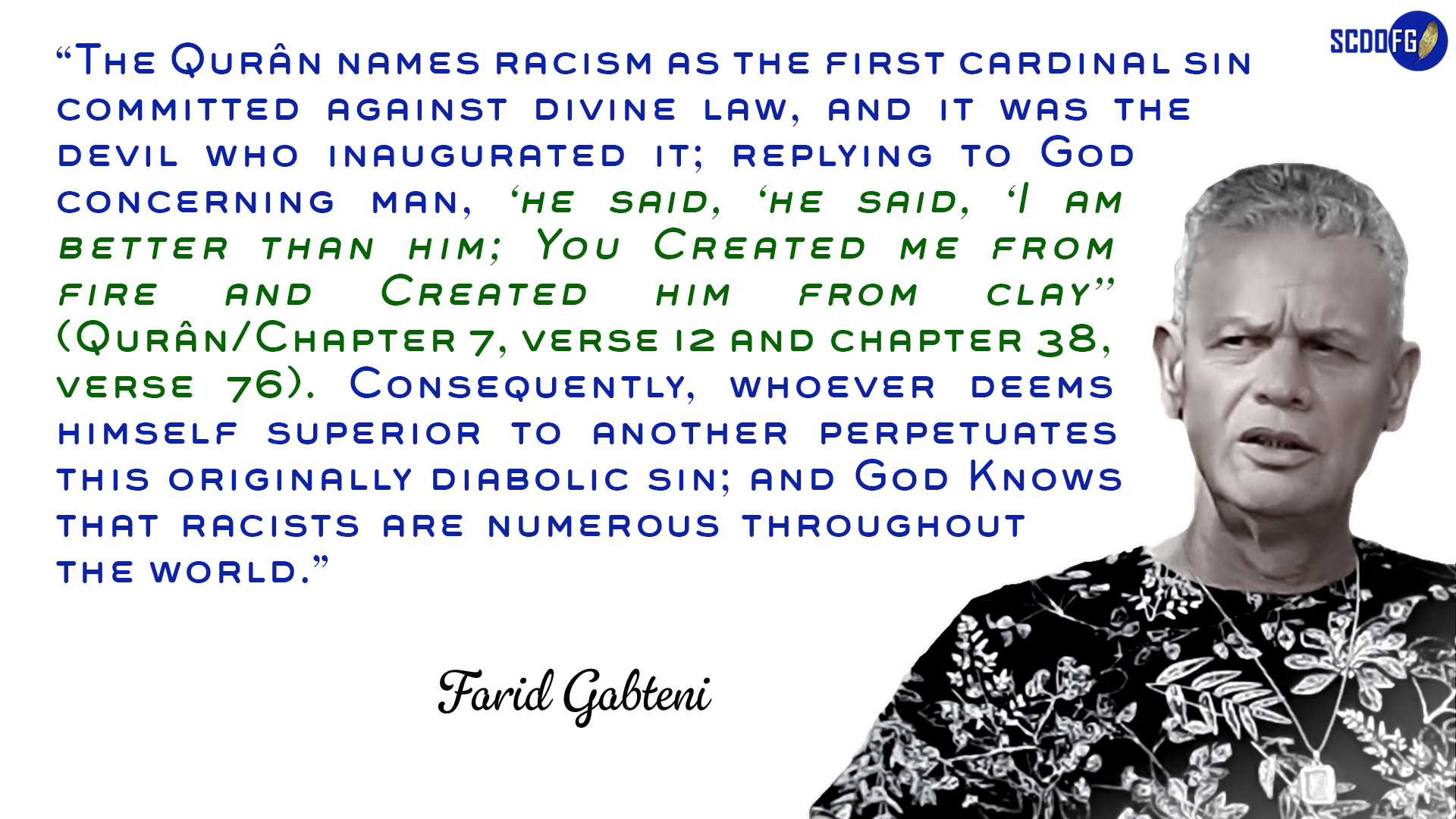
“The Qurân names racism as the first cardinal sin committed against divine law, and it was the devil who inaugurated it; replying to God concerning man, ‘he said, ‘I am better than him; You Created me from fire and Created him from clay’’ (Qurân/Chapter 7, verse 12, and chapter 38, verse 76). Consequently, whoever deems himself superior to another perpetuates this originally diabolic sin; and God Knows that racists are numerous throughout the world.” Farid Gabteni
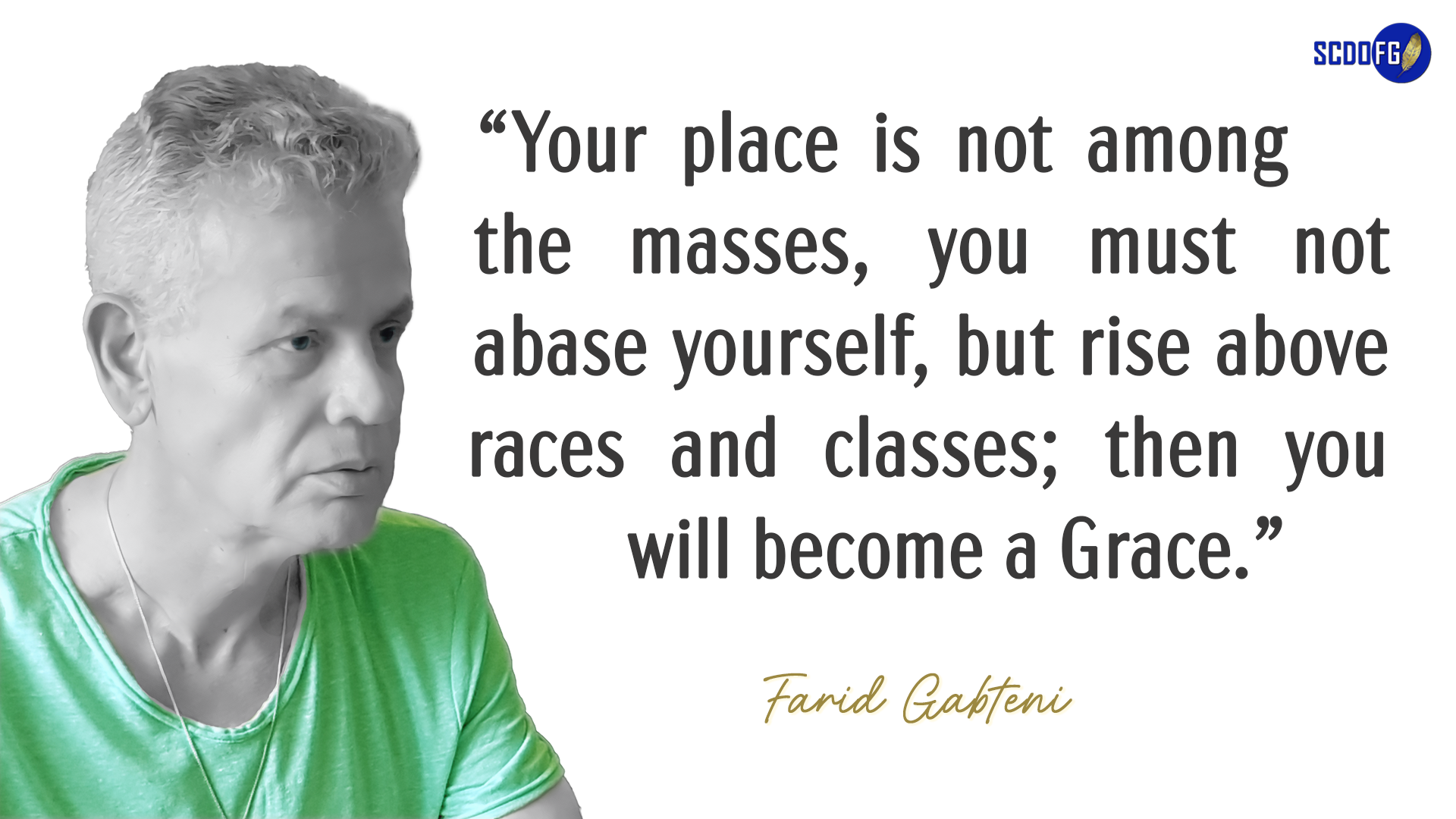
« Your place is not among the masses, you must not abase yourself, but rise above races and classes; then you will become a Grace. » — Farid Abbes Raja Gabteni
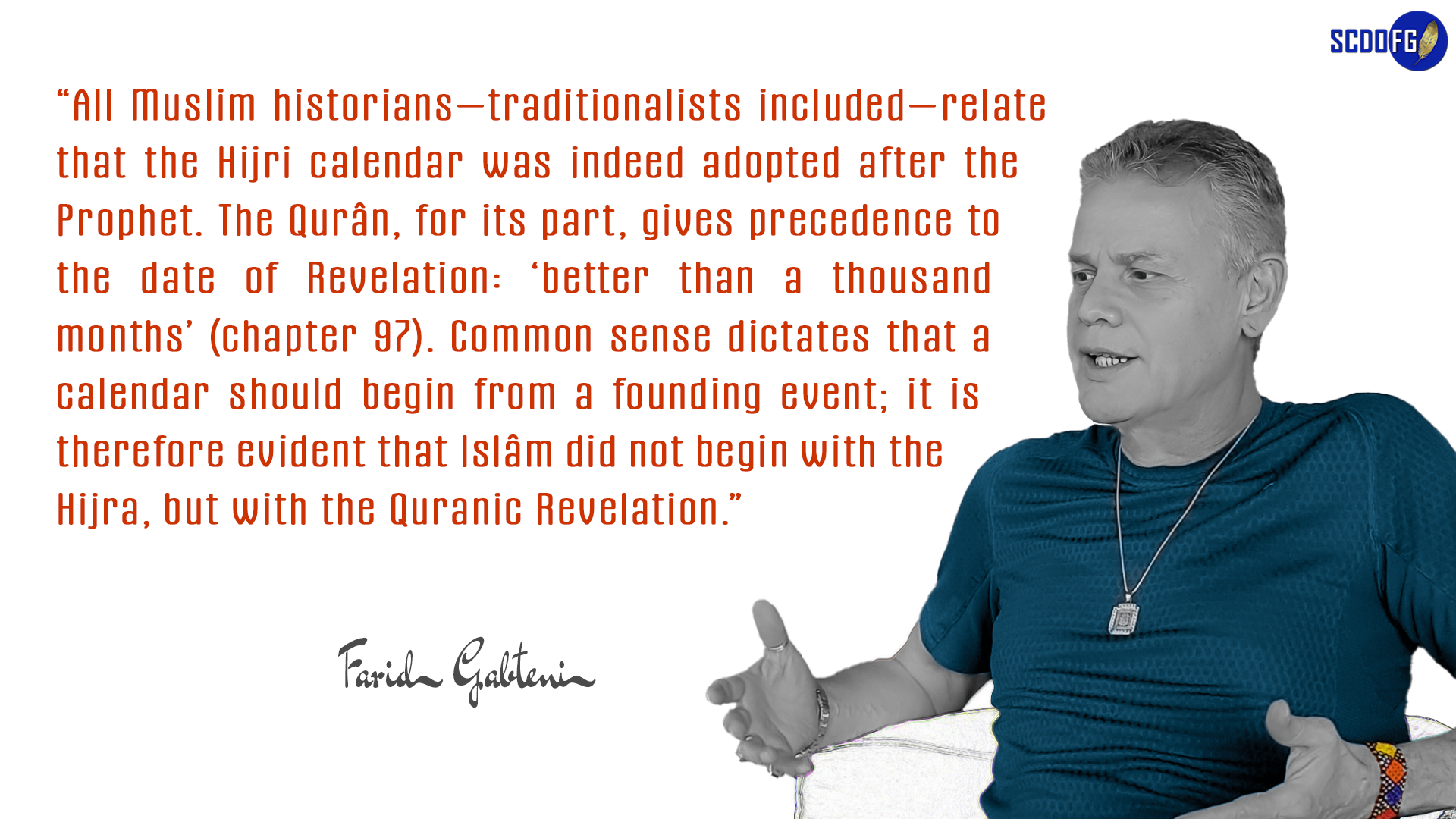
« Contrary to what was instituted after the Prophet, it is not his emigration to Medina (the Hijra, 622) that marks the beginning of the Muslim calendar; rather, this may be inferred from the Qurân (chapter 97), begining with the Quranic Revelation, in 610 (chapter 96). The original Islâm encompasses the entirety of the Revelation (610-632), whereas ideological traditionalism is wont to privilege and anchor itself in the Hijri calendar. » — Farid Abbes Raja Gabteni
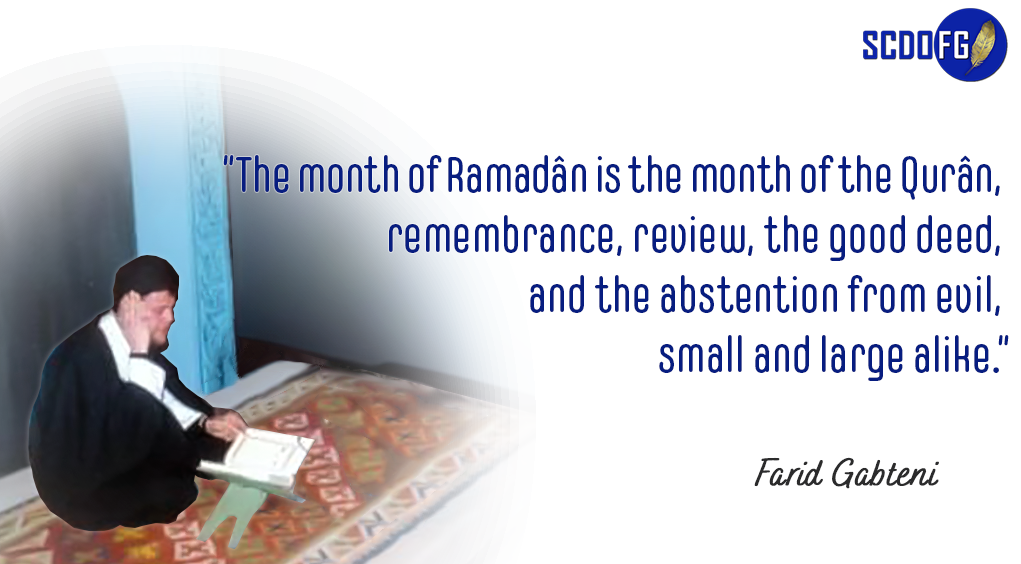
« The month of Ramadân is the month of the Qurân, remembrance, review, the good deed, and the abstention from evil, small and large alike. » — Farid Abbes Raja Gabteni
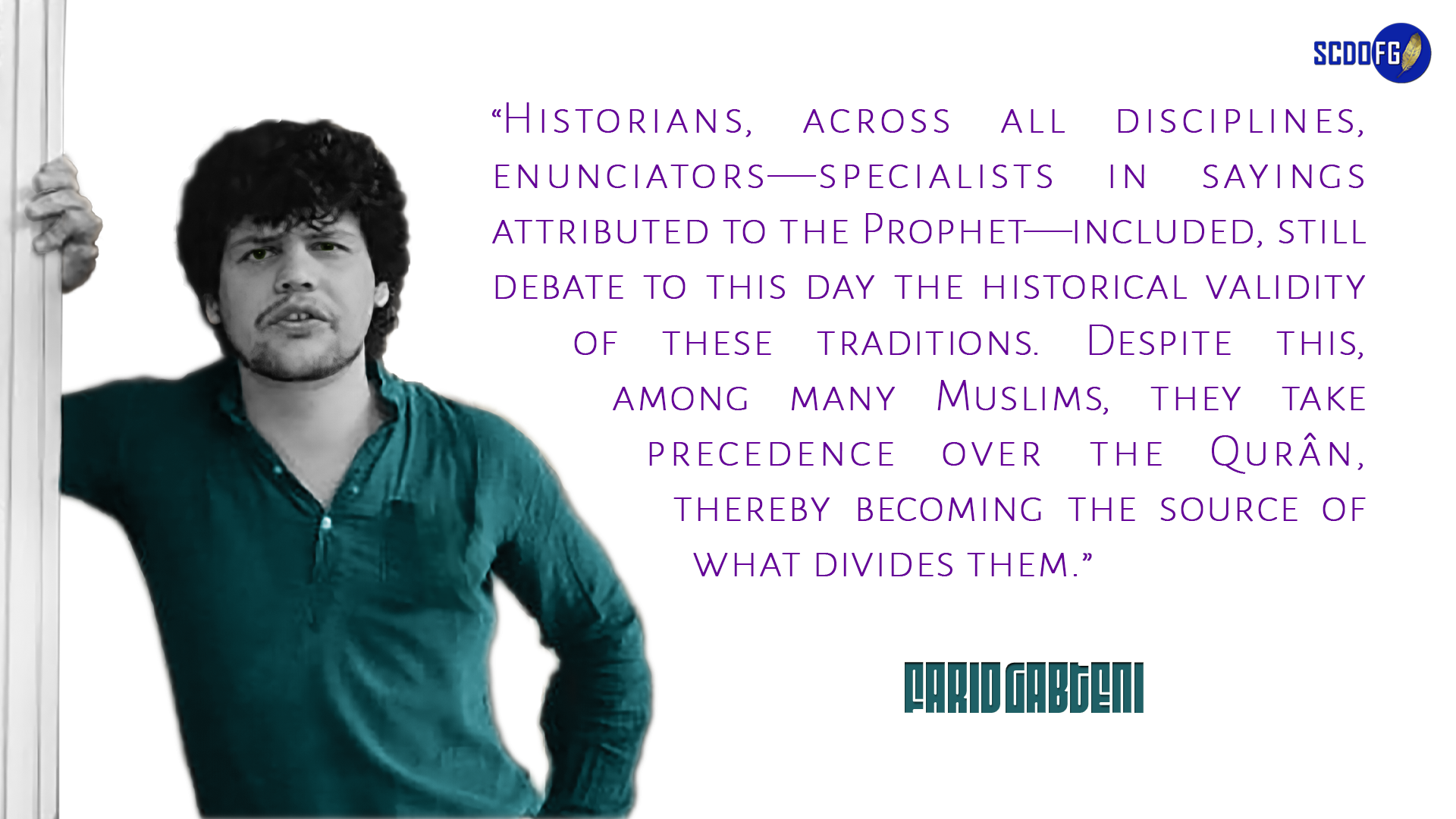
“Historians, across all disciplines, enunciators—specialists in sayings attributed to the Prophet—included, still debate to this day the historical validity of these traditions. Despite this, among many Muslims, they take precedence over the Qurân, thereby becoming the source of what divides them.” Farid Gabteni
« The adoption (after the Prophet) of the Hijri calendar had sententious repercussions of a political, theological, and jurisprudential order. Insinuatingly, it has enabled—and still enables—traditionalists to spuriously buttress their ideologies, by privileging, in their exegesis, the Medinan period over, and to the detriment of, the Meccan period. The Qurân states: « (…) Do you then assure (believe) by one part of the writing (book), and denigrate by one part? (…) » (Chapter 2, verse 85). » — Farid Abbes Raja Gabteni
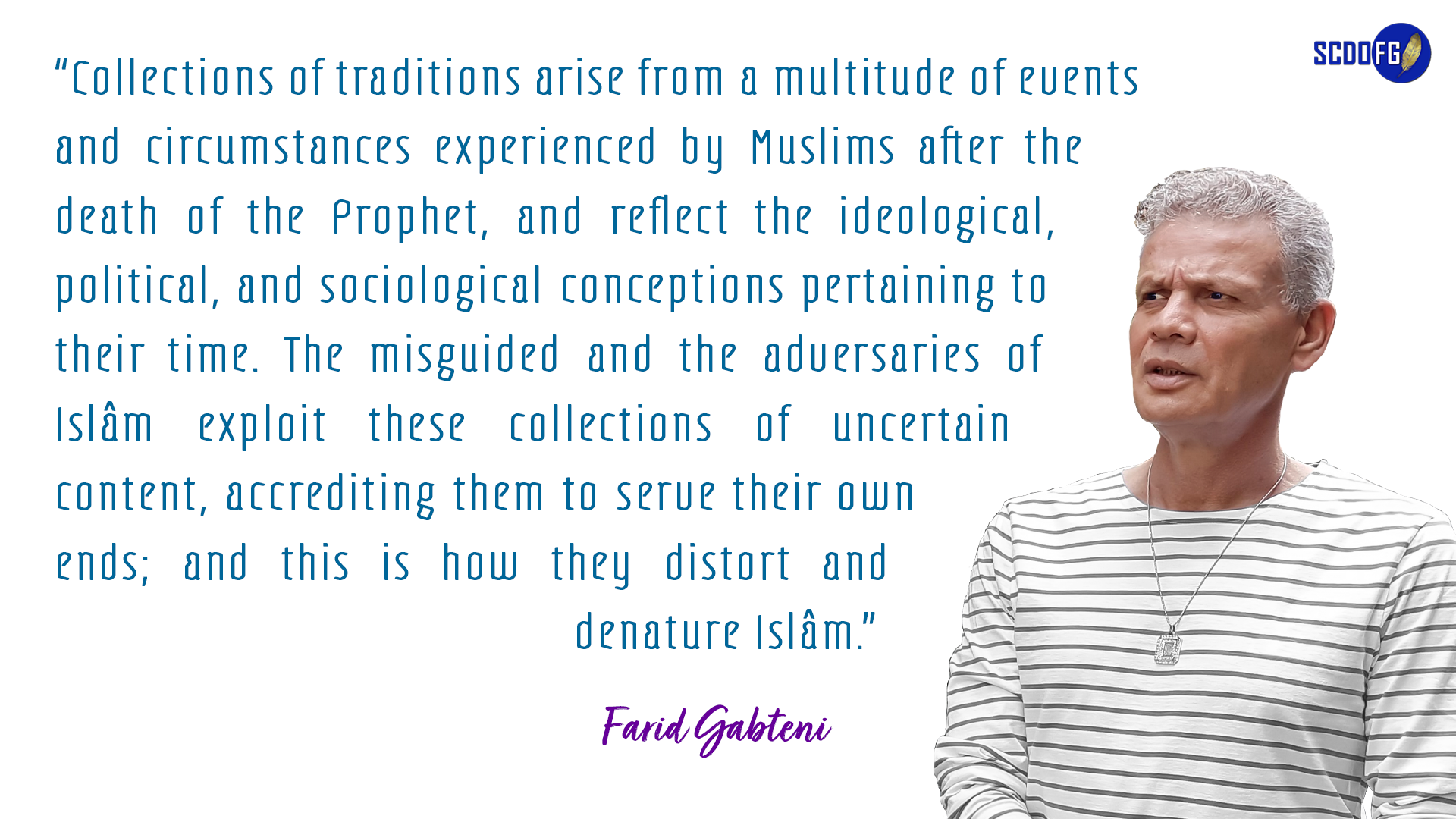
“Collections of traditions arise from a multitude of events and circumstances experienced by Muslims after the death of the Prophet, and reflect the ideological, political, and sociological conceptions pertaining to their time. The misguided and the adversaries of Islâm exploit these collections of uncertain content, accrediting them to serve their own ends; and this is how they distort and denature Islâm.” Farid Gabteni
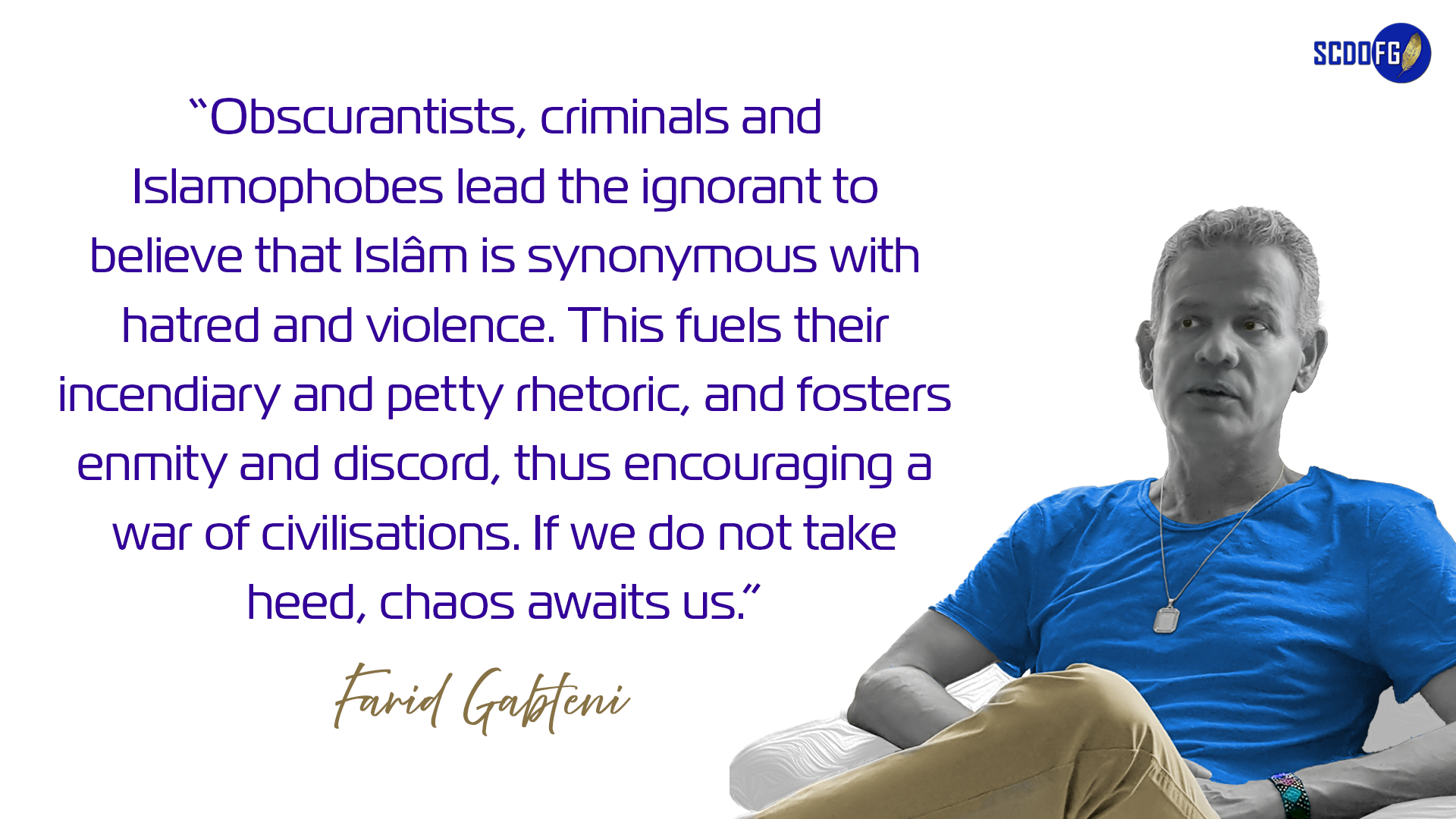
“Obscurantists, criminals and Islamophobes lead the ignorant to believe that Islâm is synonymous with hatred and violence. This fuels their incendiary and petty rhetoric, and fosters enmity and discord, thus encouraging a war of civilisations. If we do not take heed, chaos awaits us.” Farid Gabteni
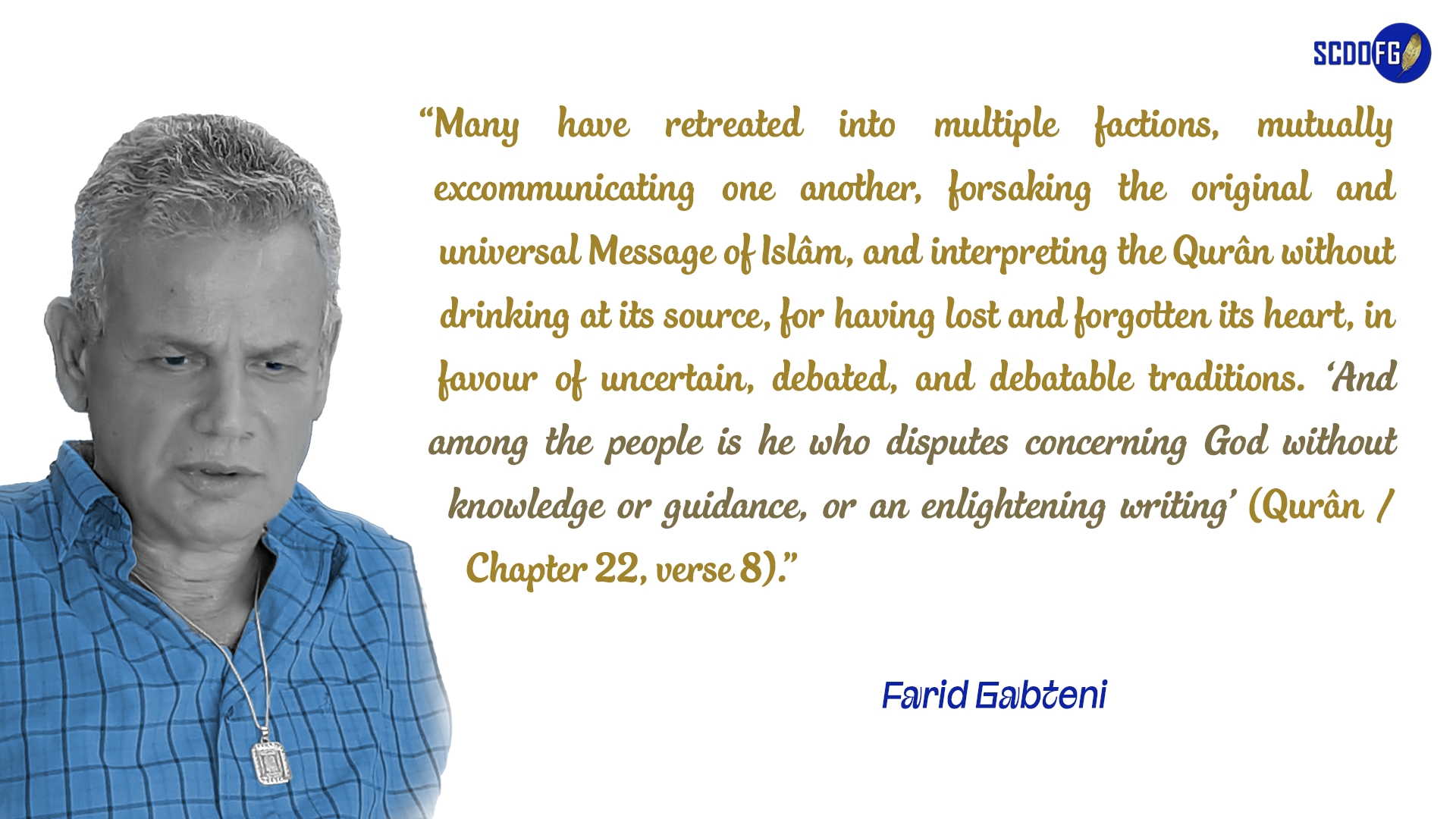
“Many have retreated into multiple factions, mutually excommunicating one another, forsaking the original and universal Message of Islâm, and interpreting the Qurân without drinking at its source, for having lost and forgotten its heart, in favour of uncertain, debated, and debatable traditions. ‘And among the people is he who disputes concerning God without knowledge or guidance, or an enlightening writing’ (Qurân/Chapter 22, verse 8).” Farid Gabteni
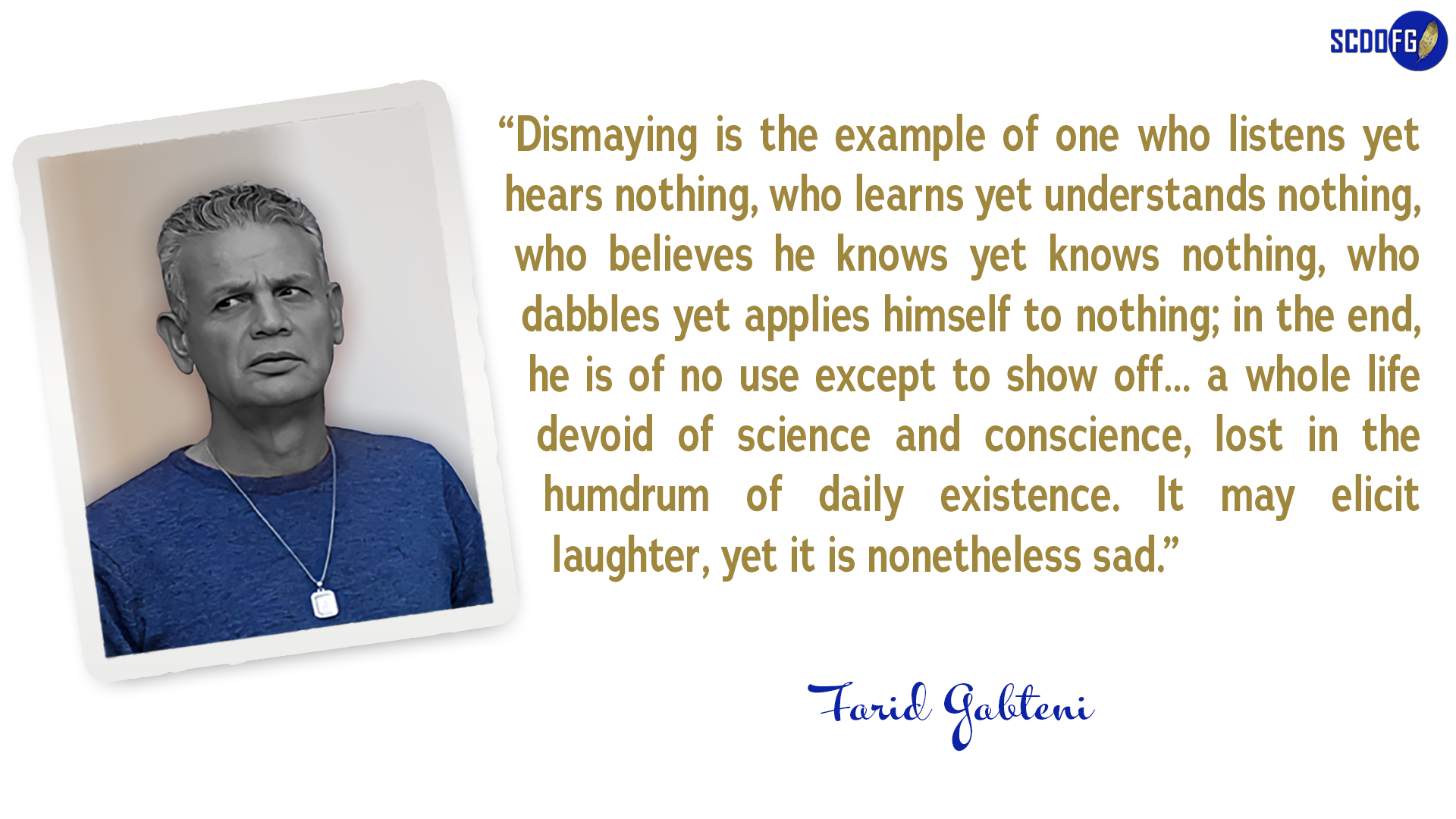
« Dismaying is the example of one who listens yet hears nothing, who learns yet understands nothing, who believes he knows yet knows nothing, who dabbles yet applies himself to nothing; in the end, he is of no use except to show off… a whole life devoid of science and conscience, lost in the humdrum of daily existence. It may elicit laughter, yet it is nonetheless sad. » — Farid Abbes Raja Gabteni
“‘And indeed, Prostratoriums (Mosques) are for God; so do not invoke alongside God anyone [else]’; ‘Say, ‘Indeed, I do not possess for you any harm, nor any [perfect] sense’’ (Qurân/Chapter 72, verses 18 and 21). This is what God Teaches and, likewise, the righteous among His Allies; God Alone Is Worthy of Adoration and Invocation; His beneficent Servants are indeed praiseworthy and serve as reference models, yet they are not perfect and must in no way be the object of worship due to God Alone.” — Farid Abbes Raja Gabteni
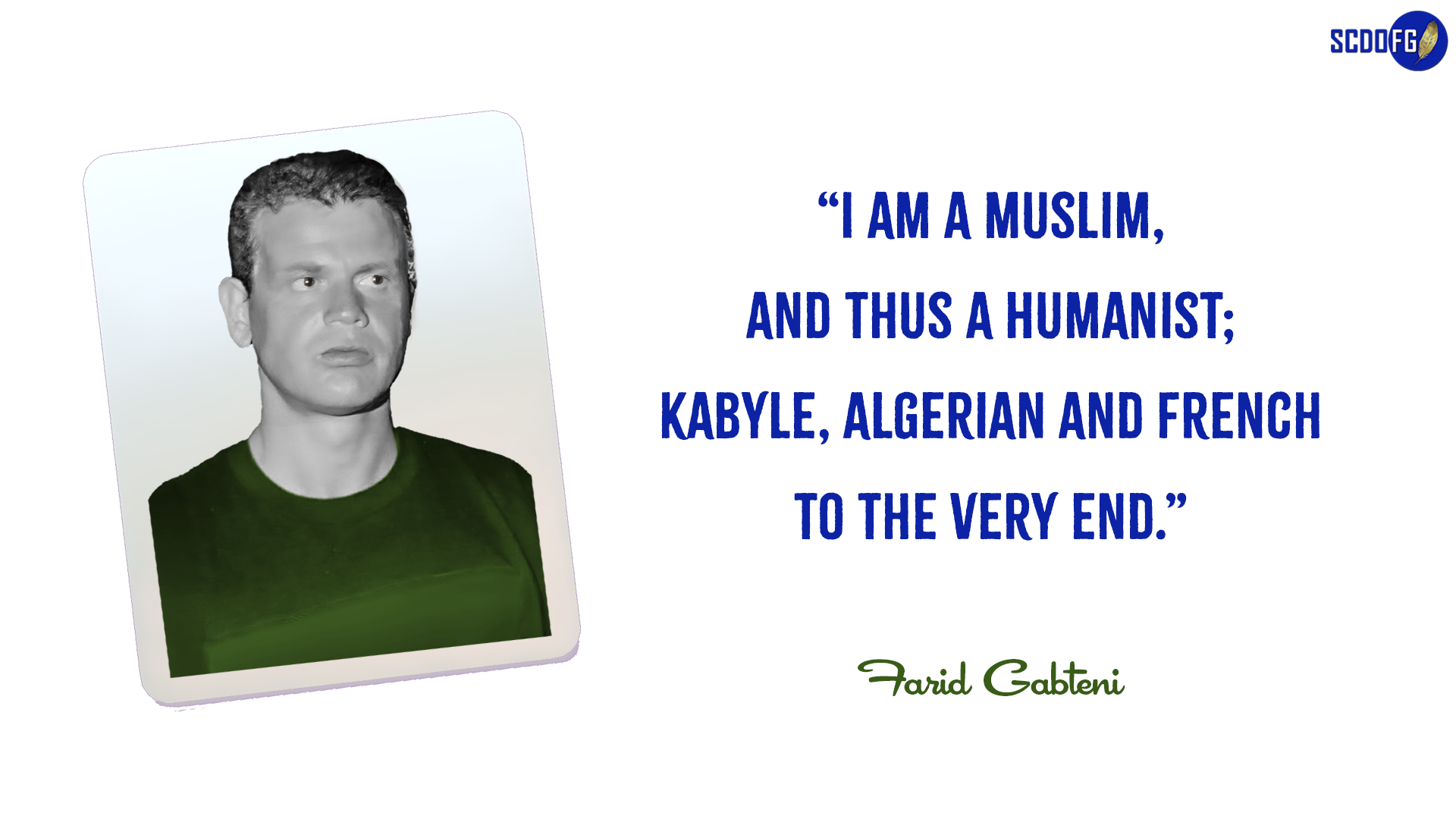
« I am a Muslim, and thus a Humanist; Kabyle, Algerian and French to the very end. » — Farid Abbes Raja Gabteni
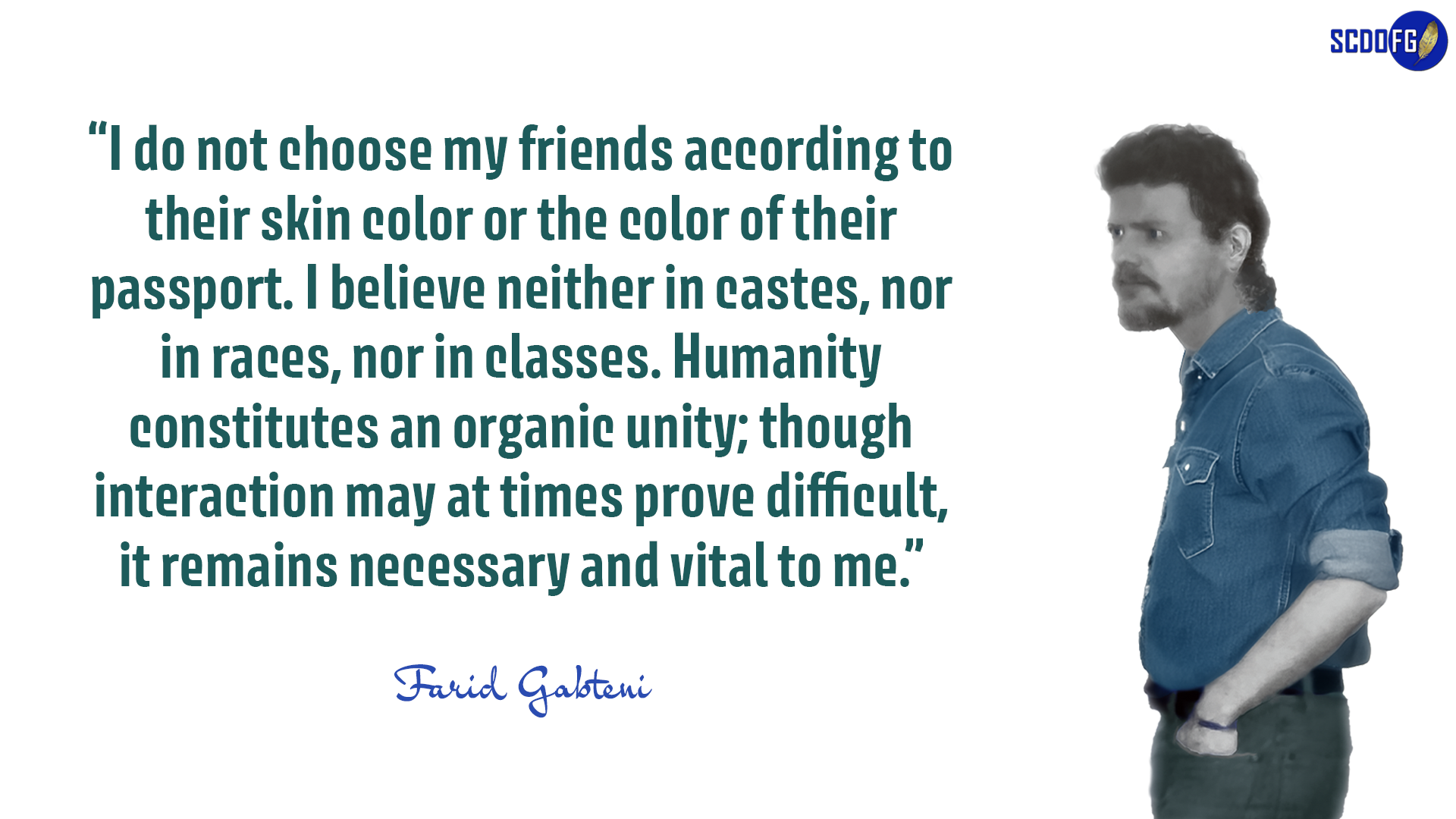
« I do not choose my friends according to their skin color or the color of their passport. I believe neither in castes, nor in races, nor in classes. Humanity constitutes an organic unity; though interaction may at times prove difficult, it remains necessary and vital to me. » — Farid Abbes Raja Gabteni
« For the believer, God Himself Is the Truth—The Sovereign and Supreme Truth; The Ineffable Truth. Other than Him, no one possesses Absolute Truth; each holds his own truth—which is to say, there are as many conceptions of truth as there are opinions. Nevertheless, ‘Truth has value only insofar as it is expressed in its total unity, whereas objections and heresies always find it easy to attack the detail’ (Blondel). Truth is knowledge recognized as right, adequate to its object, and thereby endowed with universal, absolute, and ultimate value; it is the norm, the principle of rectitude and wisdom, universally regarded as an ideal in the order of thought and/or action. » — Farid Abbes Raja Gabteni
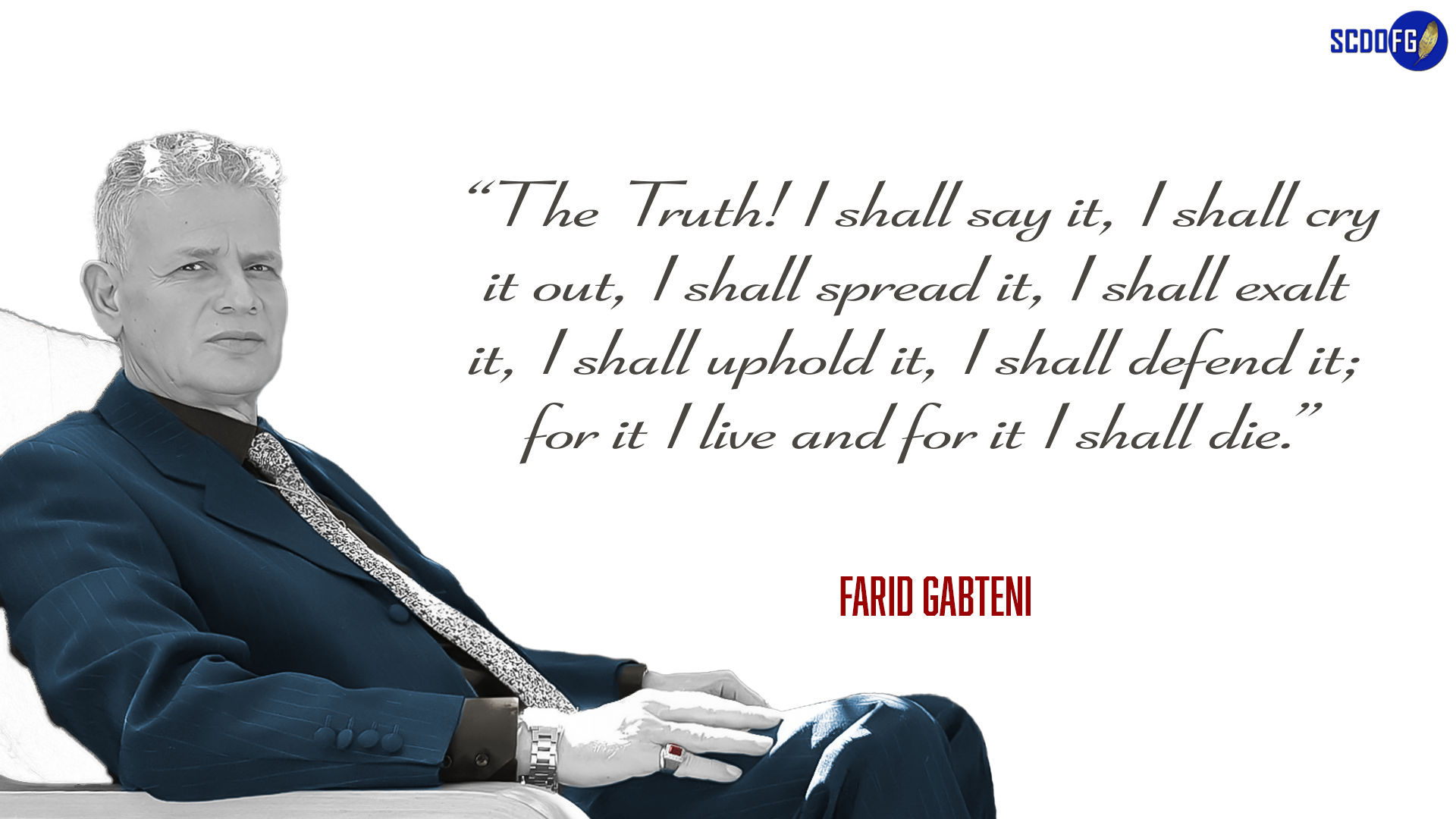
« The Truth! I shall say it, I shall cry it out, I shall spread it, I shall exalt it, I shall uphold it, I shall defend it; for it I live and for it I shall die. » — Farid Abbes Raja Gabteni
« I am a fighter, I lend myself only to the best; I am a seeker of neither reception nor hall of honor, save with God, My Master and Lord. » — Farid Abbes Raja Gabteni
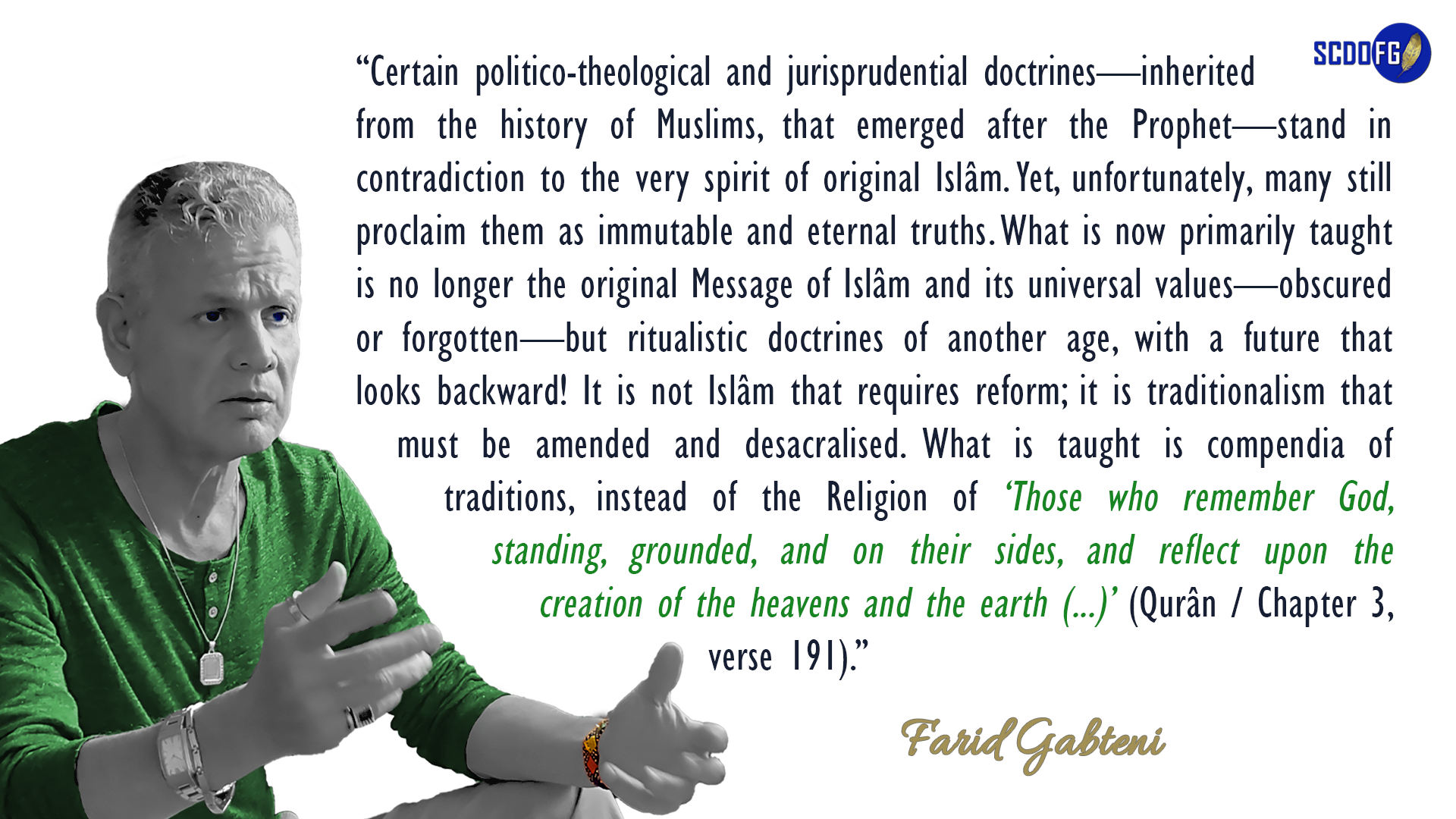
« Certain politico-theological and jurisprudential doctrines—inherited from the history of Muslims, that emerged after the Prophet—stand in contradiction to the very spirit of original Islâm. Yet, unfortunately, many still proclaim them as immutable and eternal truths. What is now primarily taught is no longer the original Message of Islâm and its universal values—obscured or forgotten—but ritualistic doctrines of another age, with a future that looks backward! It is not Islâm that requires reform; it is traditionalism that must be amended and desacralised. What is taught is compendia of traditions, instead of the Religion of ‘Those who remember God, standing, grounded, and on their sides, and reflect upon the creation of the heavens and the earth (…)’ (Qurân / Chapter 3, verse 191). » — Farid Abbes Raja Gabteni
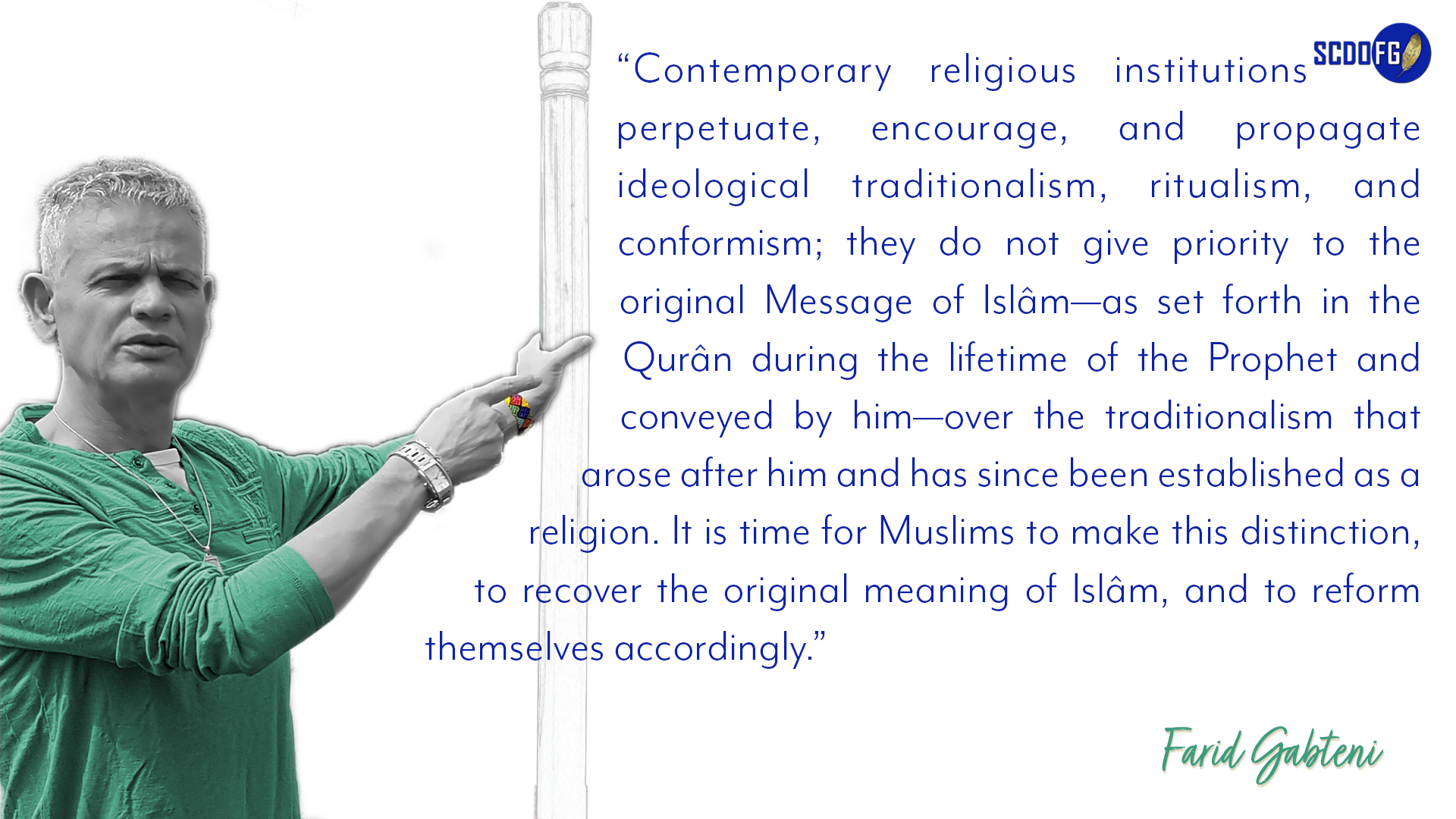
« Contemporary religious institutions perpetuate, encourage, and propagate ideological traditionalism, ritualism, and conformism; they do not give priority to the original Message of Islâm—as set forth in the Qurân during the lifetime of the Prophet and conveyed by him—over the traditionalism that arose after him and has since been established as a religion. It is time for Muslims to make this distinction, to recover the original meaning of Islâm, and to reform themselves accordingly. » — Farid Abbes Raja Gabteni
« I am a Muslim, I bear witness that there is no god but God, Unique, without partner. And I bear witness that Muhammad is His Servant and His Envoy, that the Creance, the Religion with God is Pacification, Islâm—submission to God in peace. I do not bear witness that Abû Bakr, عOmar, عOthmâne, or عAlî are messengers of God. They are but Muslims close to the Prophet, who were at times right and at times wrong, and who cannot be beyond reproach in essence. God Alone Is Perfect and Absolute. I do not claim any particular theological or jurisprudential school; this does not prevent me from profoundly feeling it my duty to defend, despite its diversity, the Muslim community of which I am a part. And I refuse—with all my strength—any further division of it. I stand against excommunicators and secessionists, whoever they may be. God loves neither aggression nor aggressors. He Is The Witness and He Is The Judge, and none may claim to possess paradise or hell, except Him. » — Farid Abbes Raja Gabteni
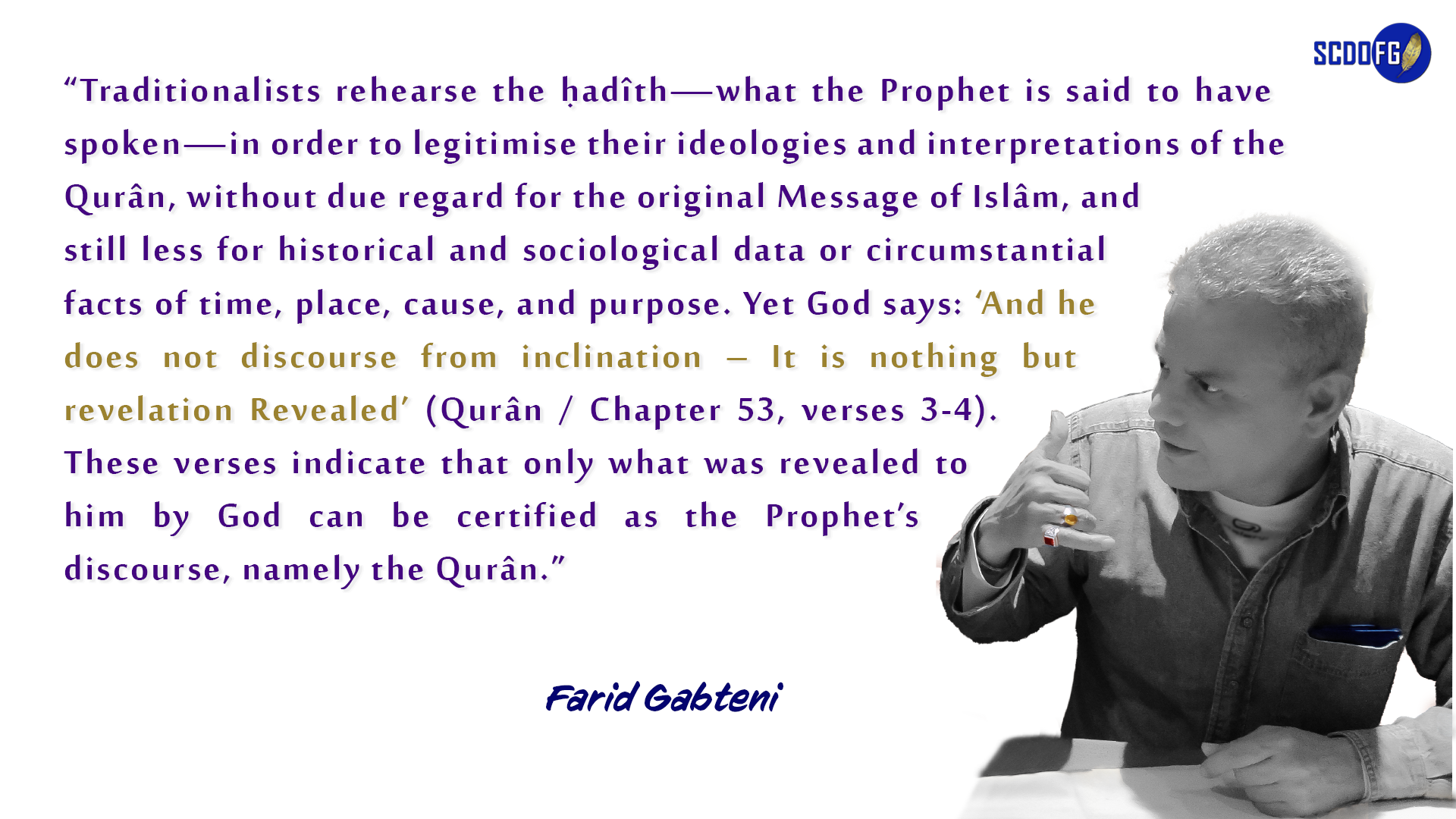
“Traditionalists rehearse the ḥadîth—what the Prophet is said to have spoken—in order to legitimise their ideologies and interpretations of the Qurân, without due regard for the original Message of Islâm, and still less for historical and sociological data or circumstantial facts of time, place, cause, and purpose. Yet God says: ‘And he does not discourse from inclination – It is nothing but revelation Revealed’ (Qurân/Chapter 53, verses 3-4). These verses indicate that only what was revealed to him by God can be certified as the Prophet’s discourse, namely the Qurân.” Farid Gabteni
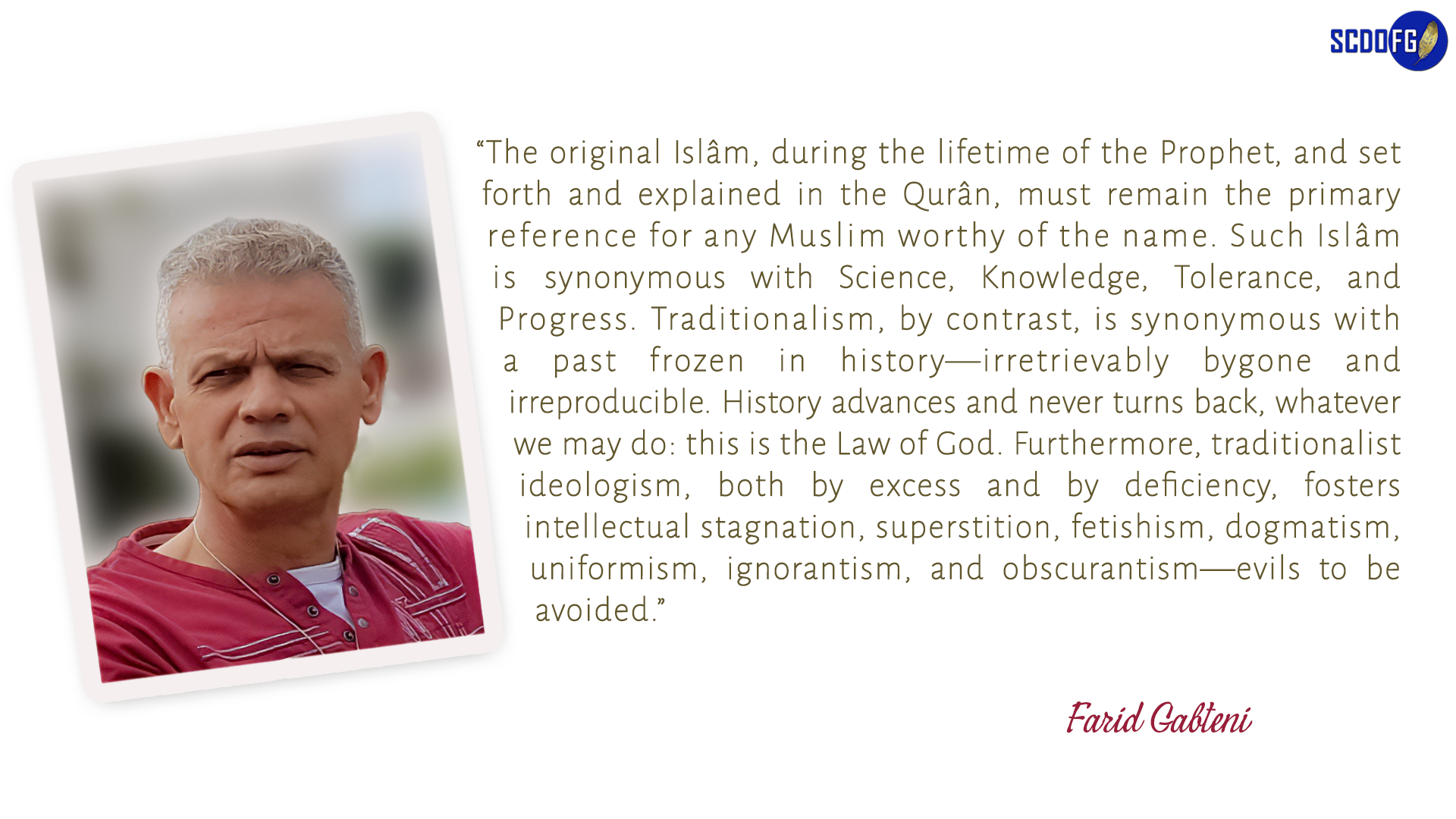
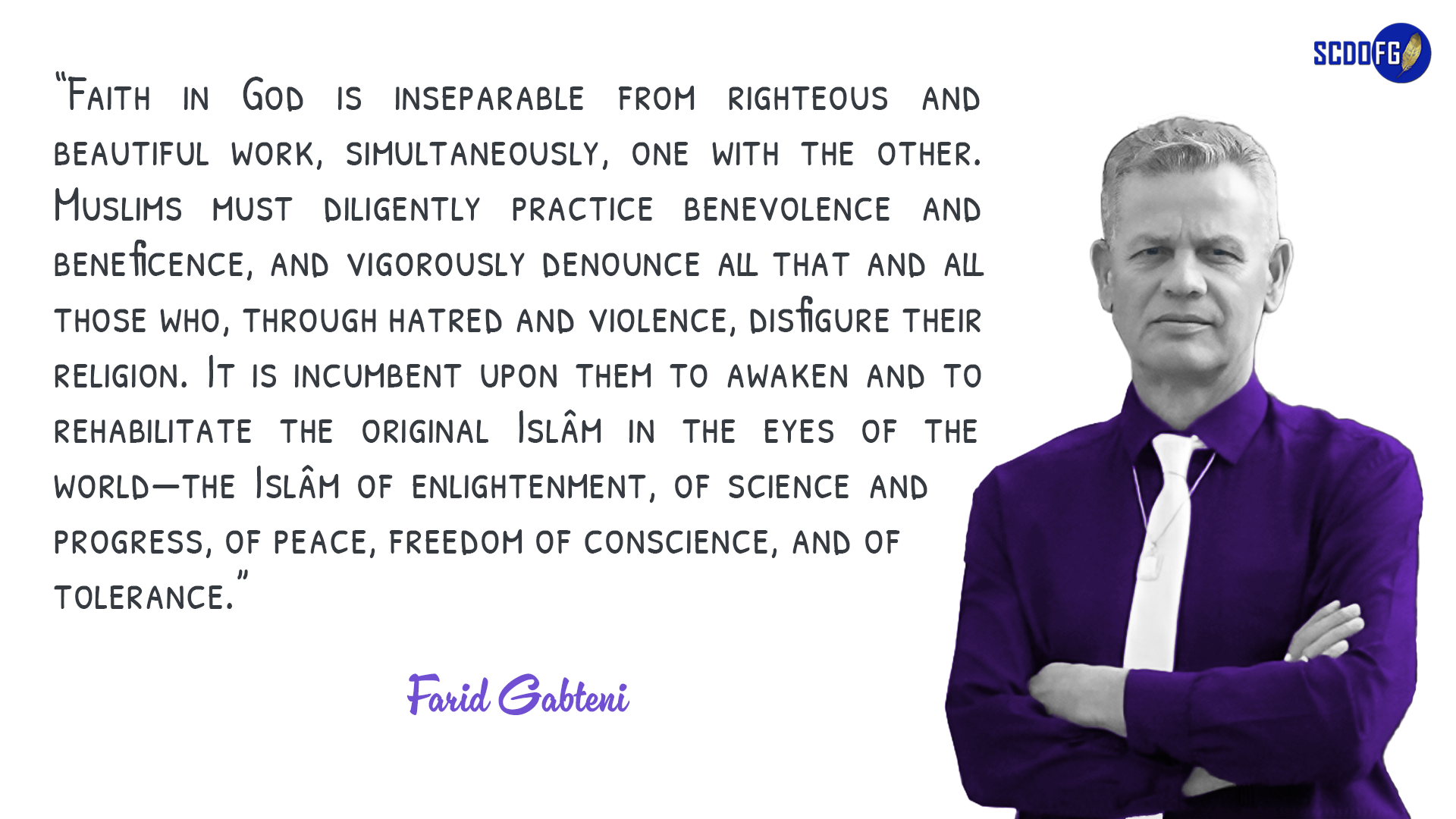
« The original Islâm, during the lifetime of the Prophet, and set forth and explained in the Qurân, must remain the primary reference for any Muslim worthy of the name. Such Islâm is synonymous with Science, Knowledge, Tolerance, and Progress. Traditionalism, by contrast, is synonymous with a past frozen in history—irretrievably bygone and irreproducible. History advances and never turns back, whatever we may do: this is the Law of God. Furthermore, traditionalist ideologism, both by excess and by deficiency, fosters intellectual stagnation, superstition, fetishism, dogmatism, uniformism, ignorantism, and obscurantism—evils to be avoided. » — Farid Abbes Raja Gabteni
“The injunction of God ‘Say!’ is repeated three hundred and thirty-two times in the Qurân (in most cases, it is addressed to the Prophet). And this divine injunction, reiterated so frequently, is inherent in the continuous transmission of the Message, well-heard (well understood). What the Prophet said with certainty is what God commanded him to say through revelation, in the Qurân. ‘Such [are] the Signs (Verses) of God, We Relate them upon you by the true, then by what statement (ḥadîthin) after God and His Signs (Verses) do they assure (believe)?’ (Qurân/Chapter 45, verse 6).” Farid Gabteni
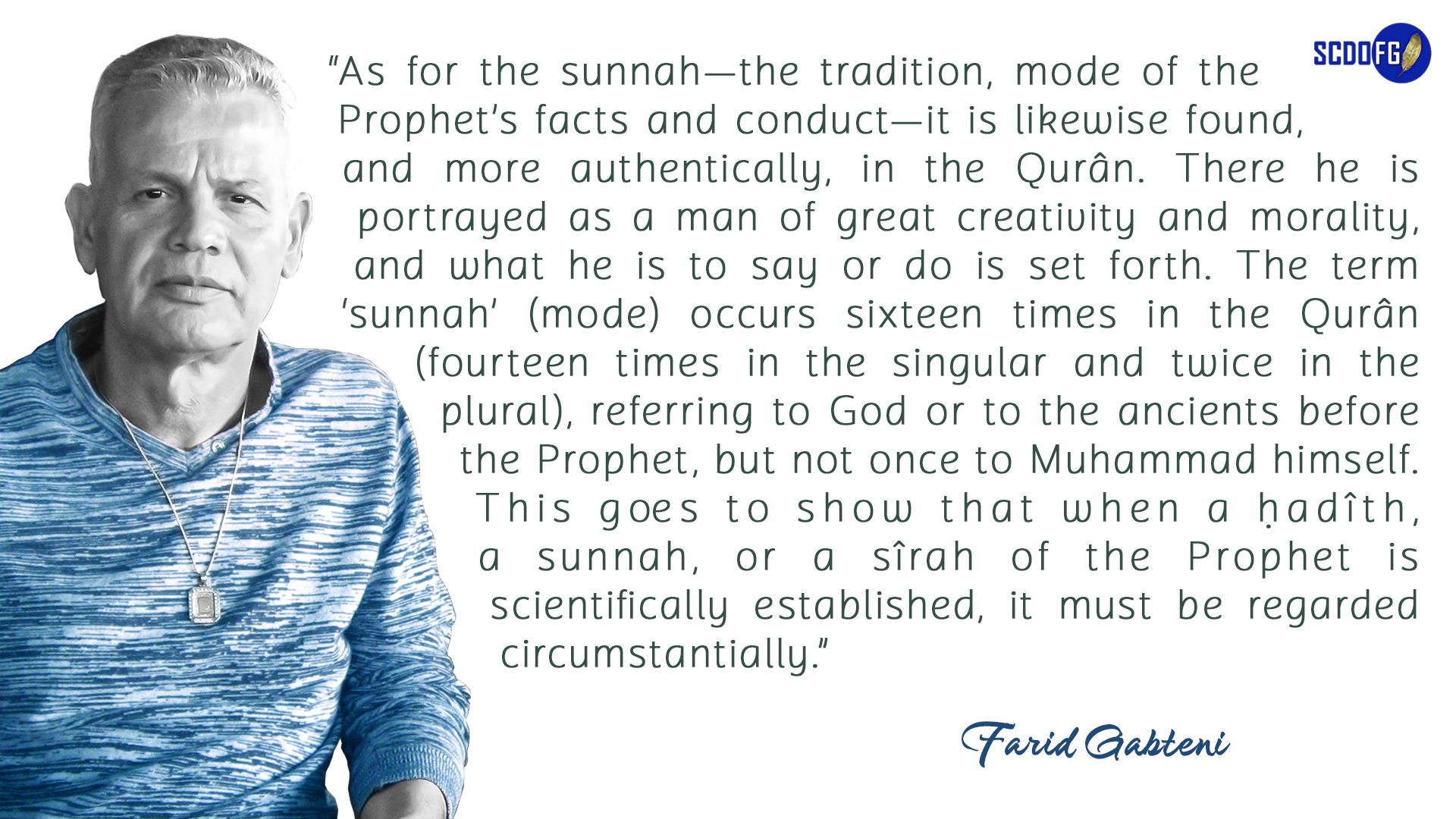
“As for the sunnah—the tradition, mode of the Prophet’s facts and conduct—it is likewise found, and more authentically, in the Qurân. There he is portrayed as a man of great creativity and morality, and what he is to say or do is set forth. The term ‘sunnah’ (mode) occurs sixteen times in the Qurân (fourteen times in the singular and twice in the plural), referring to God or to the ancients before the Prophet, but not once to Muhammad himself. This goes to show that when a ḥadîth, a sunnah, or a sîrah of the Prophet is scientifically established, it must be regarded circumstantially.” Farid Gabteni
« Pseudo-religious fanatics draw inspiration from traditionalism consequent upon the history of Muslims, and not from Islâm itself. It is therefore incumbent upon us to inform and teach the original Islâm (during the Prophet’s lifetime) and to distinguish it from the traditionalist islam (after the Prophet’s death), contrived, constituted, and instituted by political-theological, sociological, and historical circumstances that were amalgamated with the original Message of Islâm (Knowledge, Faith, Beneficence, Tolerance, and Pacification). » — Farid Abbes Raja Gabteni
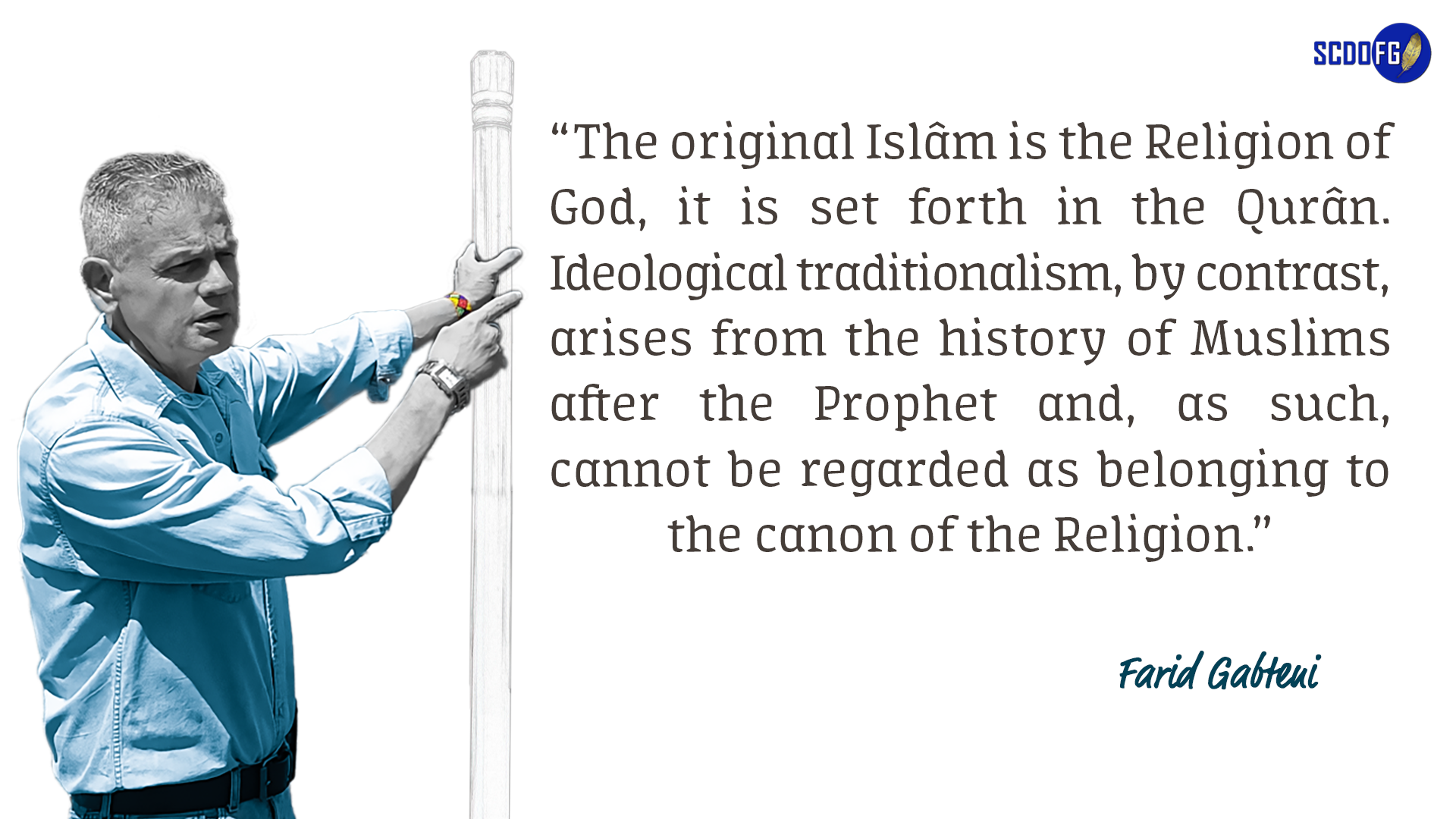
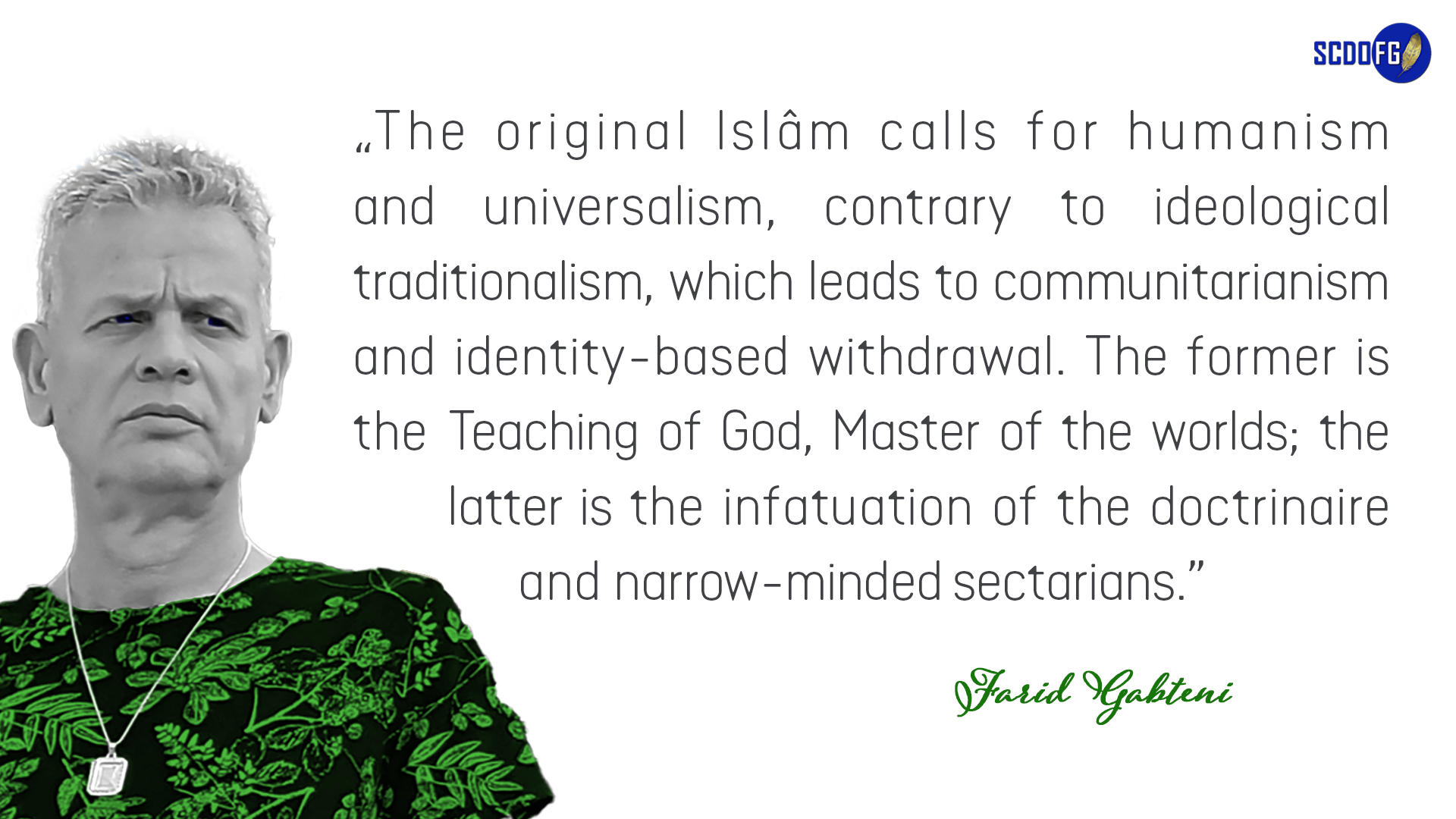
« The original Islâm is the Religion of God, it is set forth in the Qurân. Ideological traditionalism, by contrast, arises from the history of Muslims after the Prophet and, as such, cannot be regarded as belonging to the canon of the Religion. » — Farid Abbes Raja Gabteni
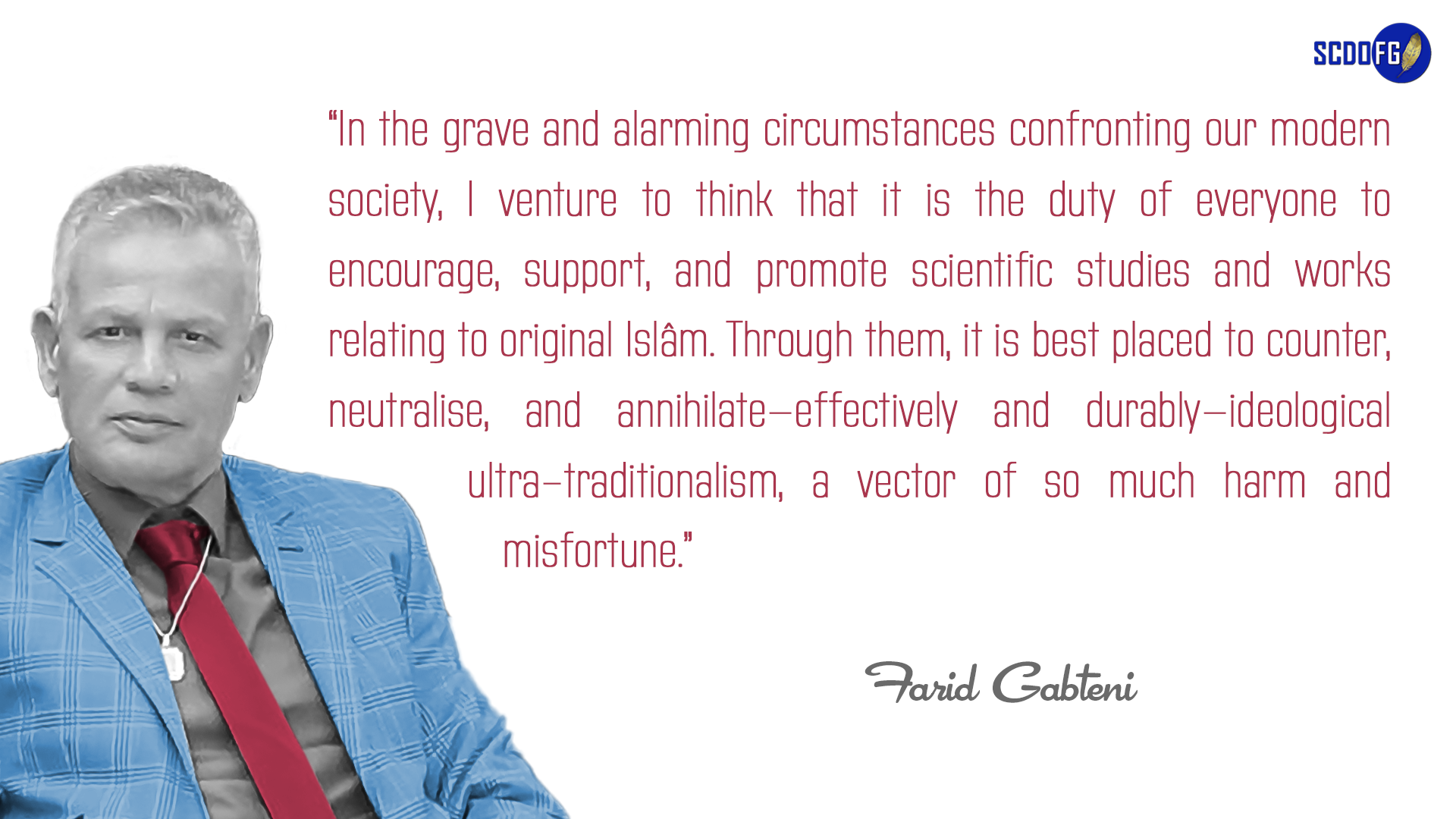
“In the grave and alarming circumstances confronting our modern society, I venture to think that it is the duty of everyone to encourage, support, and promote scientific studies and works relating to original Islâm. Through them, it is best placed to counter, neutralise, and annihilate—effectively and durably—ideological ultra-traditionalism, a vector of so much harm and misfortune.” — Farid Abbes Raja Gabteni
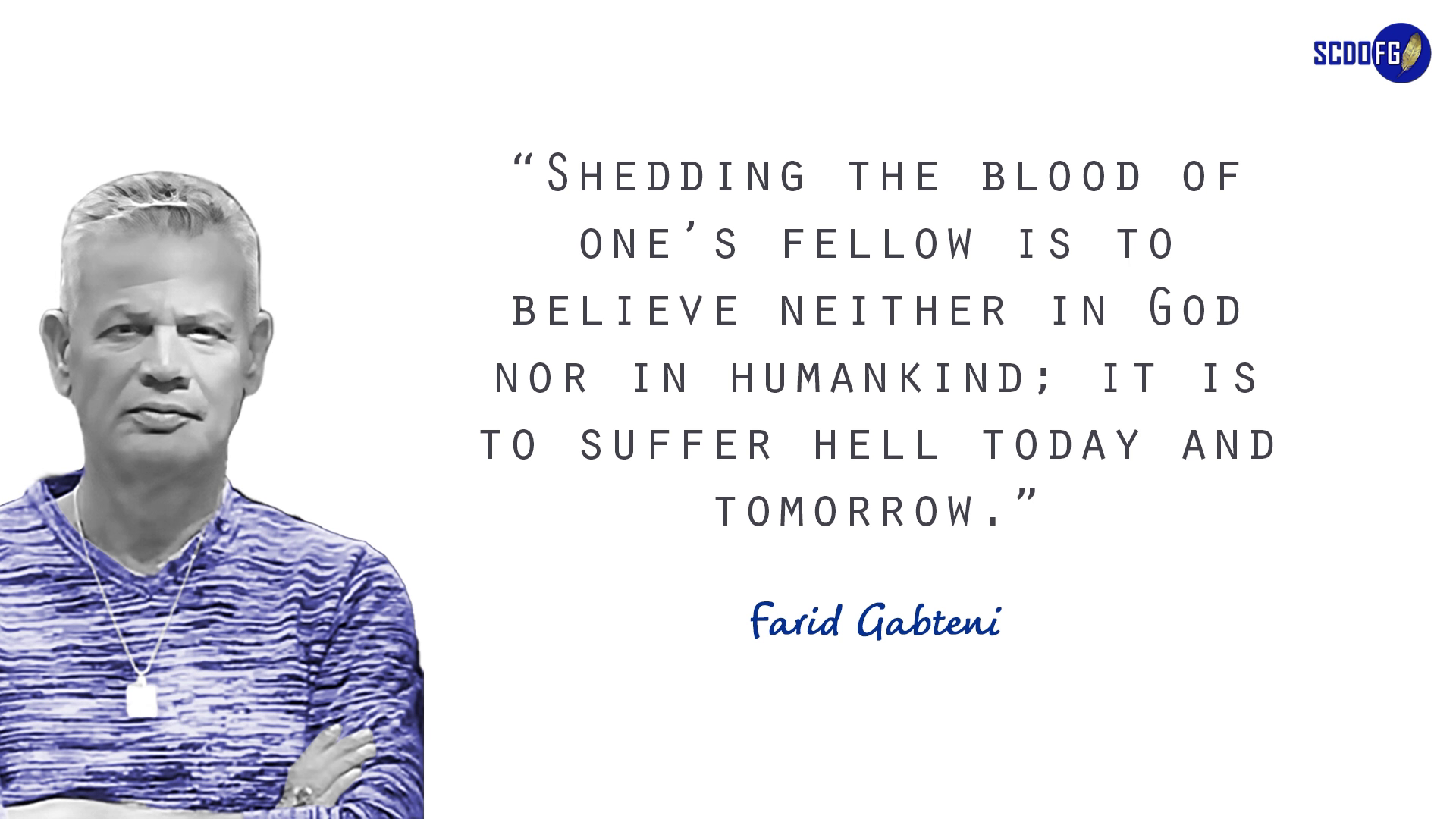
» Shedding the blood of one’s fellow is to believe neither in God nor in humankind; it is to suffer hell today and tomorrow. » — Farid Abbes Raja Gabteni
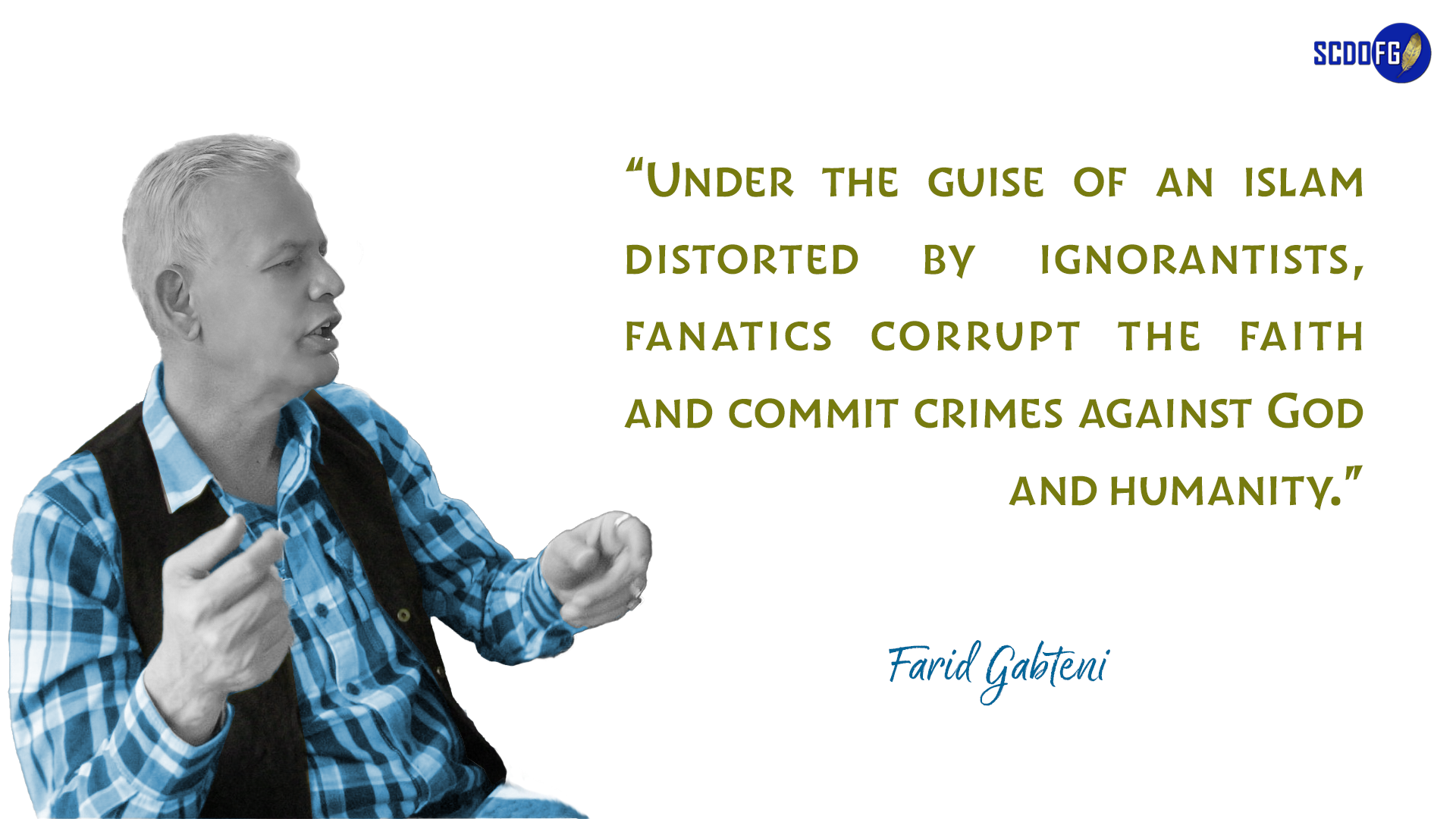
“Under the guise of an islam distorted by ignorantists, fanatics corrupt the faith and commit crimes against God and humanity.” — Farid Abbes Raja Gabteni
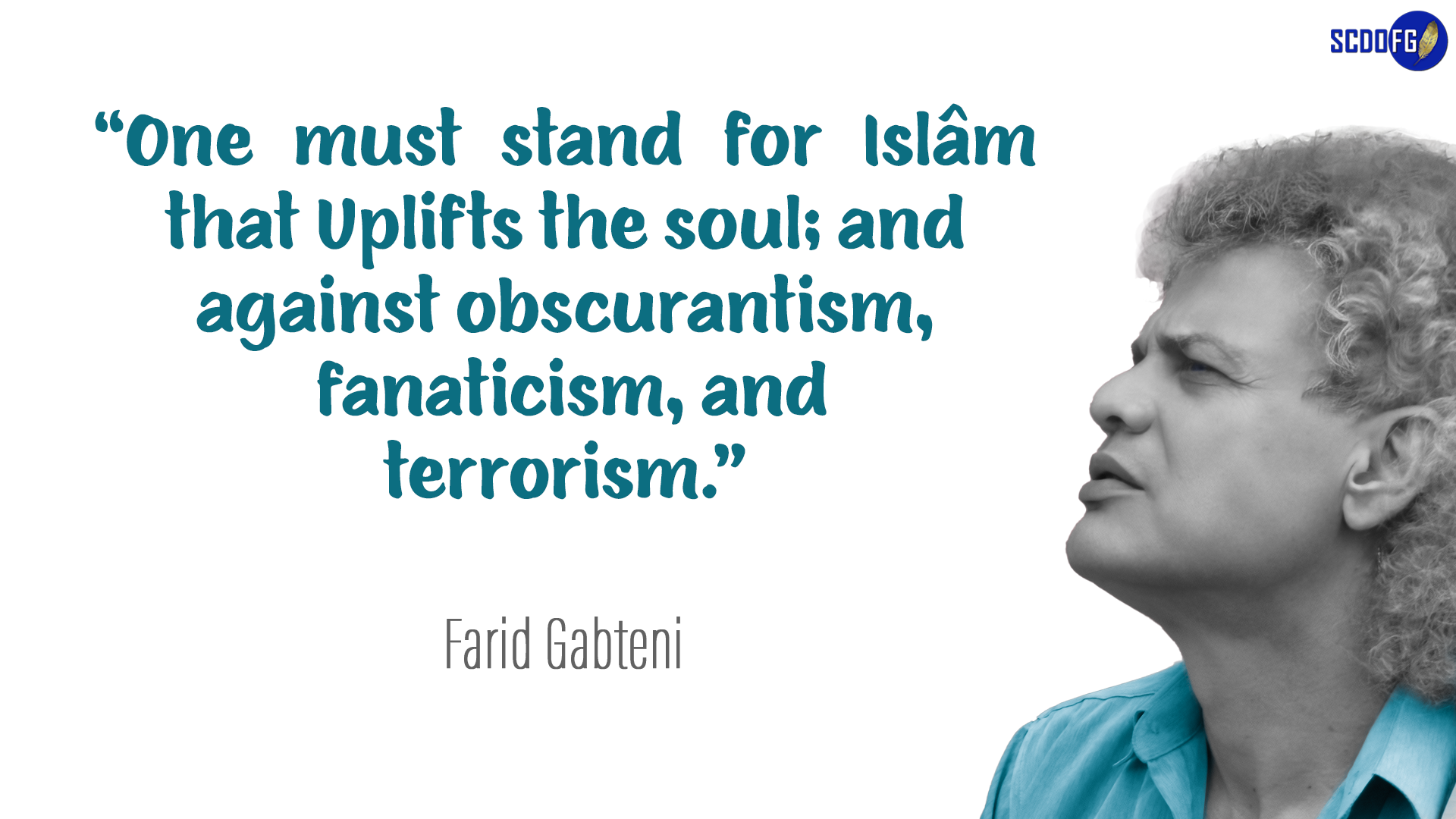
“One must stand for Islâm that Uplifts the soul; and against obscurantism, fanaticism, and terrorism.” — Farid Abbes Raja Gabteni
« Bumptious people are loud; that notwithstanding, when you expound a subject scientifically, expertly and with mastery, they are then disconcerted and have no reply but the exposure of their own insufficiency. » — Farid Abbes Raja Gabteni
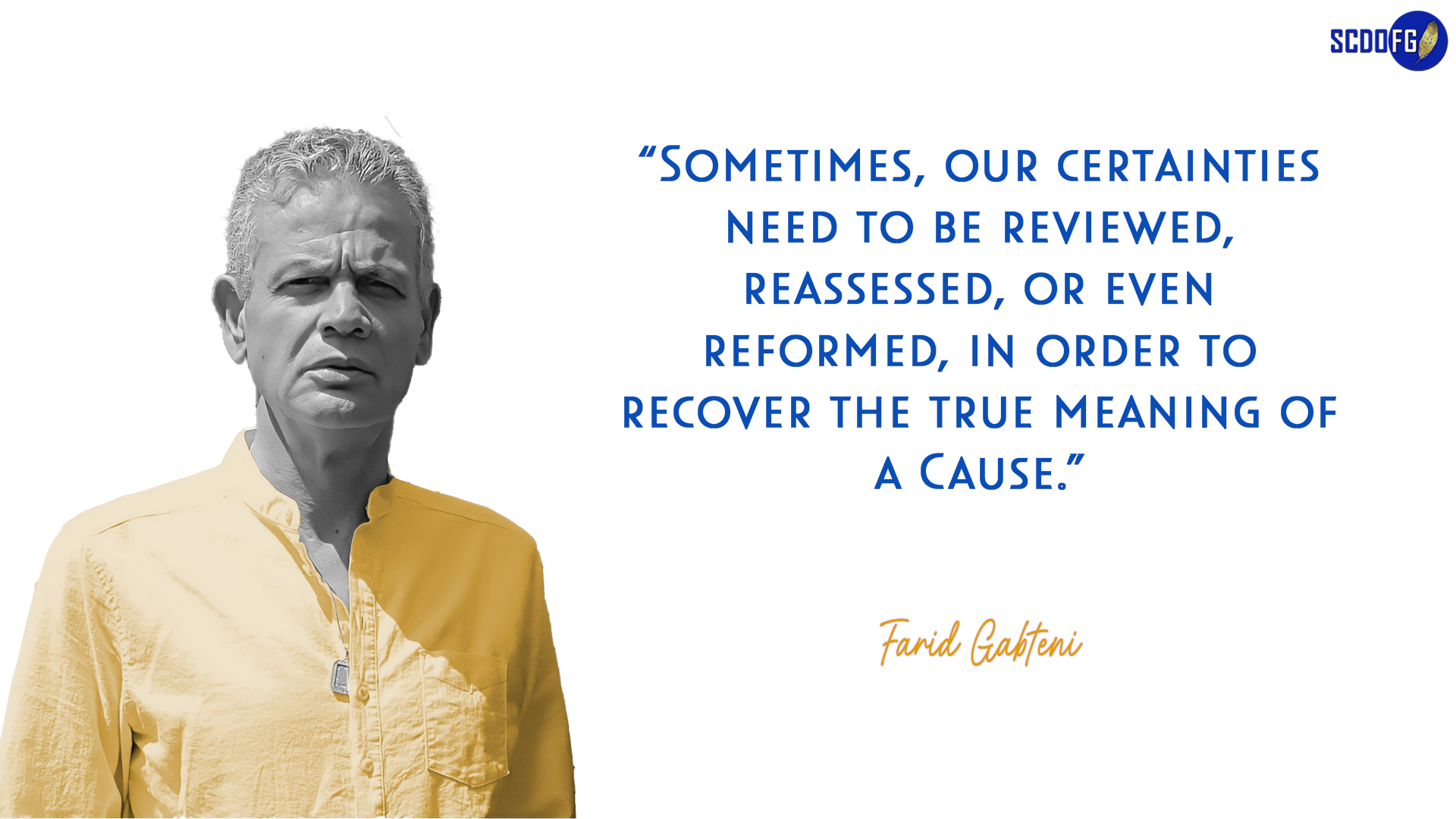
« Sometimes, our certainties need to be reviewed, reassessed, or even reformed, in order to recover the true meaning of a Cause. » — Farid Abbes Raja Gabteni
« The Qurân mentions the law of retaliation in relation to earlier peoples, then organized into primitive societies; that being said, it gives precedence to the narrative—the faculty of narrating and acting accordingly—among ‘those ranked first in quintessences’, those who grasp the essential. The level of knowledge attained in our modern societies no longer allows us to act out of instinct and a spirit of vengeance, but rather through prevention and justice that are civilising. Qurân, Chapter 2, verse 179: « And for you a life in the narrative, O those ranked first in quintessences; perhaps you may protect yourselves! » » — Farid Abbes Raja Gabteni
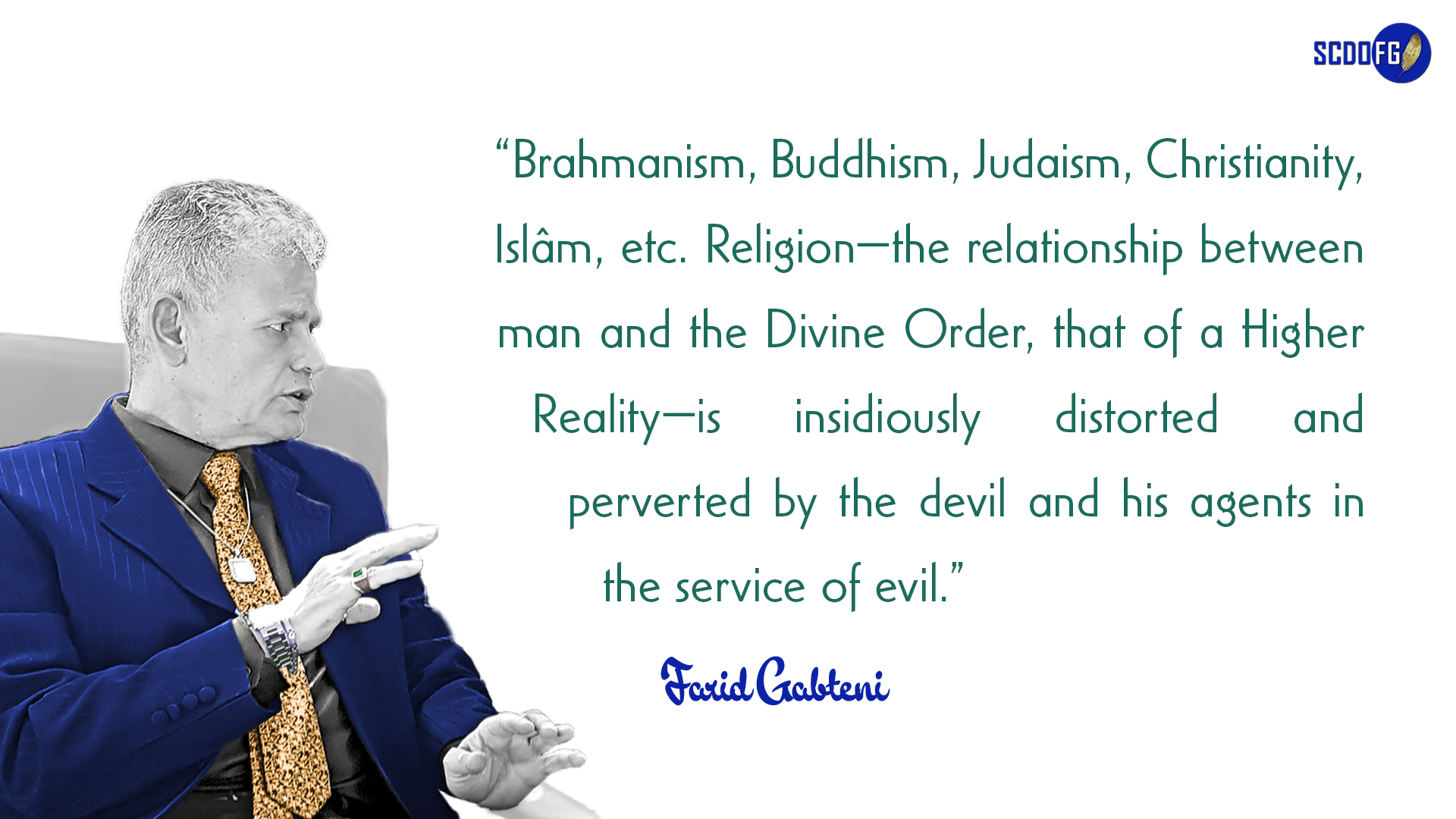
« Brahmanism, Buddhism, Judaism, Christianity, Islâm, etc. Religion—the relationship between man and the Divine Order, that of a Higher Reality—is insidiously distorted and perverted by the devil and his agents in the service of evil. » — Farid Abbes Raja Gabteni
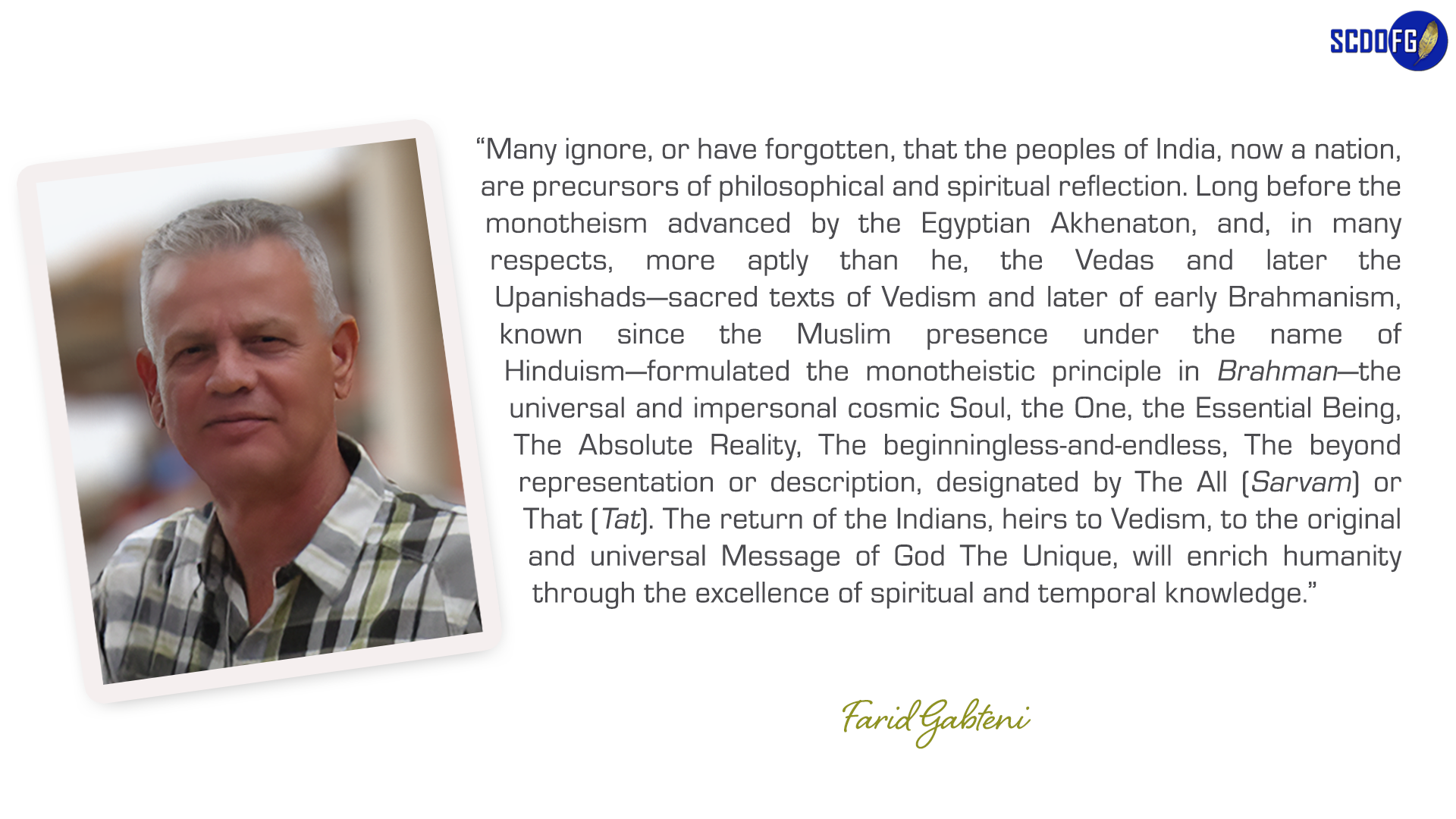
« Many ignore, or have forgotten, that the peoples of India, now a nation, are precursors of philosophical and spiritual reflection. Long before the monotheism advanced by the Egyptian Akhenaton, and, in many respects, more aptly than he, the Vedas and later the Upanishads—sacred texts of Vedism and later of early Brahmanism, known since the Muslim presence under the name of Hinduism—formulated the monotheistic principle in Brahman—the universal and impersonal cosmic Soul, the One, the Essential Being, The Absolute Reality, The beginningless-and-endless, The beyond representation or description, designated by The All (Sarvam) or That (Tat). The return of the Indians, heirs to Vedism, to the original and universal Message of God The Unique, will enrich humanity through the excellence of spiritual and temporal knowledge. » — Farid Abbes Raja Gabteni
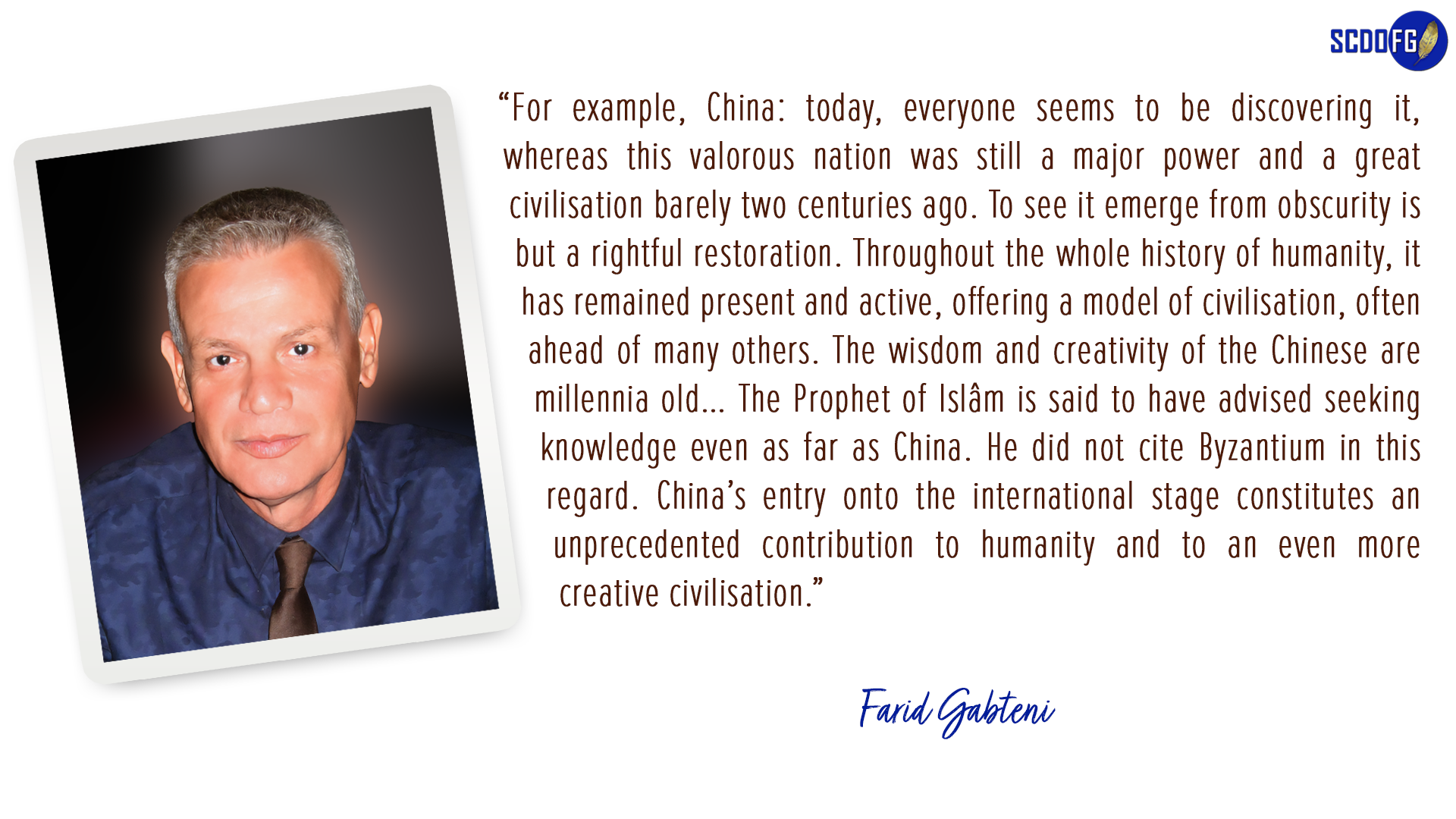
« For example, China: today, everyone seems to be discovering it, whereas this valorous nation was still a major power and a great civilisation barely two centuries ago. To see it emerge from obscurity is but a rightful restoration. Throughout the whole history of humanity, it has remained present and active, offering a model of civilisation, often ahead of many others. The wisdom and creativity of the Chinese are millennia old… The Prophet of Islâm is said to have advised seeking knowledge even as far as China. He did not cite Byzantium in this regard. China’s entry onto the international stage constitutes an unprecedented contribution to humanity and to an even more creative civilisation. » — Farid Abbes Raja Gabteni
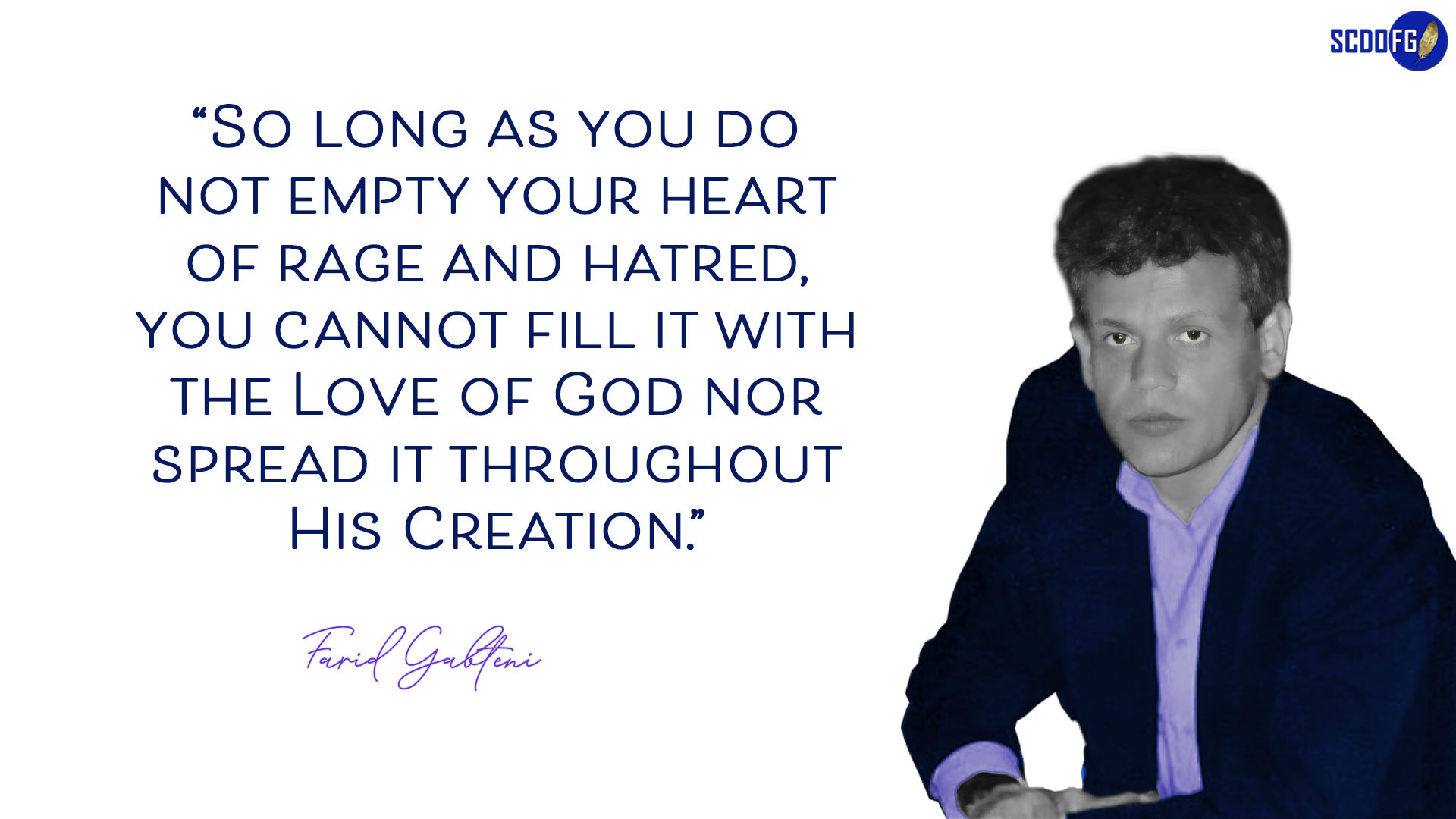
« So long as you do not empty your heart of rage and hatred, you cannot fill it with the Love of God nor spread it throughout His Creation. » — Farid Abbes Raja Gabteni
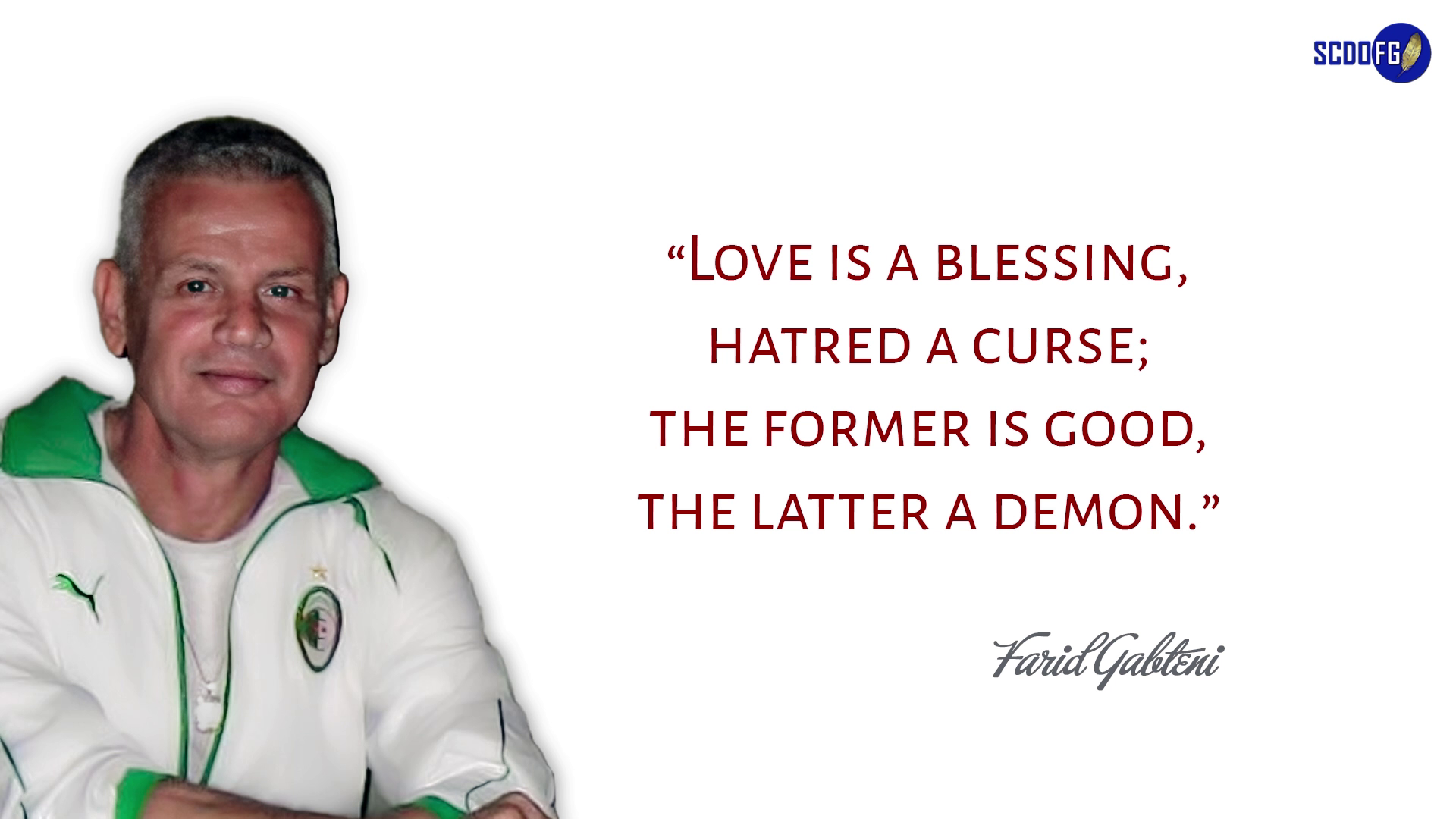
» Love is a blessing, hatred a curse; the former is good, the latter a demon. » — Farid Abbes Raja Gabteni
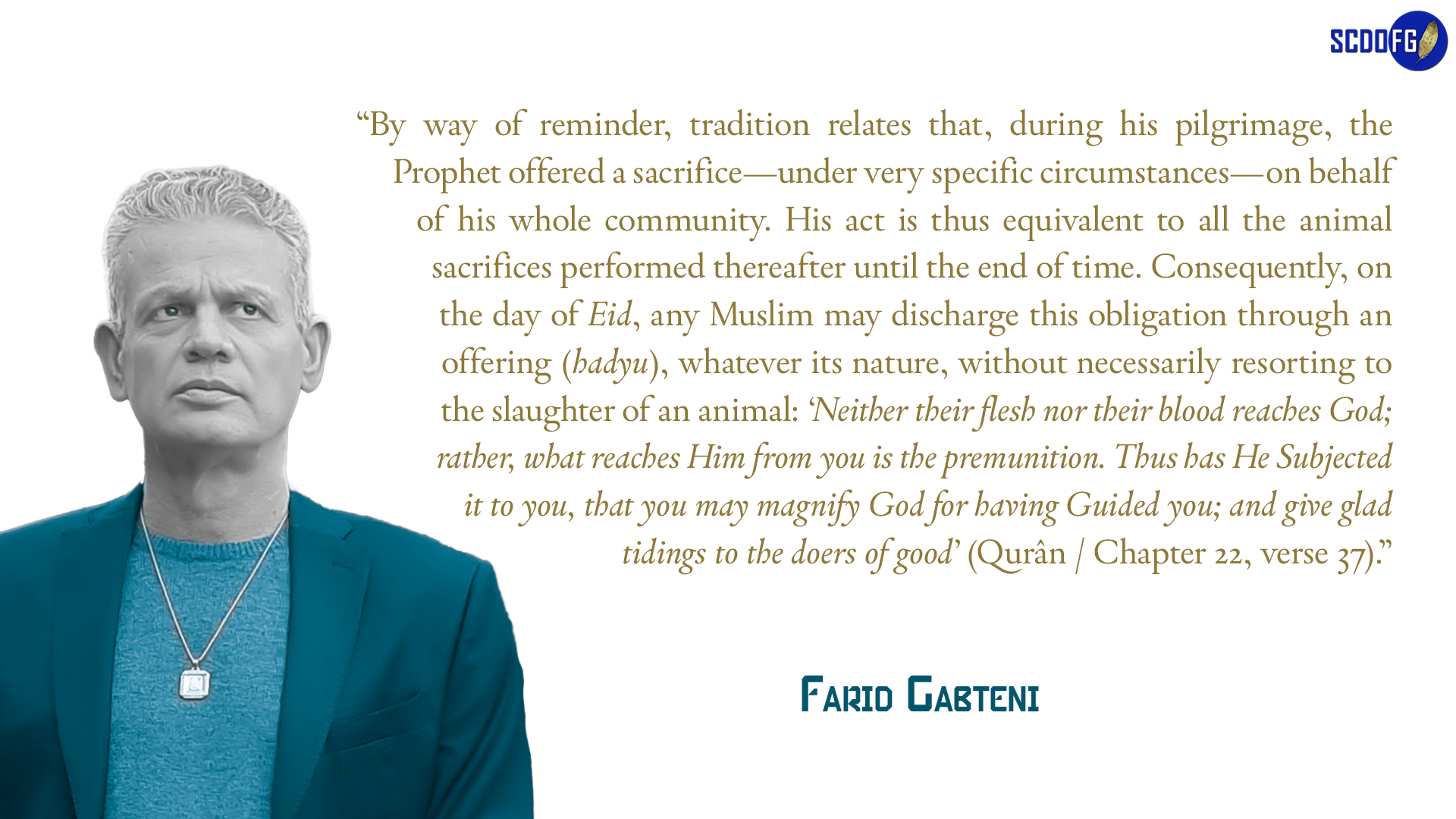
« By way of reminder, tradition relates that, during his pilgrimage, the Prophet offered a sacrifice—under very specific circumstances—on behalf of his whole community. His act is thus equivalent to all the animal sacrifices performed thereafter until the end of time. Consequently, on the day of Eid, any Muslim may discharge this obligation through an offering (hadyu), whatever its nature, without necessarily resorting to the slaughter of an animal: ‘Neither their flesh nor their blood reaches God; rather, what reaches Him from you is the premunition. Thus has He Subjected it to you, that you may magnify God for having Guided you; and give glad tidings to the doers of good’ (Qurân / Chapter 22, verse 37). » — Farid Abbes Raja Gabteni
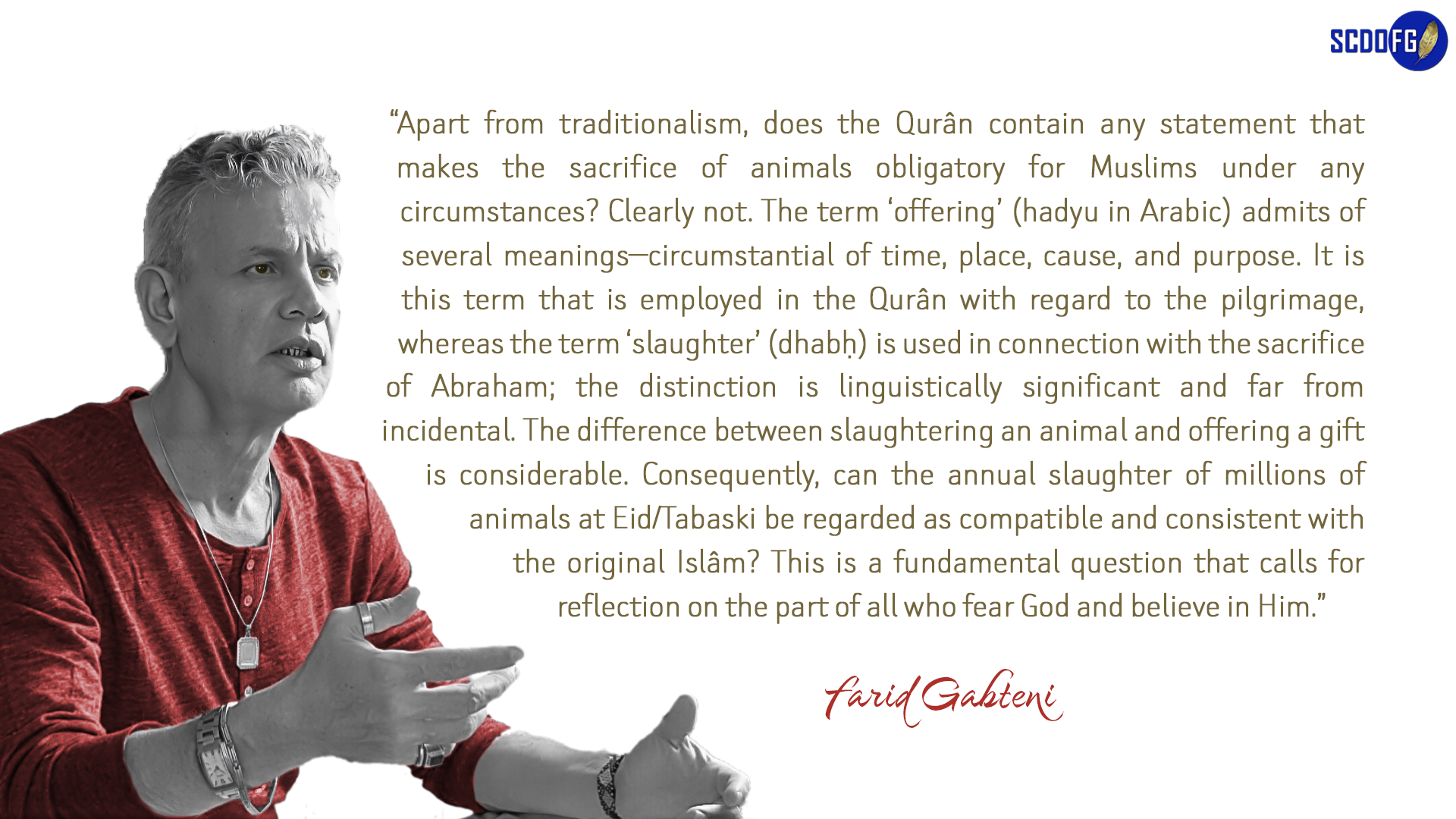
« Apart from traditionalism, does the Qurân contain any statement that makes the sacrifice of animals obligatory for Muslims under any circumstances? Clearly not. The term ‘offering’ (hadyu in Arabic) admits of several meanings—circumstantial of time, place, cause, and purpose. It is this term that is employed in the Qurân with regard to the pilgrimage, whereas the term ‘slaughter’ (dhabḥ) is used in connection with the sacrifice of Abraham; the distinction is linguistically significant and far from incidental. The difference between slaughtering an animal and offering a gift is considerable. Consequently, can the annual slaughter of millions of animals at Eid/Tabaski be regarded as compatible and consistent with the original Islâm? This is a fundamental question that calls for reflection on the part of all who fear God and believe in Him. » — Farid Abbes Raja Gabteni
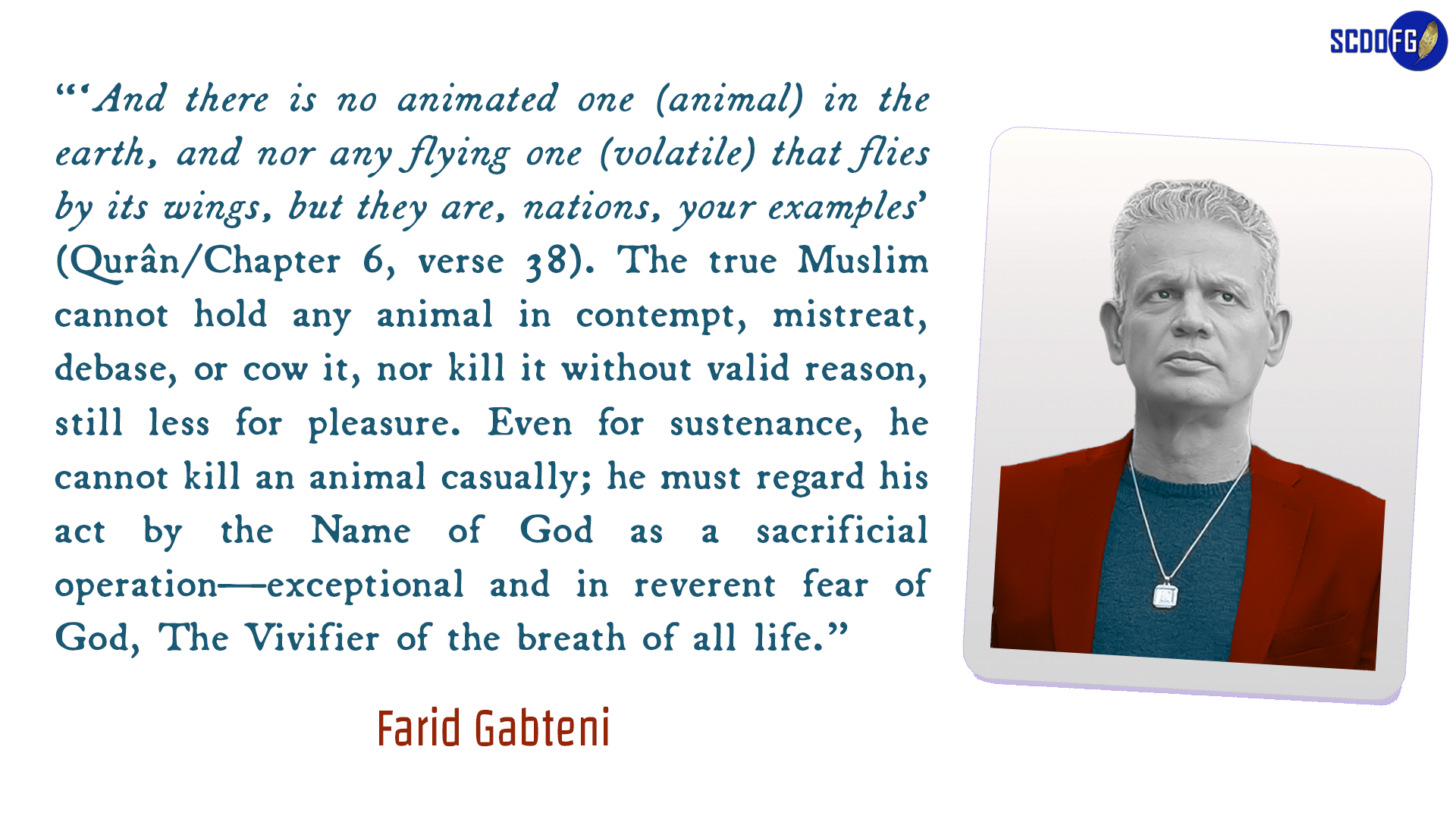
“‘And there is no animated one (animal) in the earth, and nor any flying one (volatile) that flies by its wings, but they are, nations, your examples’ (Qurân/Chapter 6, verse 38). The true Muslim cannot hold any animal in contempt, mistreat, debase, or cow it, nor kill it without valid reason, still less for pleasure. Even for sustenance, he cannot kill an animal casually; he must regard his act by the Name of God as a sacrificial operation—exceptional and in reverent fear of God, The Vivifier of the breath of all life.” — Farid Abbes Raja Gabteni
« ‘(…) and the garment of premunition—that is best, that is among the Signs of God, that they may remember’ (Qurân, chapter 7, verse 26). Covering one’s head, wearing a beard, the qamis or daffah, the boubou or the djellaba, the veil, the niqab, the burqa or the chador—all these derive from traditionalism and have nothing to do with the original Islâm as a religion. Quite the contrary, all these practices today harm the image of Islâm and of Muslims, predominantly in non-Muslim countries; they are synonymous with obscurantism, sectarianism, provocation, and aggression. For the Muslim— learned, responsible and aware of the true Islâm—it is intolerable to see it thus distorted and reduced to such ostentatious displays. The Islâm of enlightenment, which gave rise to the emergence of modern science, is travestied by ideological traditionalism into a ritualistic, past-oriented, and retrograde religion. Muslims must awaken to the original Islâm—the Islâm of science and progress—and also safeguard both themselves and their religion from any harmful preconception. » — Farid Abbes Raja Gabteni
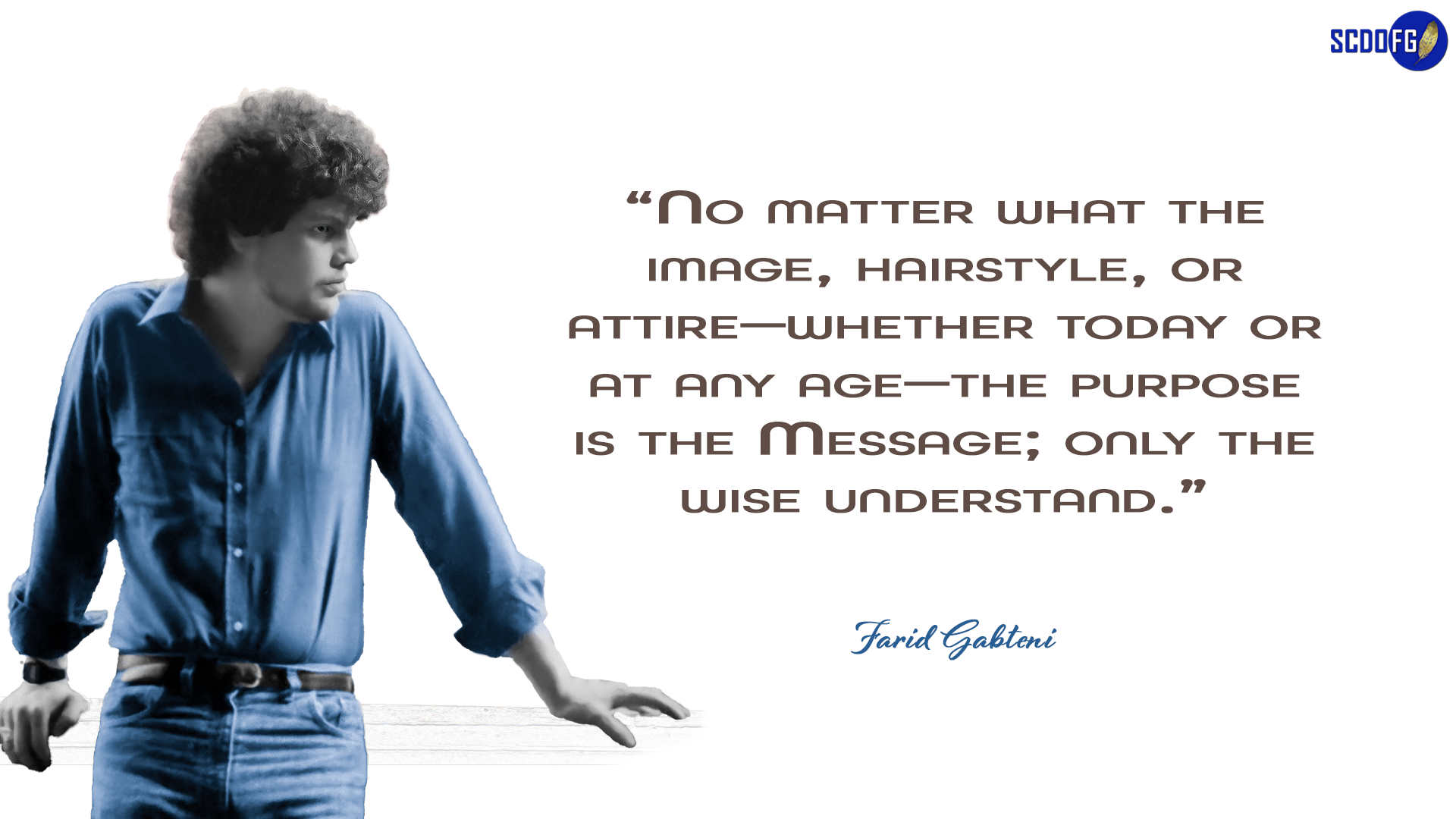
« No matter what the image, hairstyle, or attire—whether today or at any age—the purpose is the Message; only the wise understand » — Farid Abbes Raja Gabteni
« The only one entitled to announce my death to you is myself; so long as you hear of what I have said or written, know that I am alive. » — Farid Abbes Raja Gabteni
« The Muslim is the one who has a commitment with God, to believe in Him, to worship Him through Islâm—which elevates the soul, in all purity—to act with goodness, to practice beneficence, to commend what is proper and censure what is reprehensible, to call men to God, to humanism, to reform, and to equity. He has a benefit in this world and the best with God. Truly, the best provision is piety. He who rises with God, who drinks and who eats with God, who works and who rests with God, who sleeps and who dreams with God, who thinks, who speaks, and who acts with God, who is poor and who is rich with God, who is healthy and who is sick with God, who is young and who is old with God, who lives and who dies—with God upon his lips and in his heart—that one has this world and the hereafter; that one rises, drinks and eats, works and rests, sleeps and dreams, thinks, speaks and acts, lives and dies at peace: at peace with himself, with men, beings and things; and thus, at peace with God, The Supremely-Good. Such are the righteous. » — Farid Abbes Raja Gabteni
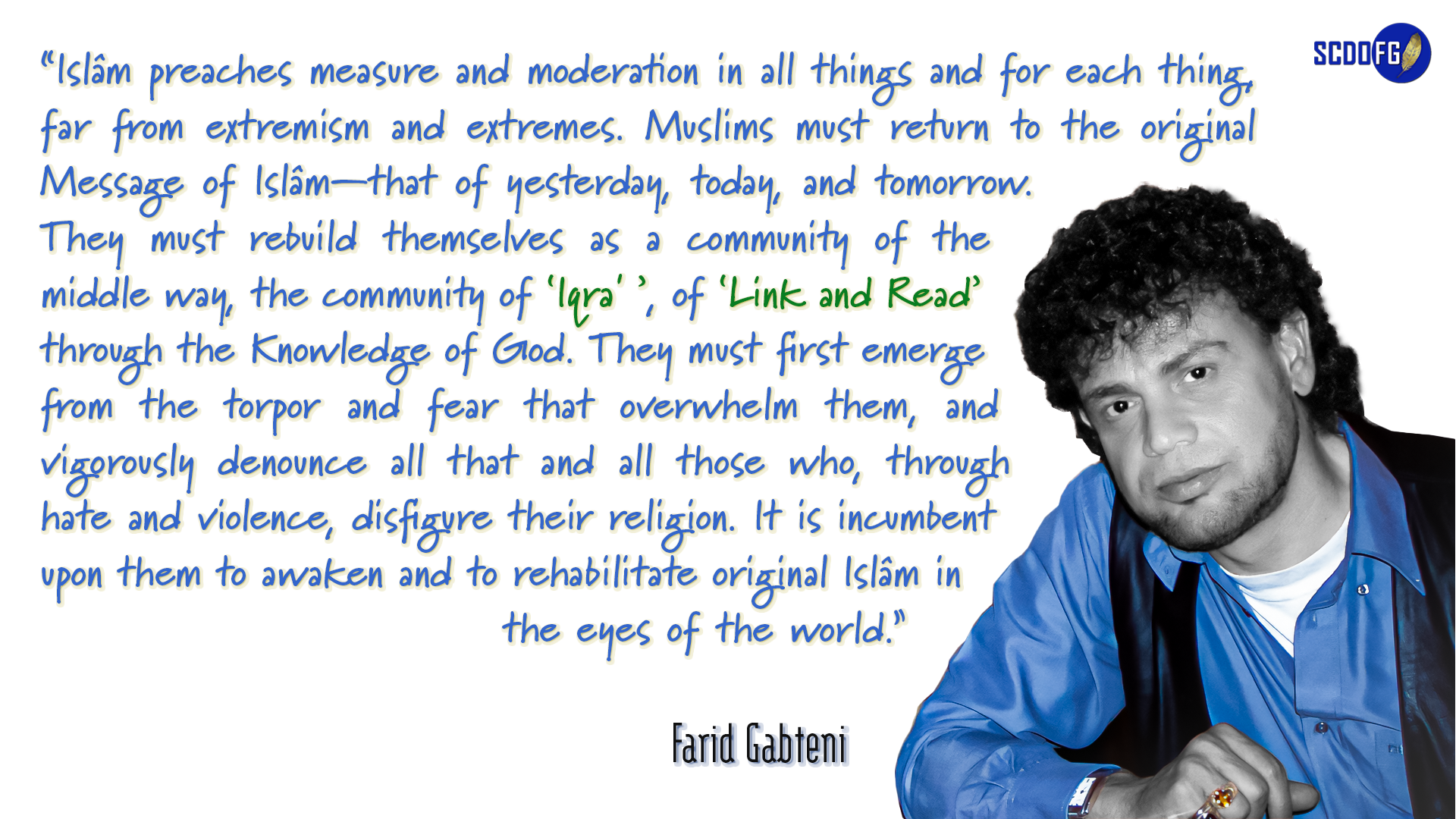
“Islâm preaches measure and moderation in all things and for each thing, far from extremism and extremes. Muslims must return to the original Message of Islâm—that of yesterday, today, and tomorrow. They must rebuild themselves as a community of the middle way, the community of ‘Iqra’ ’, of ‘Link and Read’ through the Knowledge of God. They must first emerge from the torpor and fear that overwhelm them, and vigorously denounce all that and all those who, through hate and violence, disfigure their religion. It is incumbent upon them to awaken and to rehabilitate original Islâm in the eyes of the world.” Farid Gabteni
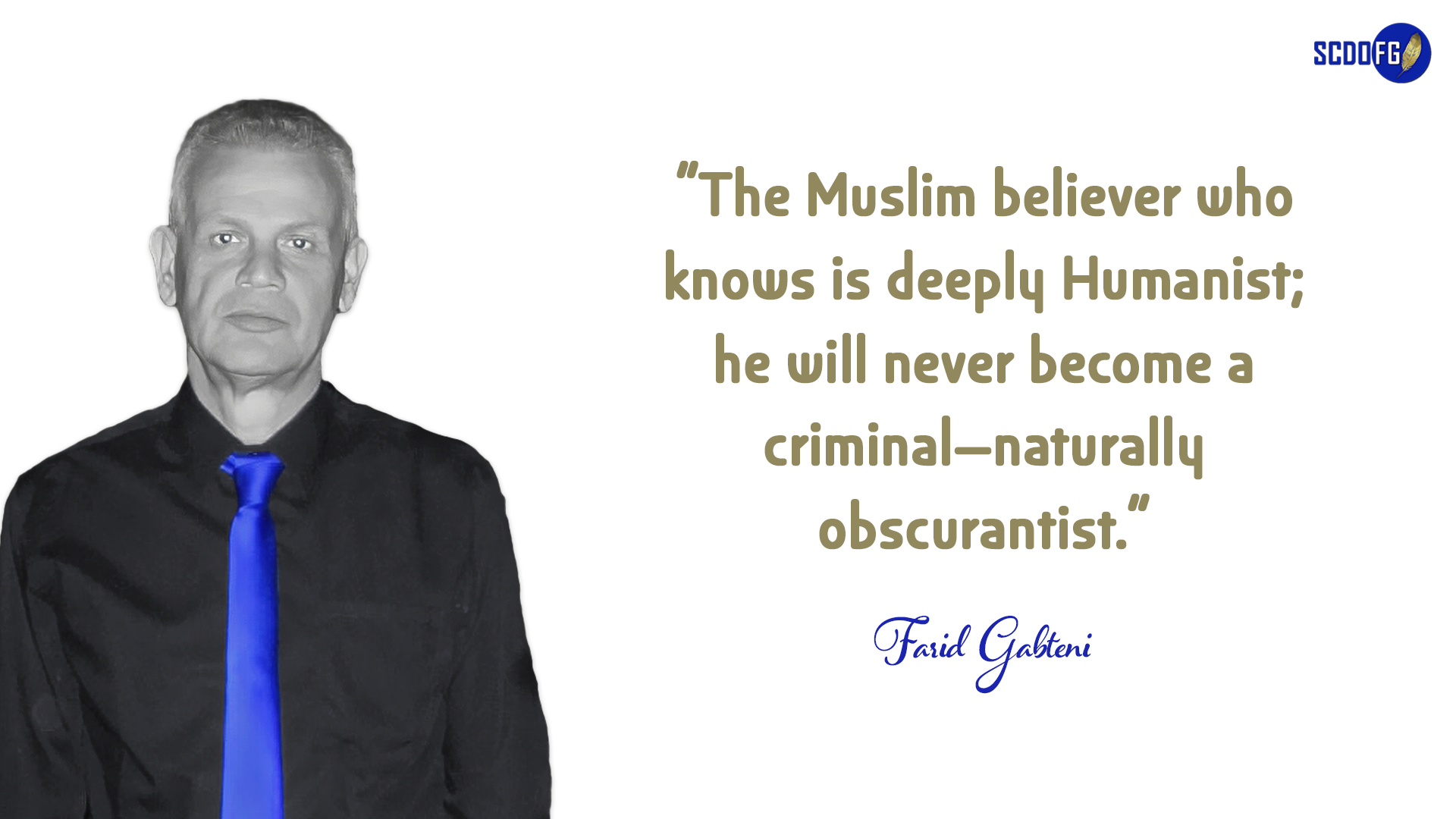
“The Muslim believer who knows is deeply Humanist; he will never become a criminal—naturally obscurantist.” — Farid Abbes Raja Gabteni
“When you’ve seen a being – reduced, subjected and debased – and you could do nothing for them, tell yourself today that you can surely do something for others like them. Blessed is he who says, acts and fulfills.” — Farid Abbes Raja Gabteni
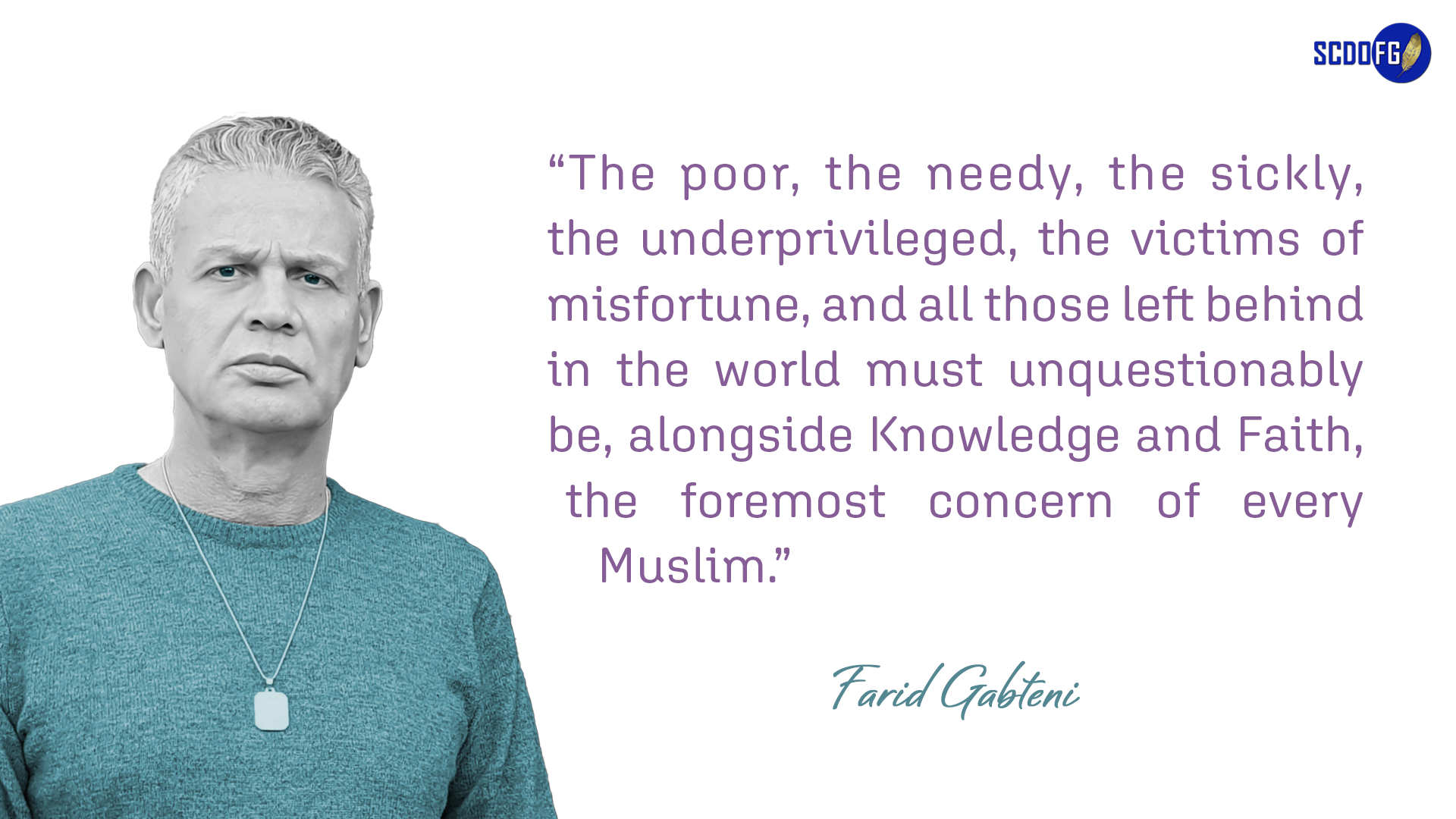
« The poor, the needy, the sickly, the underprivileged, the victims of misfortune, and all those left behind in the world must unquestionably be, alongside Knowledge and Faith, the foremost concern of every Muslim. » — Farid Abbes Raja Gabteni
» Know how to love your fellow men, be kind to your neighbours, feed the hungry, take in orphans; that is what is good, what is right and is not vain. » — Farid Abbes Raja Gabteni
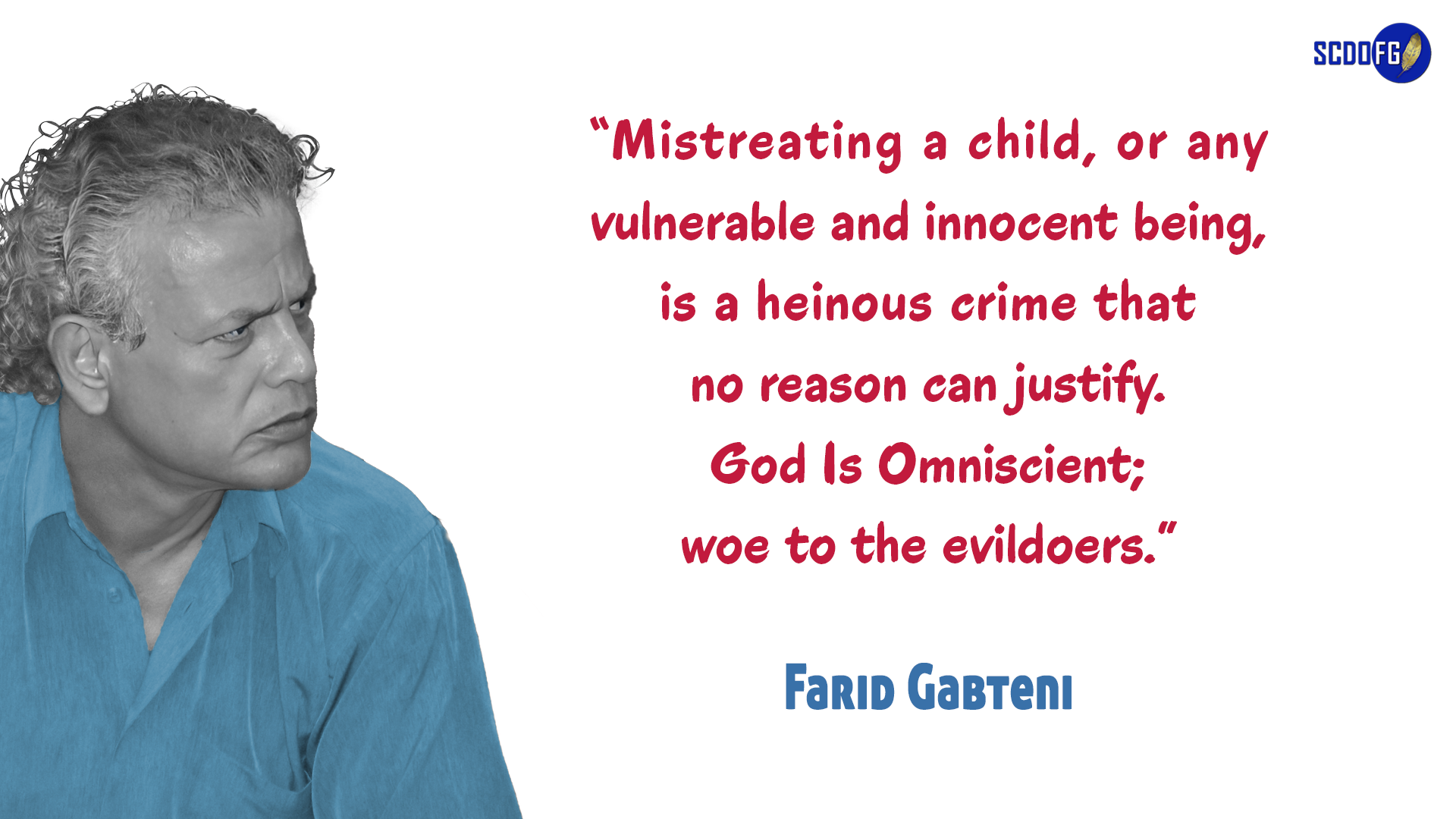
« Mistreating a child, or any vulnerable and innocent being, is a heinous crime that no reason can justify. God Is Omniscient; woe to the evildoers. » — Farid Abbes Raja Gabteni
« Think of those who suffer and die, here and elsewhere. Have a heart and be fighters, rescue those in distress and soothe those who are afraid; no one grows accustomed to pain. » — Farid Abbes Raja Gabteni
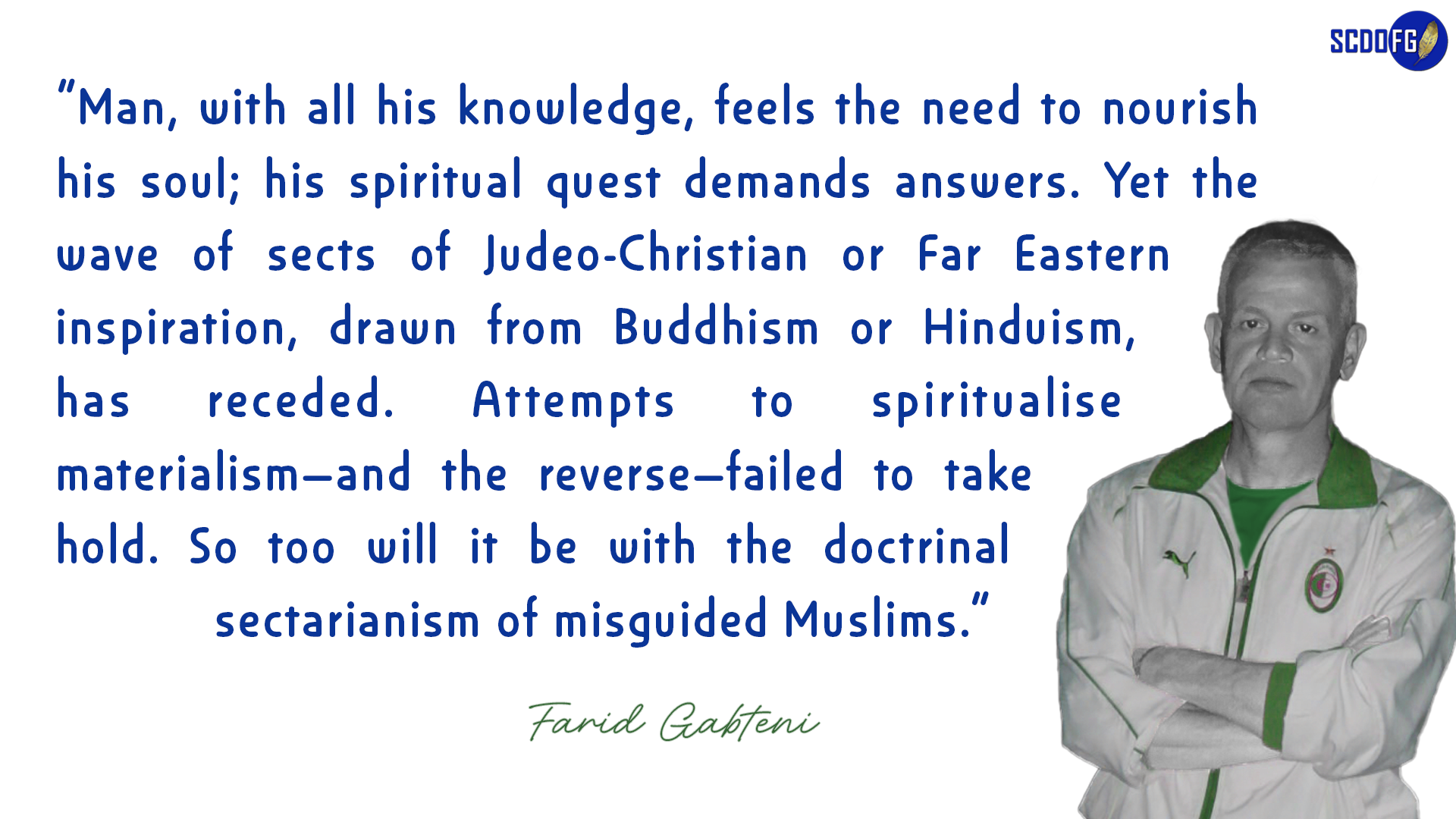
“Man, with all his knowledge, feels the need to nourish his soul; his spiritual quest demands answers. Yet the wave of sects of Judeo-Christian or Far Eastern inspiration, drawn from Buddhism or Hinduism, has receded. Attempts to spiritualise materialism—and the reverse—failed to take hold. So too will it be with the doctrinal sectarianism of misguided Muslims.” Farid Gabteni
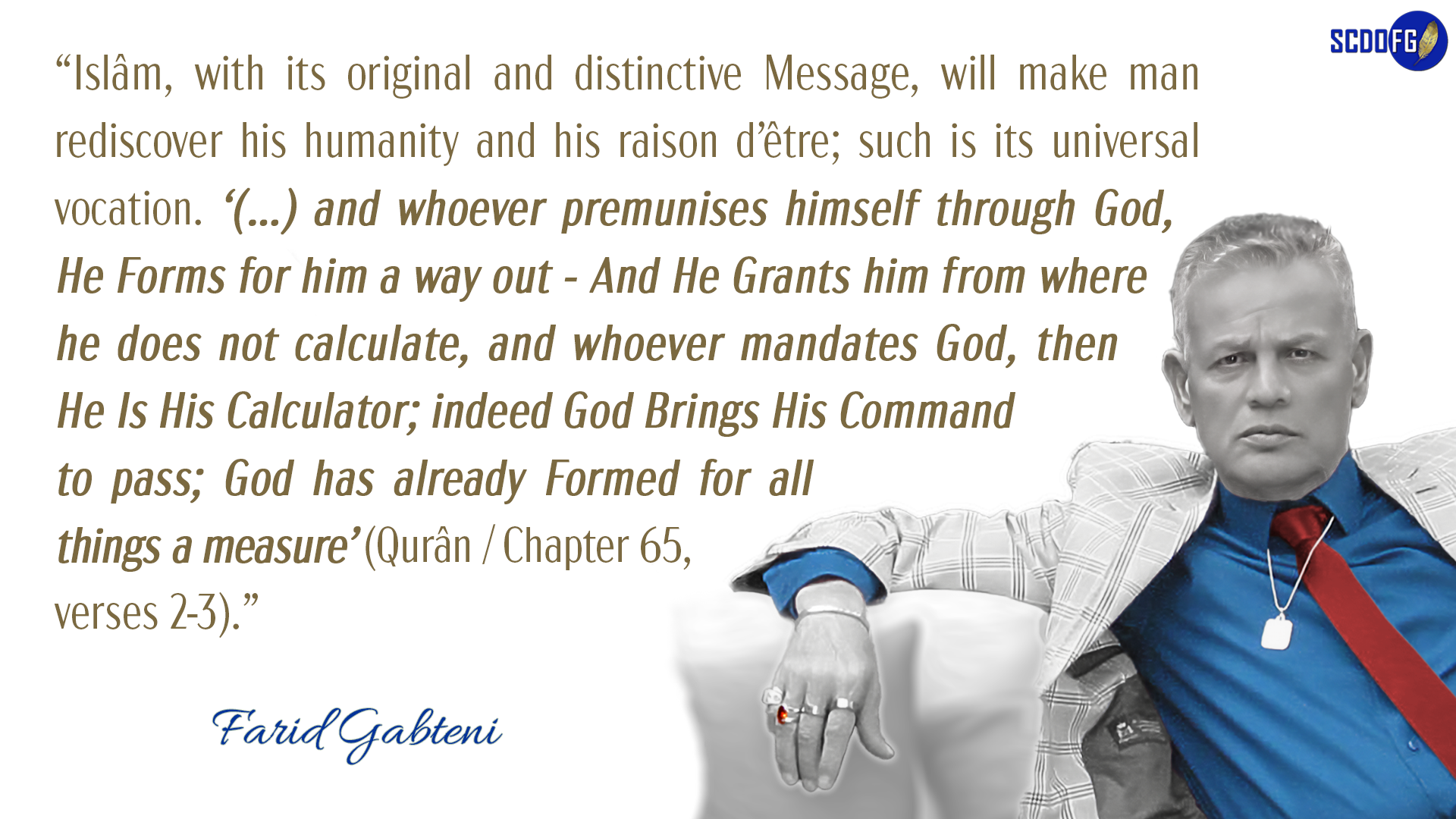
“Islâm, with its original and distinctive Message, will make man rediscover his humanity and his raison d’être; such is its universal vocation. ‘(…) and whoever premunises himself through God, He Forms for him a way out – And He Grants him from where he does not calculate, and whoever mandates God, then He Is His Calculator; indeed God Brings His Command to pass; God has already Formed for all things a measure’ (Qurân/Chapter 65, verses 2-3).” Farid Gabteni
“ In Arabic, the words ‘injustice’ and ‘obscurity’ (ẓulm, ẓulmah, ظﻠم ظﻠﻤﺔ) have the same root (Ẓ-L-M, ظ ل م). An inherent logic in the Arabic language explains the link between injustice and obscurity: in obscurity we act without accuracy, operate blindly, move things incorrectly, deviate, stray and lead others astray; thus the one darkened is obscured, he appraises and acts unjustly, he in turn becomes obscuring. Therefore, I translate the word ‘unjust’ as ‘obscurantist’.” Farid Gabteni
« Look and listen with your nose, for your eyes and ears often deceive you; your nose, for its part, smells what is bad or what is good » — Farid Abbes Raja Gabteni
« If you listen, you will hear; if you look, you will see; if you reflect, you will believe » — Farid Abbes Raja Gabteni
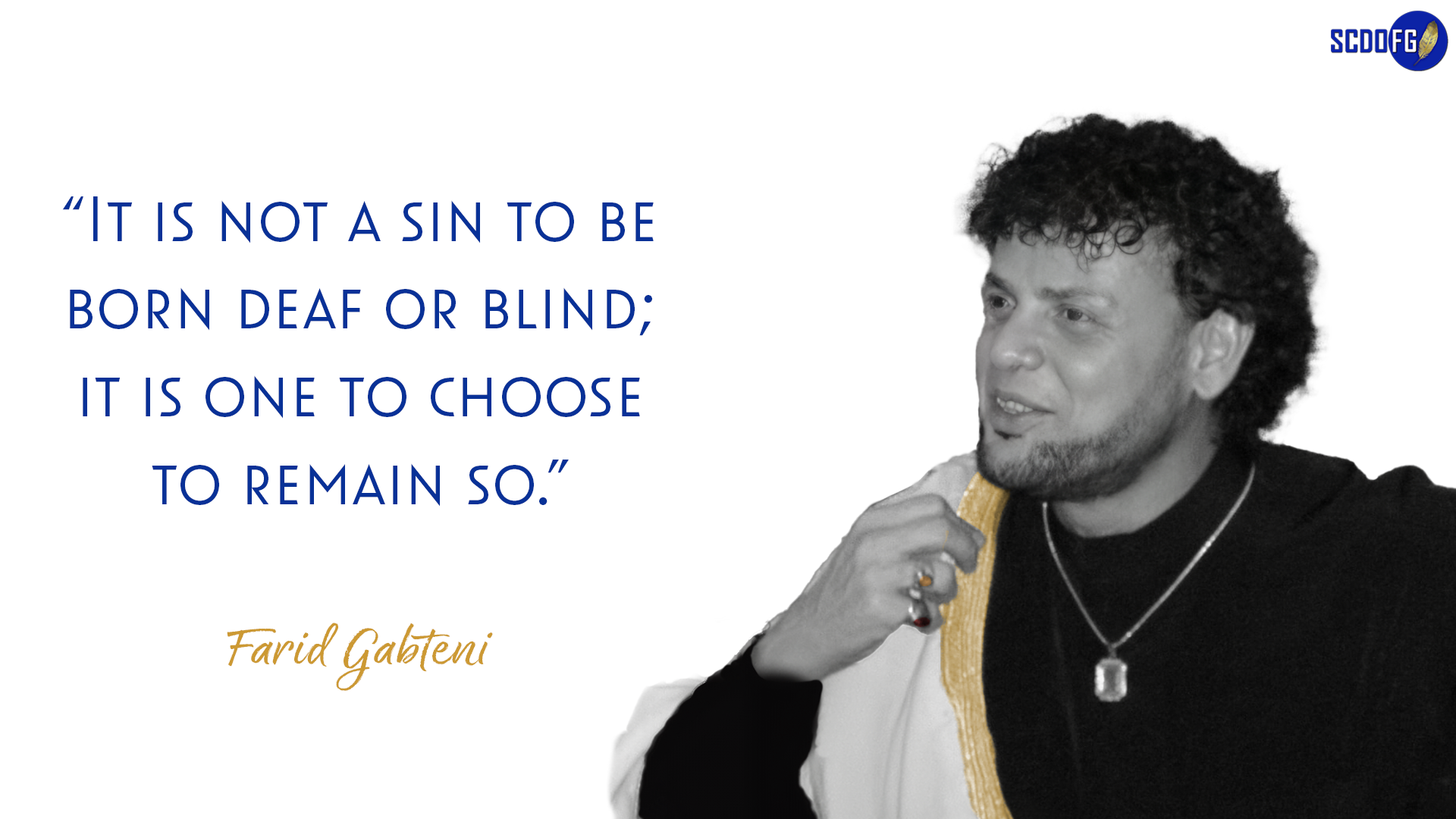
« It is not a sin to be born deaf or blind; it is one to choose to remain so » — Farid Abbes Raja Gabteni
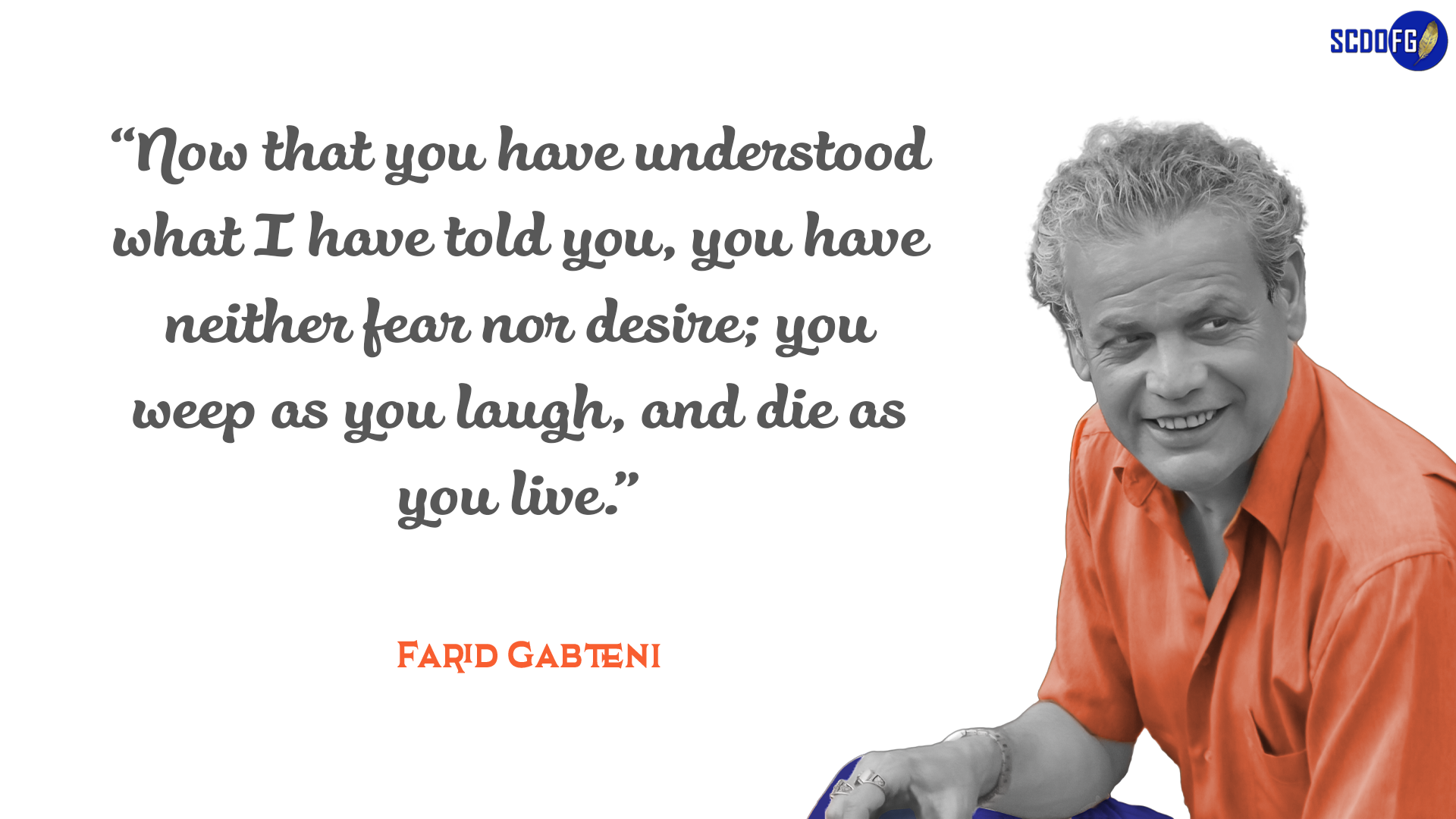
“Now that you have understood what I have told you, you have neither fear nor desire; you weep as you laugh, and die as you live.” — Farid Abbes Raja Gabteni
« We may say that we are in the era of the end times of ignorantism. Charlatans disguised as Muslims and Islamophobes think they can create chaos to achieve their goal of domination. But when these forces of darkness are overcome and annihilated, a new world/mode of science, rationality, justice, and sharing will emerge, in which Humanity will then experience the most beautiful era in its history. » — Farid Abbes Raja Gabteni
« He who sees only with his eyes possesses but little knowledge and knows of the world only its emptiness; indeed, how truly wretched he is. » — Farid Abbes Raja Gabteni
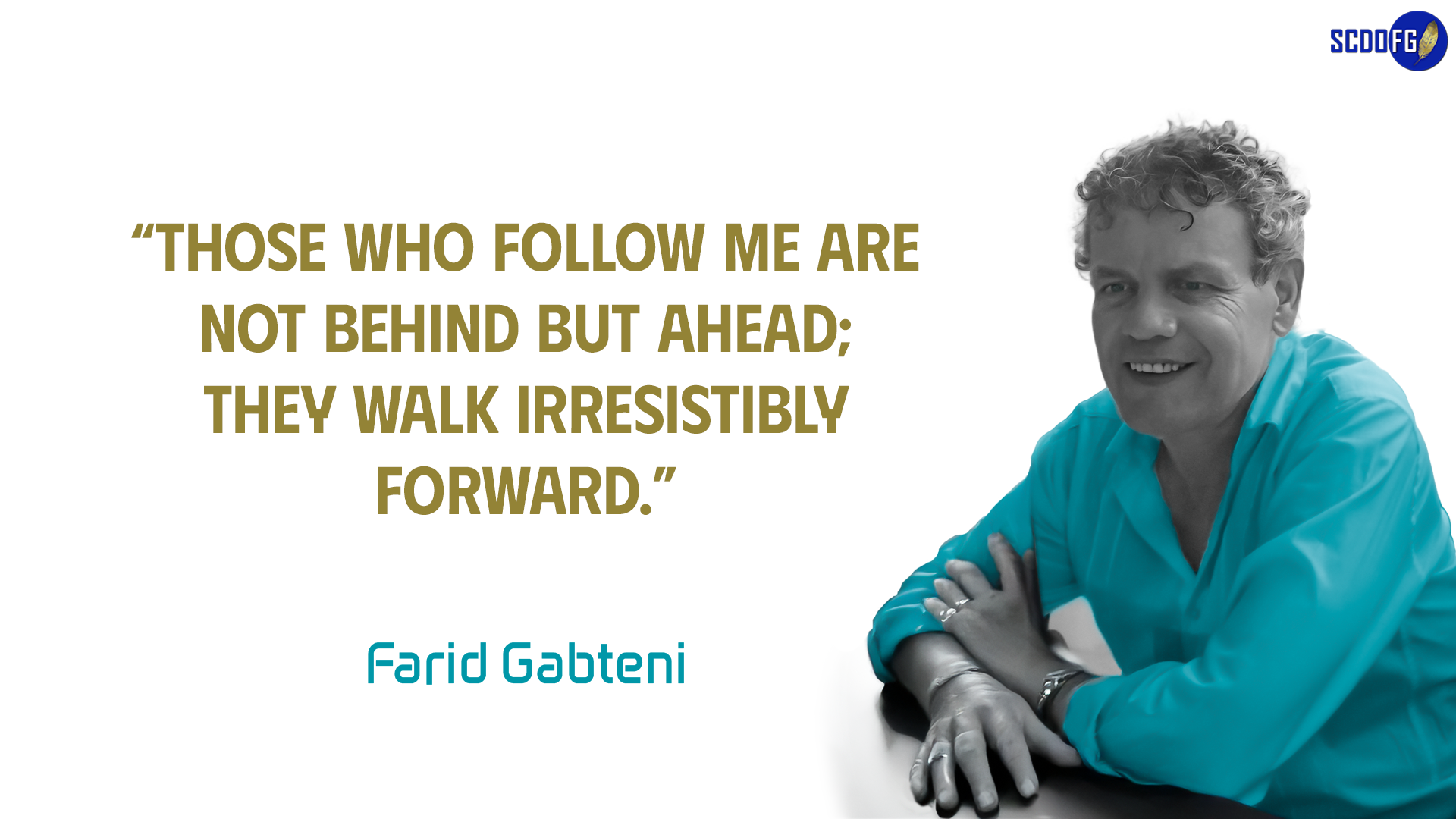
“Those who follow me are not behind but ahead; they walk irresistibly forward.” — Farid Abbes Raja Gabteni
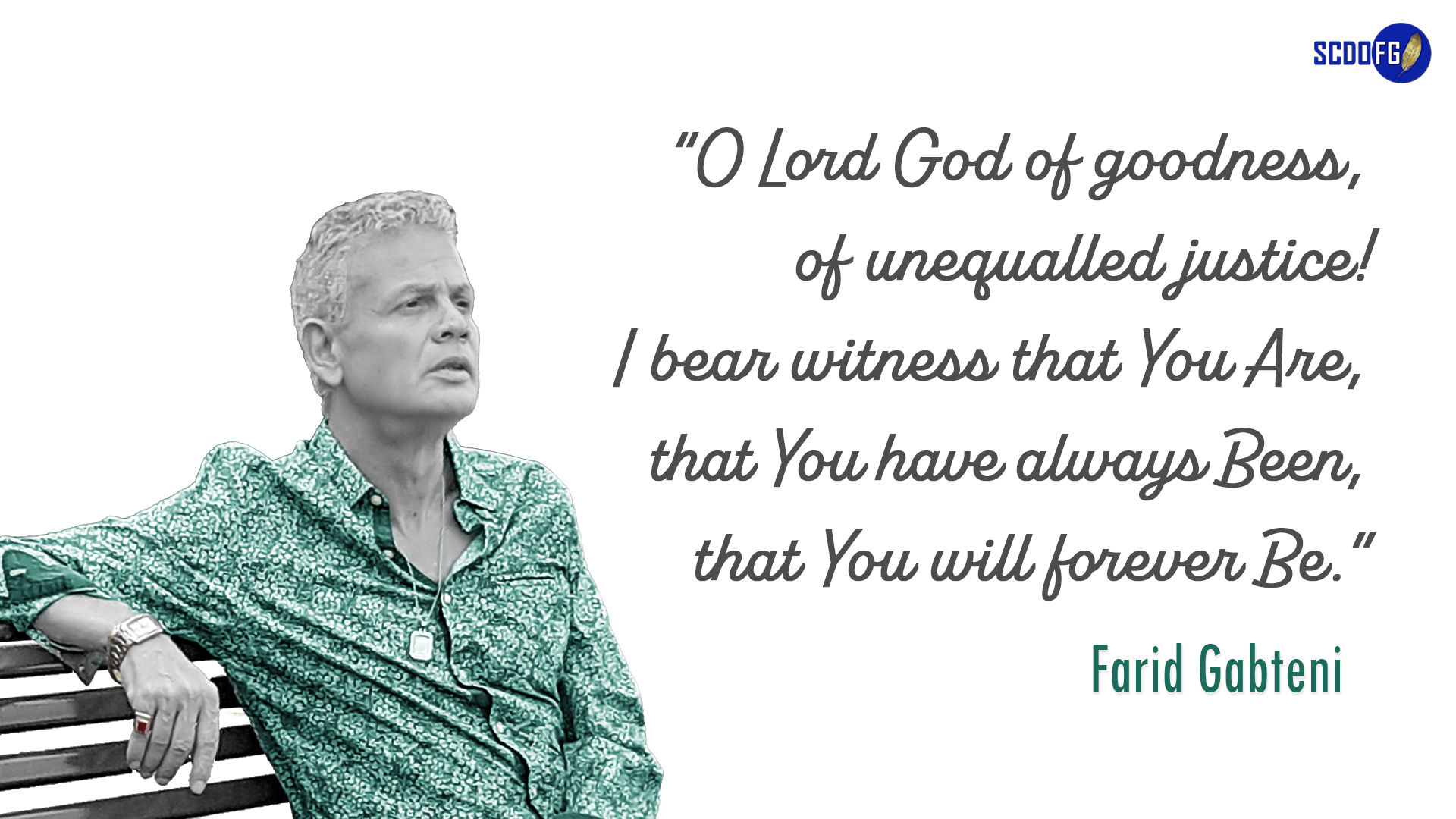
« O Lord God of goodness, of unequalled justice! I bear witness that You Are, that You have always Been, that You will forever Be. » — Farid Abbes Raja Gabteni
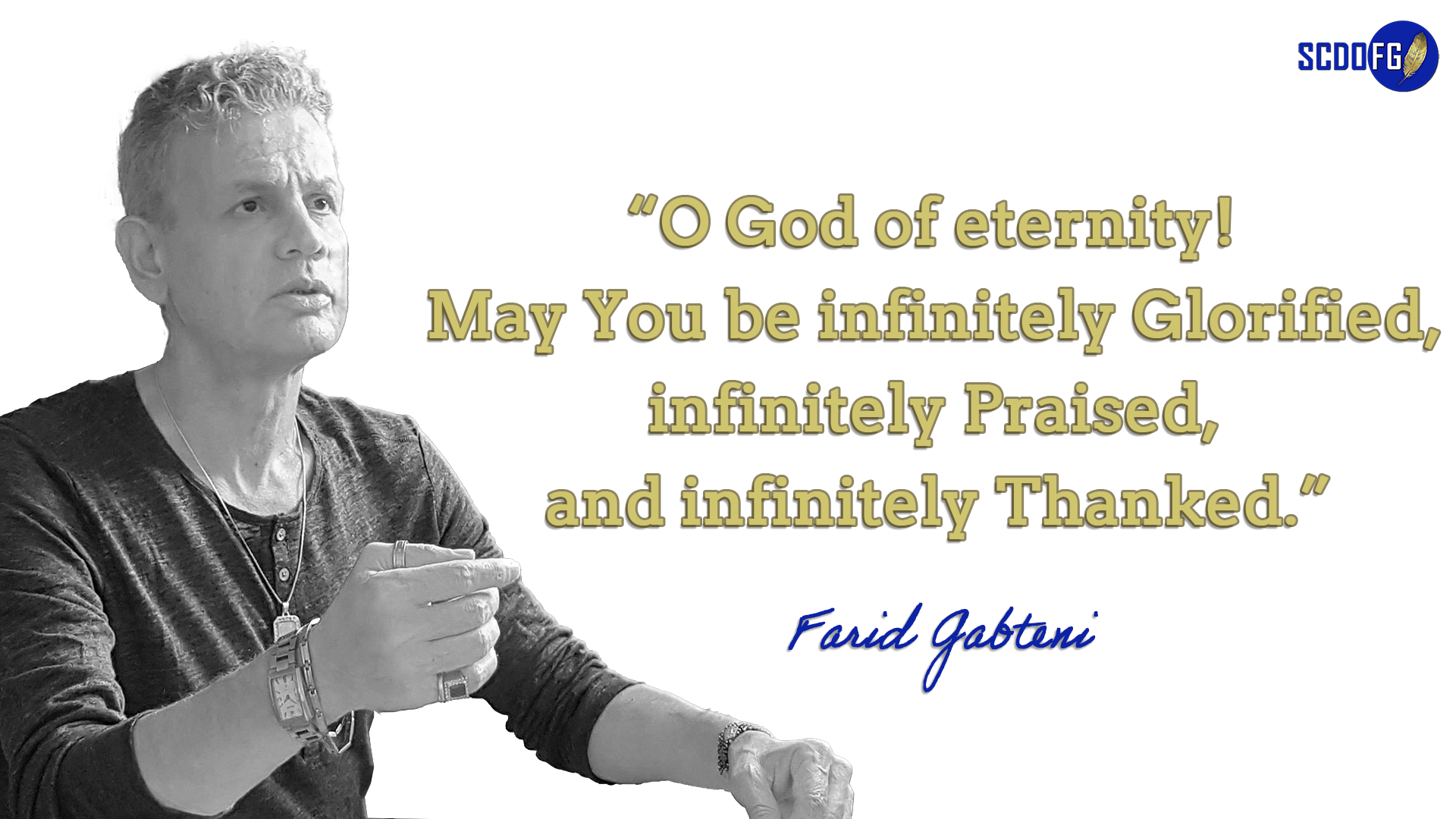
« O God of eternity! May You be infinitely Glorified, infinitely Praised, and infinitely Thanked. » — Farid Abbes Raja Gabteni
» You have not received if you have not opened and you have not lived if you have not suffered. » — Farid Abbes Raja Gabteni
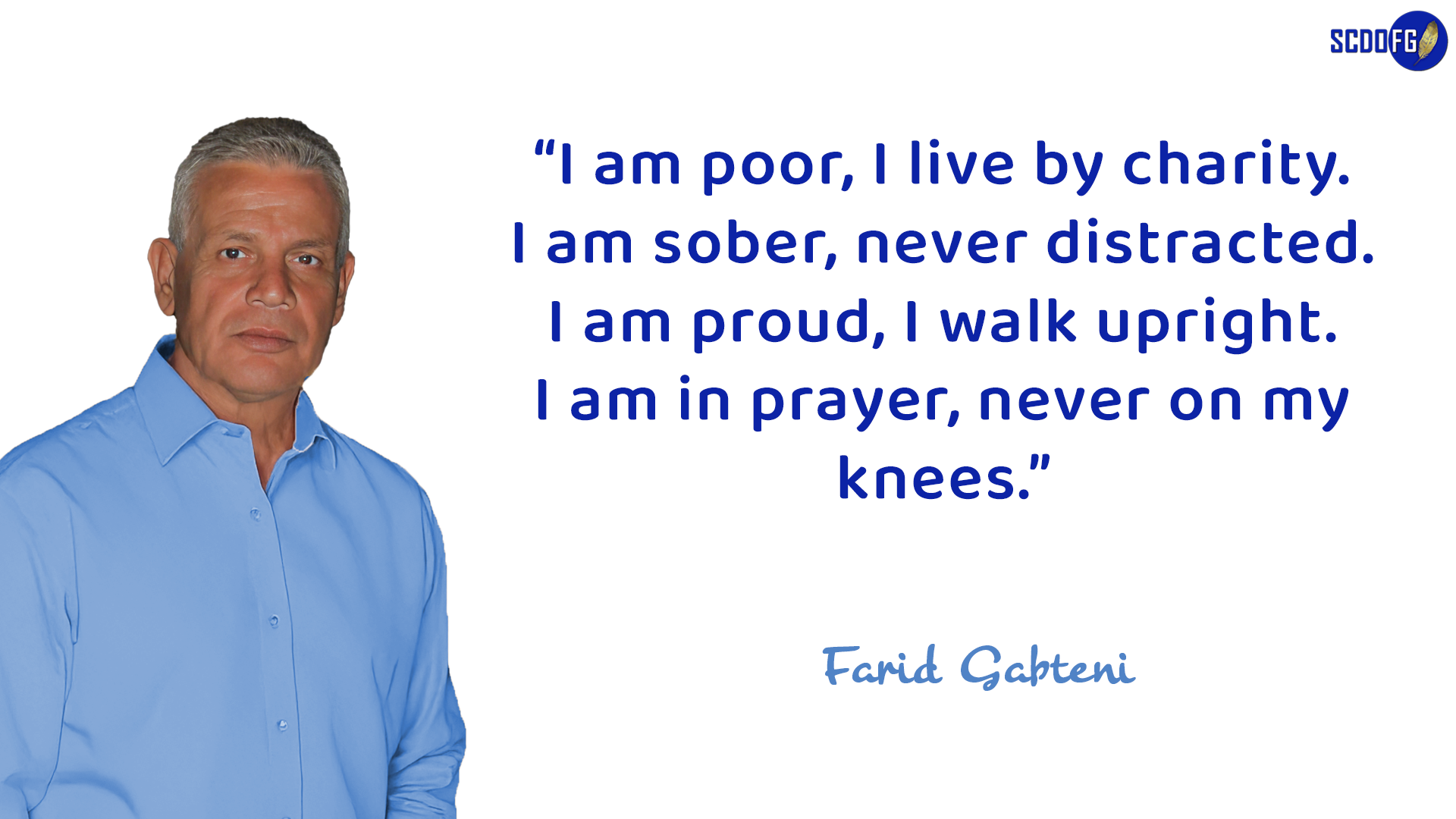
« I am poor, I live by charity. I am sober, never distracted. I am proud, I walk upright. I am in prayer, never on my knees » — Farid Abbes Raja Gabteni
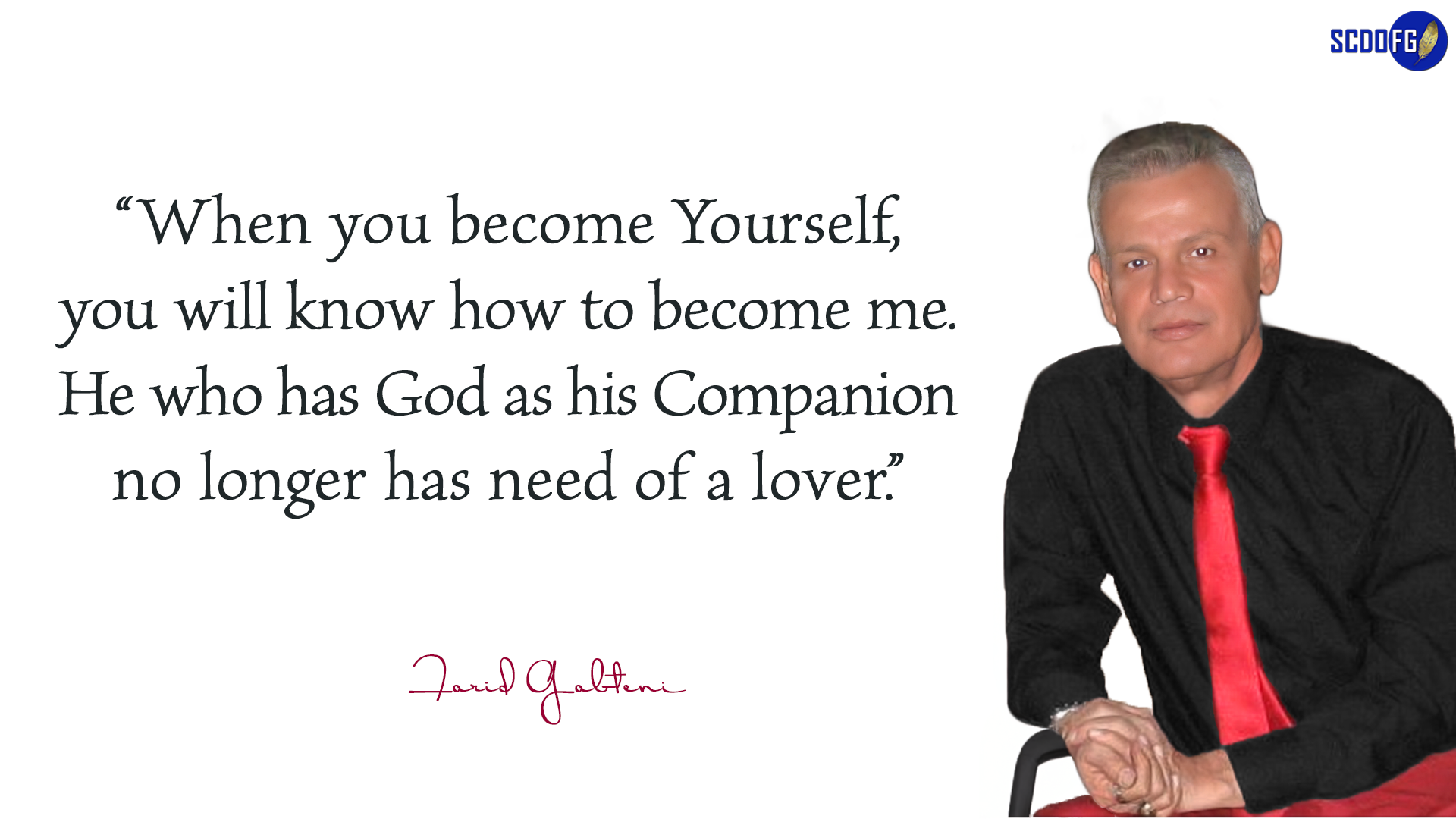
« When you become Yourself, you will know how to become me. He who has God as his Companion no longer has need of a lover » — Farid Abbes Raja Gabteni
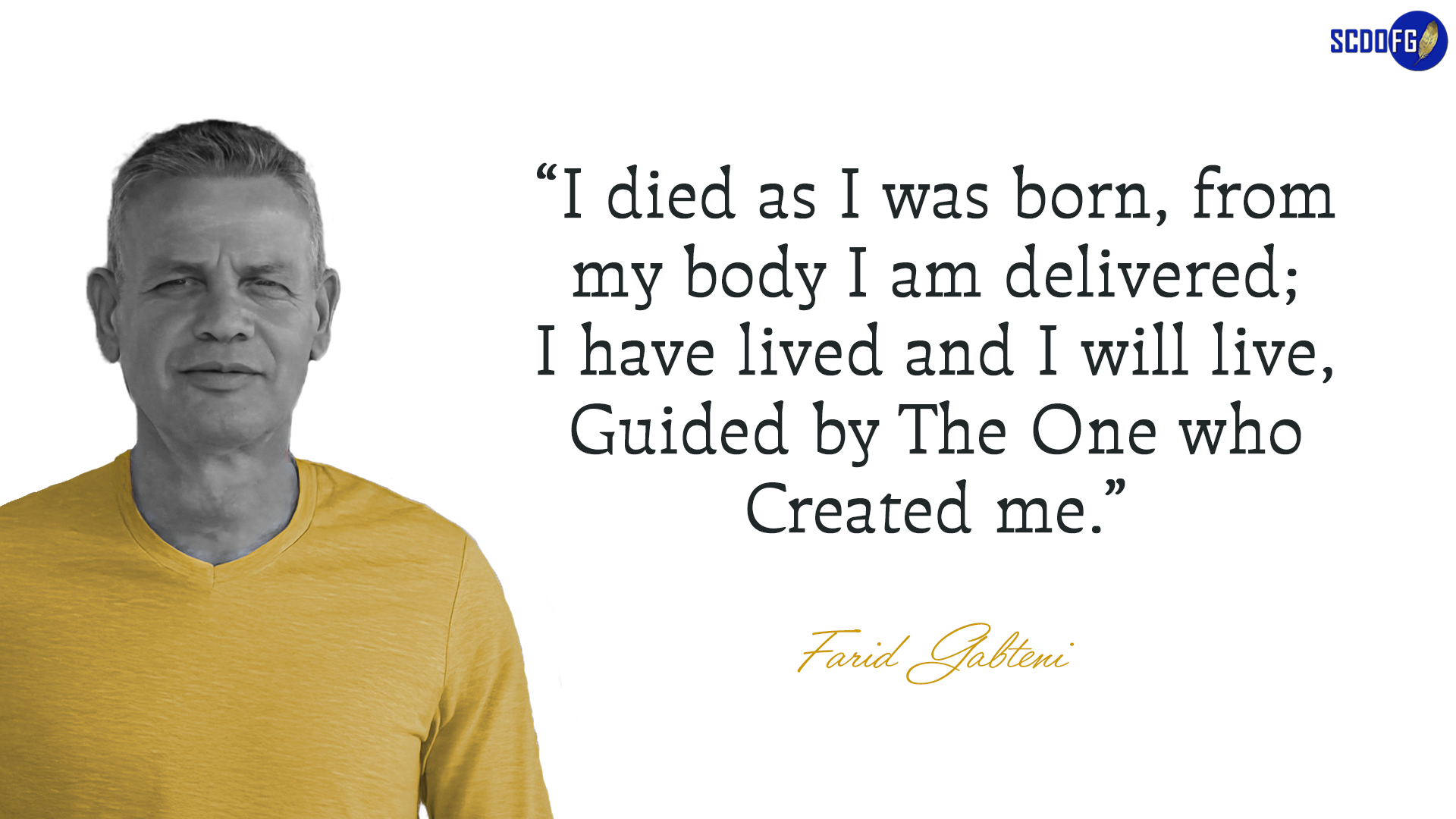
« I died as I was born, from my body I am delivered; I have lived and I will live, Guided by The One who Created me » — Farid Abbes Raja Gabteni
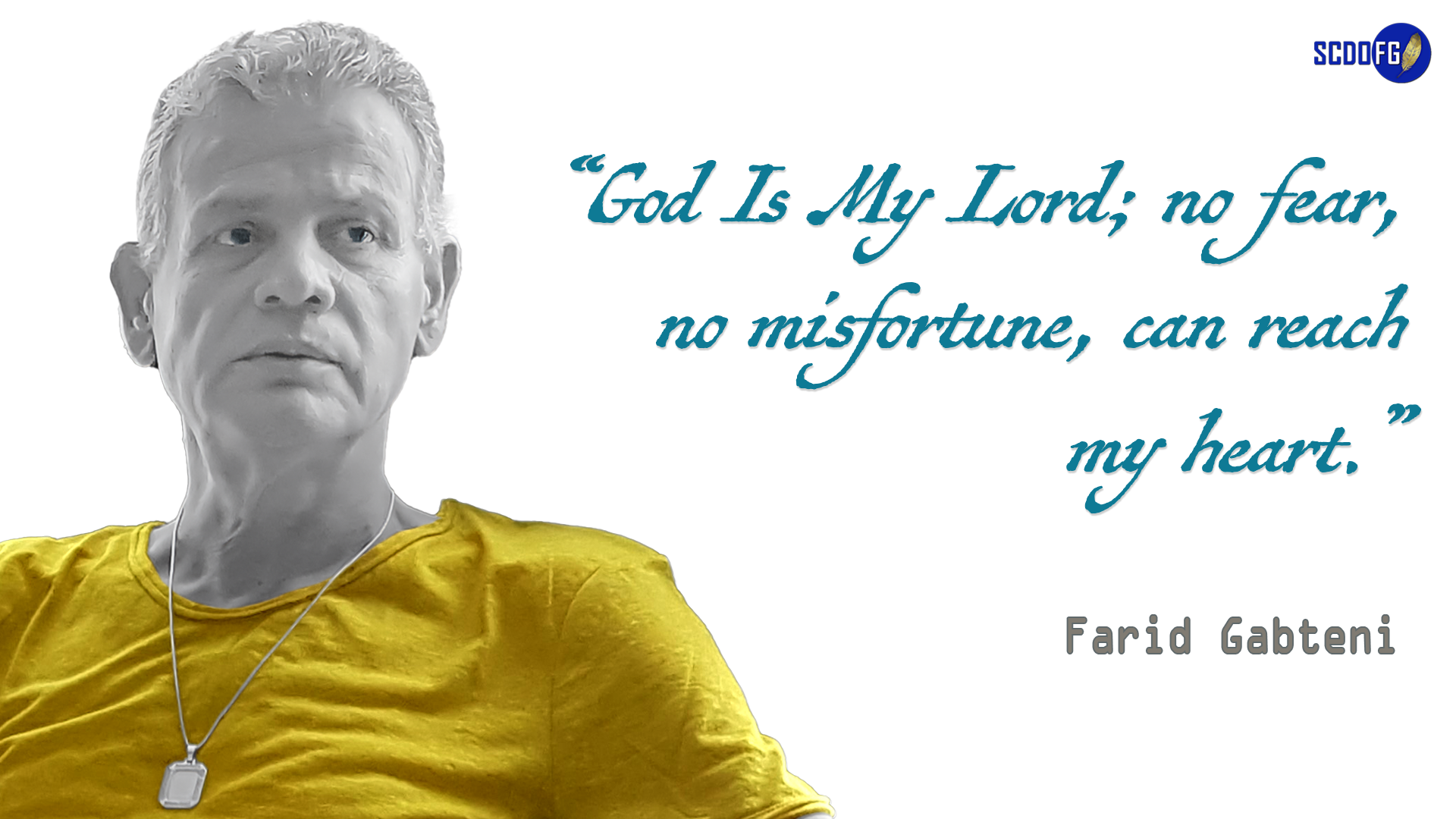
« God Is My Lord; no fear, no misfortune, can reach my heart » — Farid Abbes Raja Gabteni
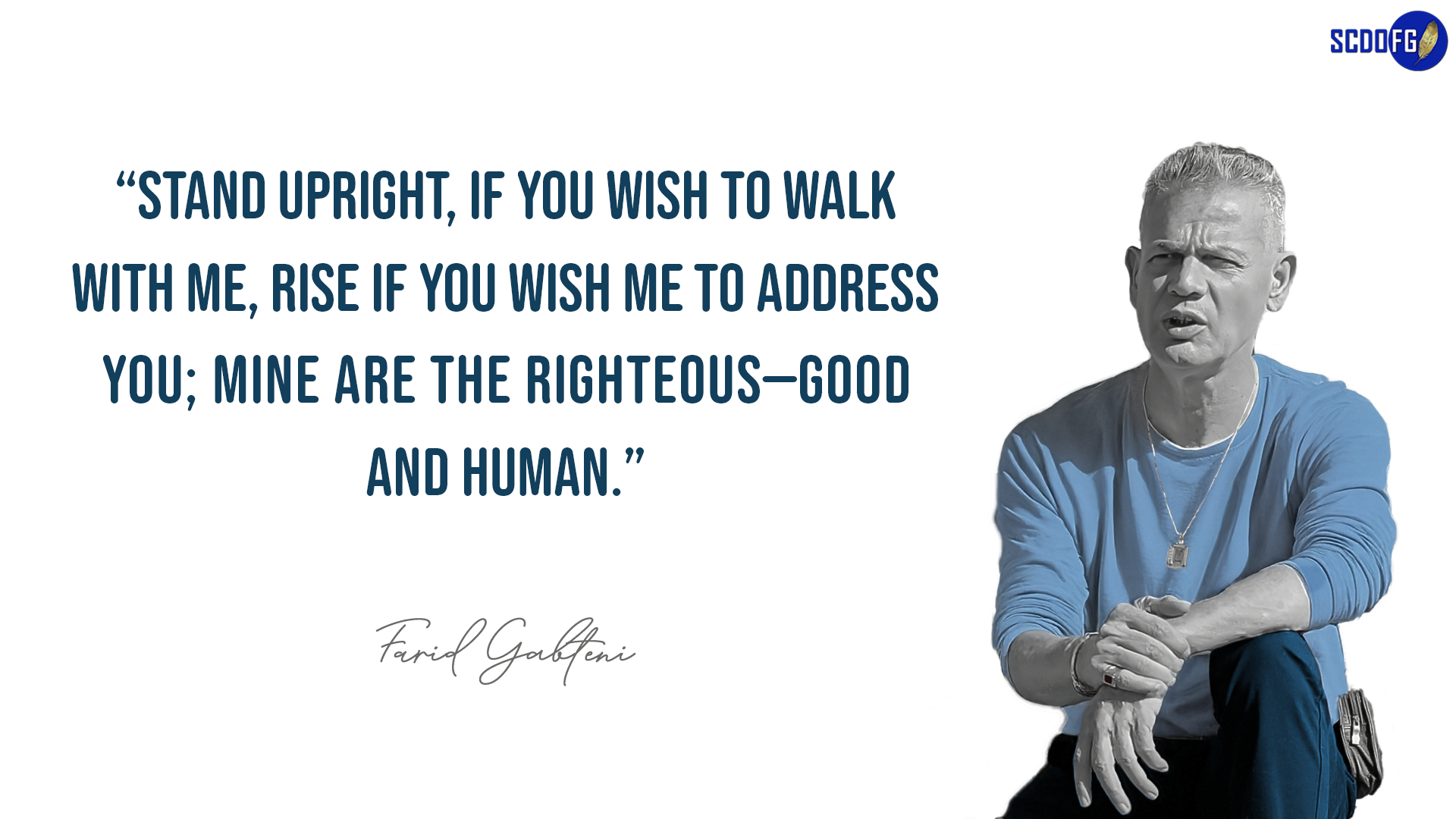
« Stand upright, if you wish to walk with me, rise if you wish me to address you; mine are the righteous—good and human. » — Farid Abbes Raja Gabteni
« We intoxicate ourselves with many things; but beware: those who grow fond of pink elephants face bleak tomorrows ahead. » — Farid Abbes Raja Gabteni
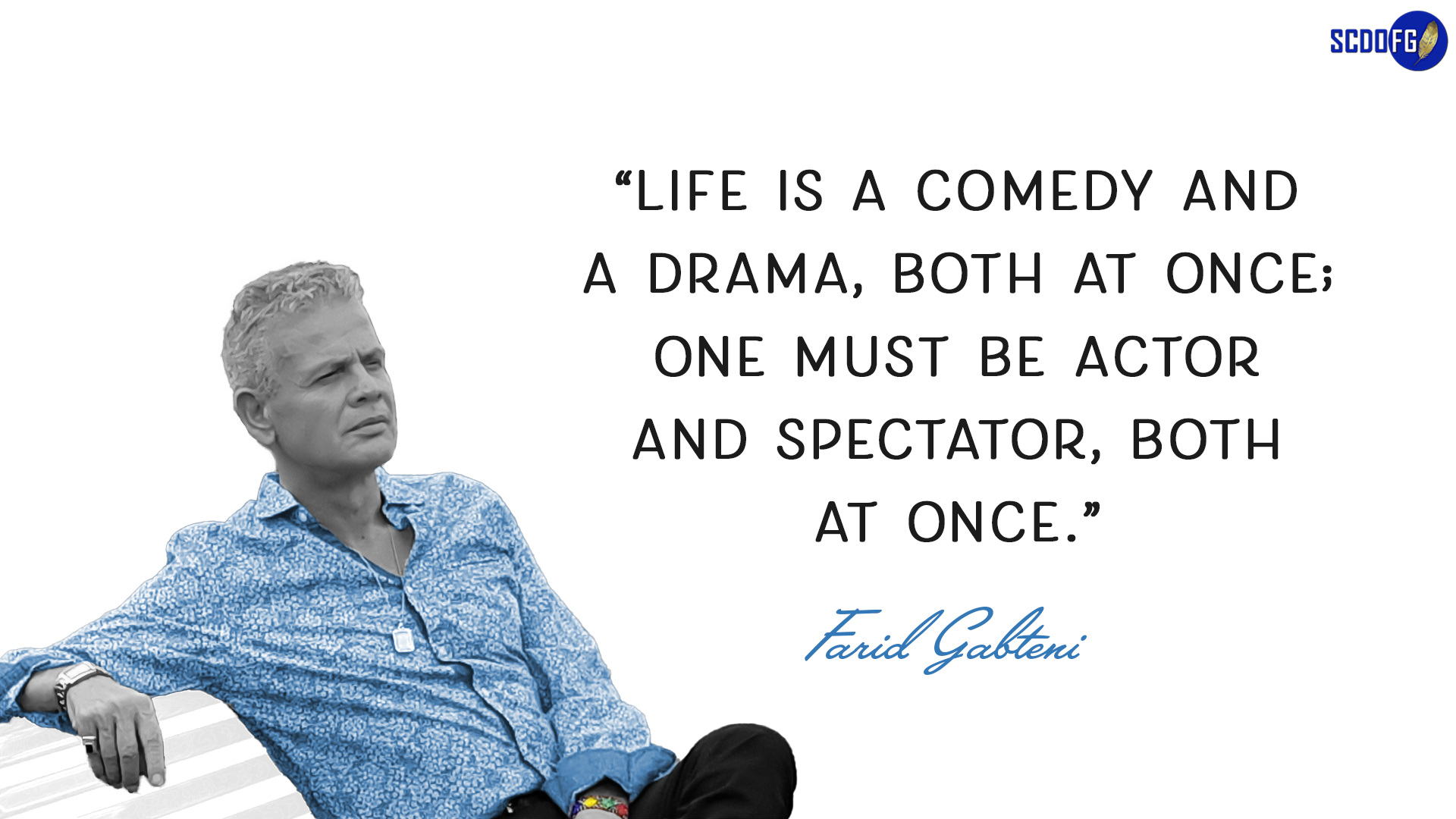
« Life is a comedy and a drama, both at once; one must be actor and spectator, both at once. » — Farid Abbes Raja Gabteni
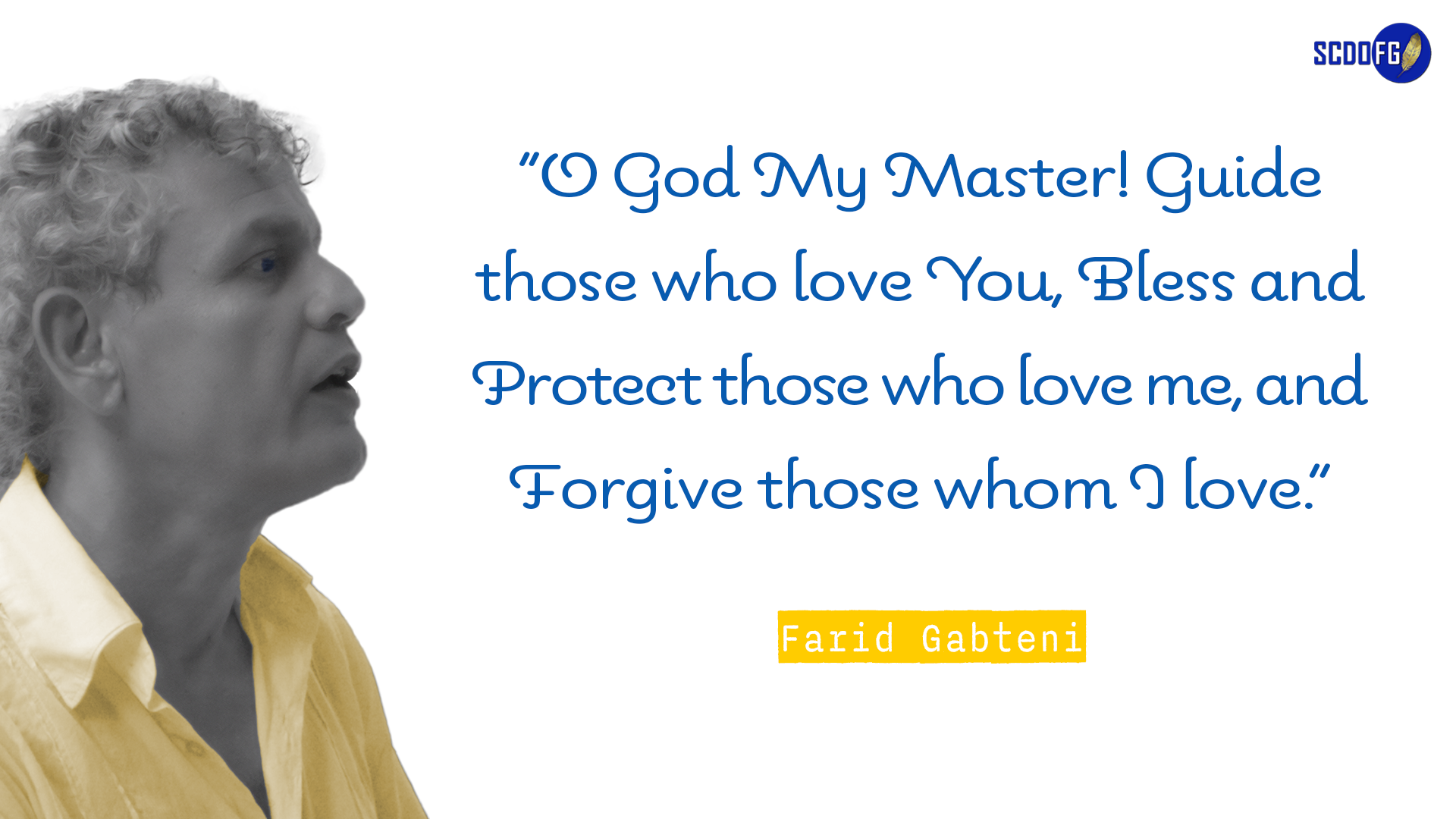
« O God My Master! Guide those who love You, Bless and Protect those who love me, and Forgive those whom I love » — Farid Abbes Raja Gabteni
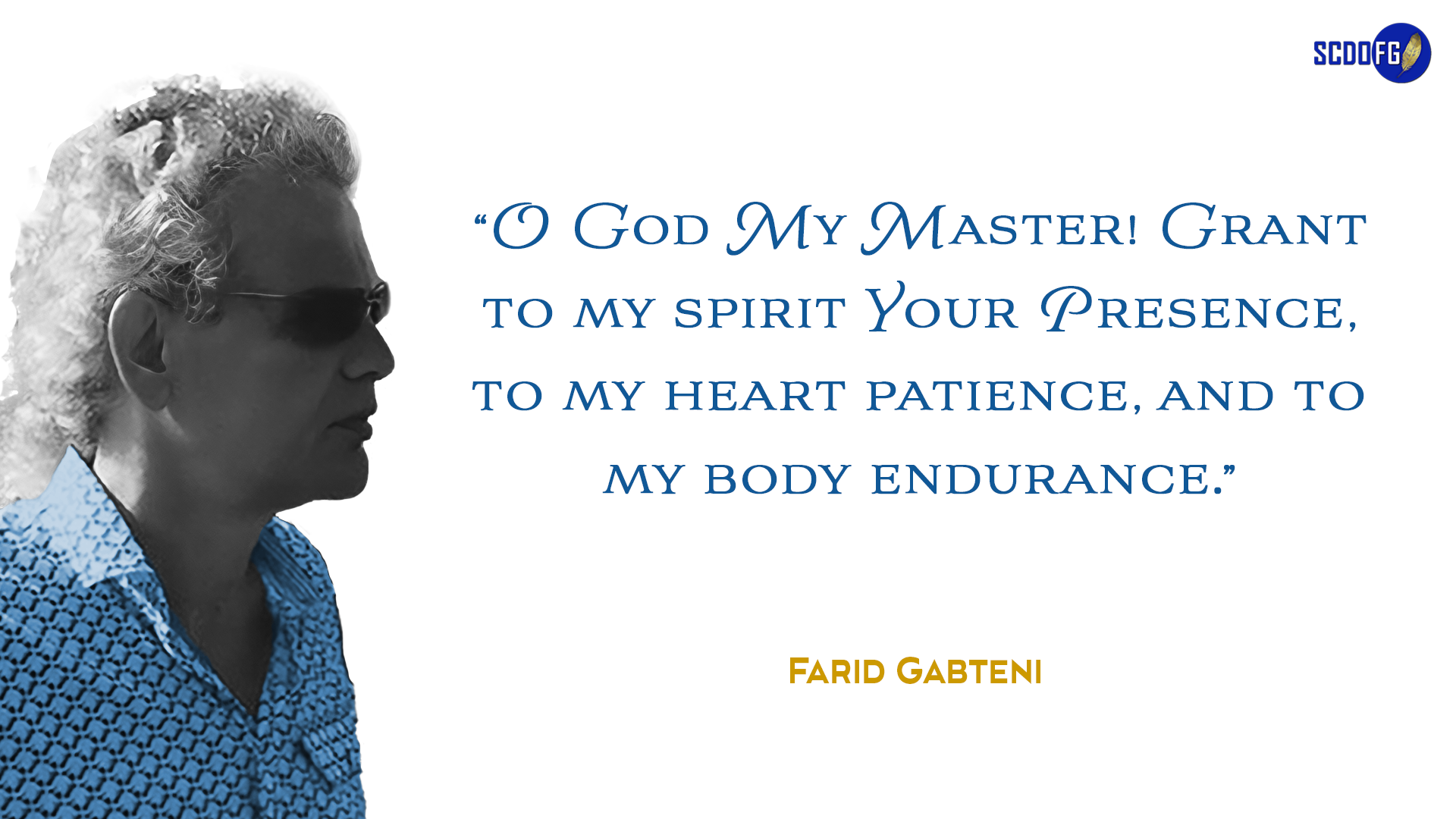
« O God My Master! Grant to my spirit Your Presence, to my heart patience, and to my body endurance » — Farid Abbes Raja Gabteni
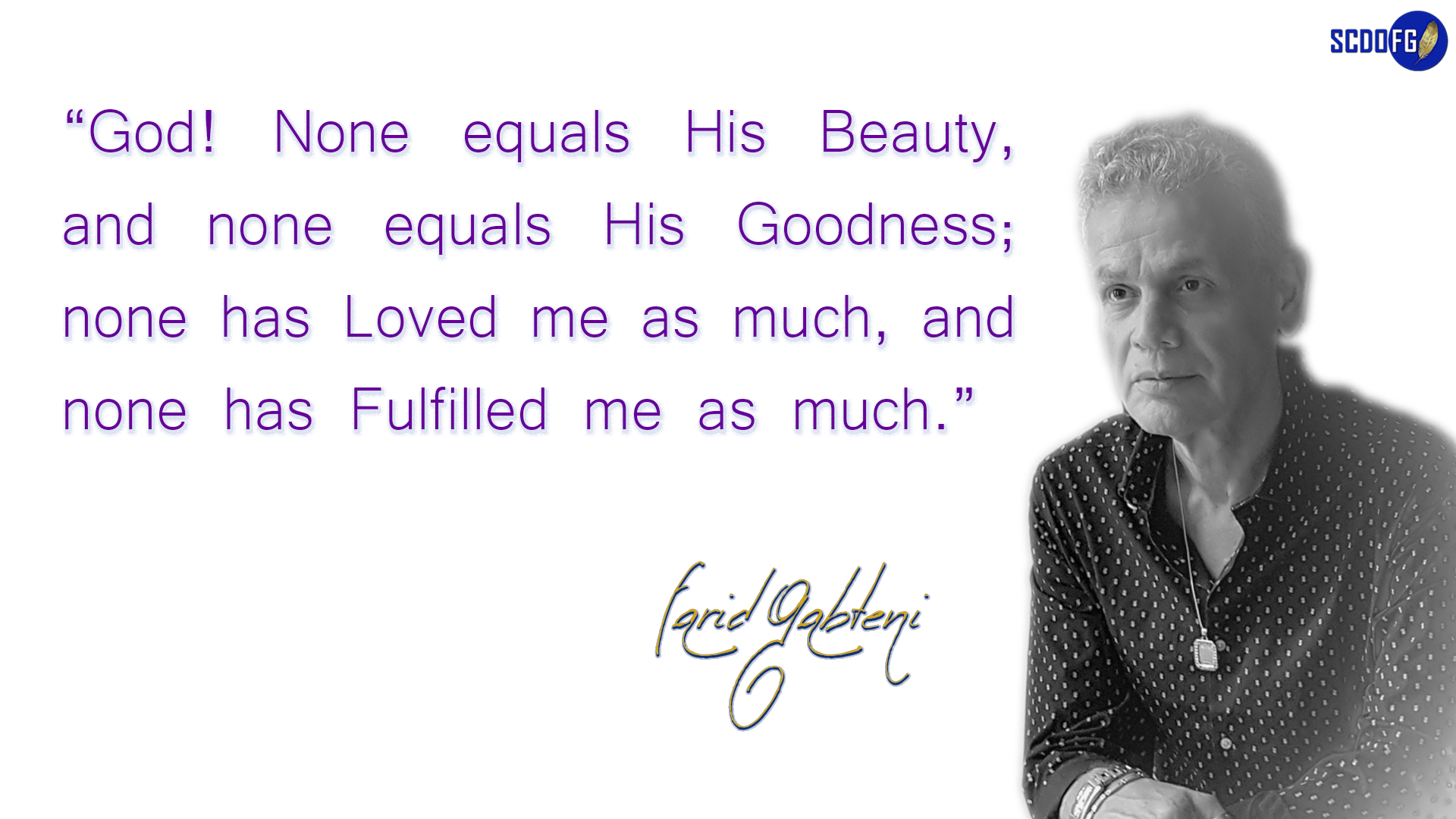
« God! None equals His Beauty, and none equals His Goodness; none has Loved me as much, and none has Fulfilled me as much. » — Farid Abbes Raja Gabteni
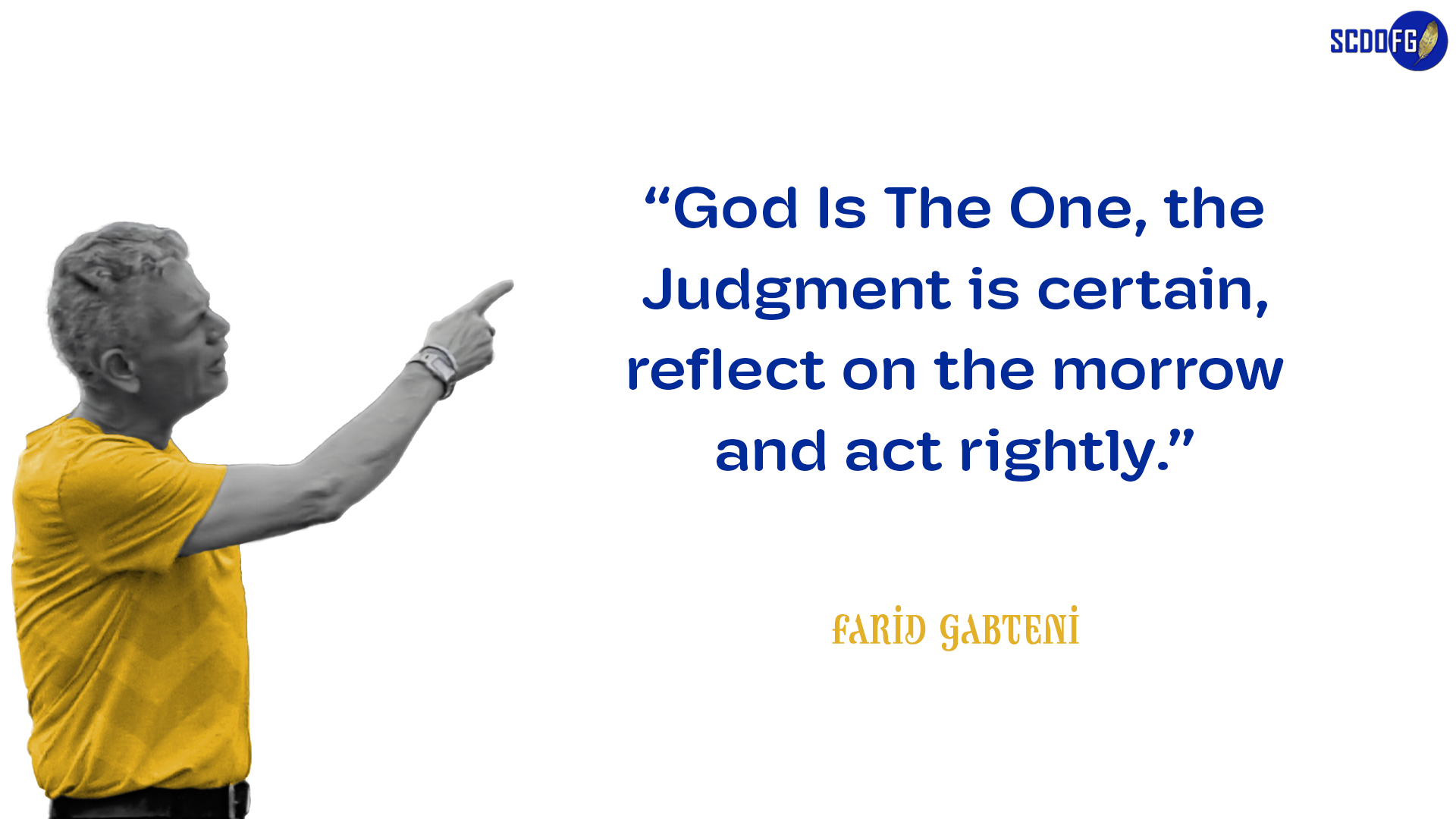
« God Is The One, the Judgment is certain, reflect on the morrow and act rightly » — Farid Abbes Raja Gabteni
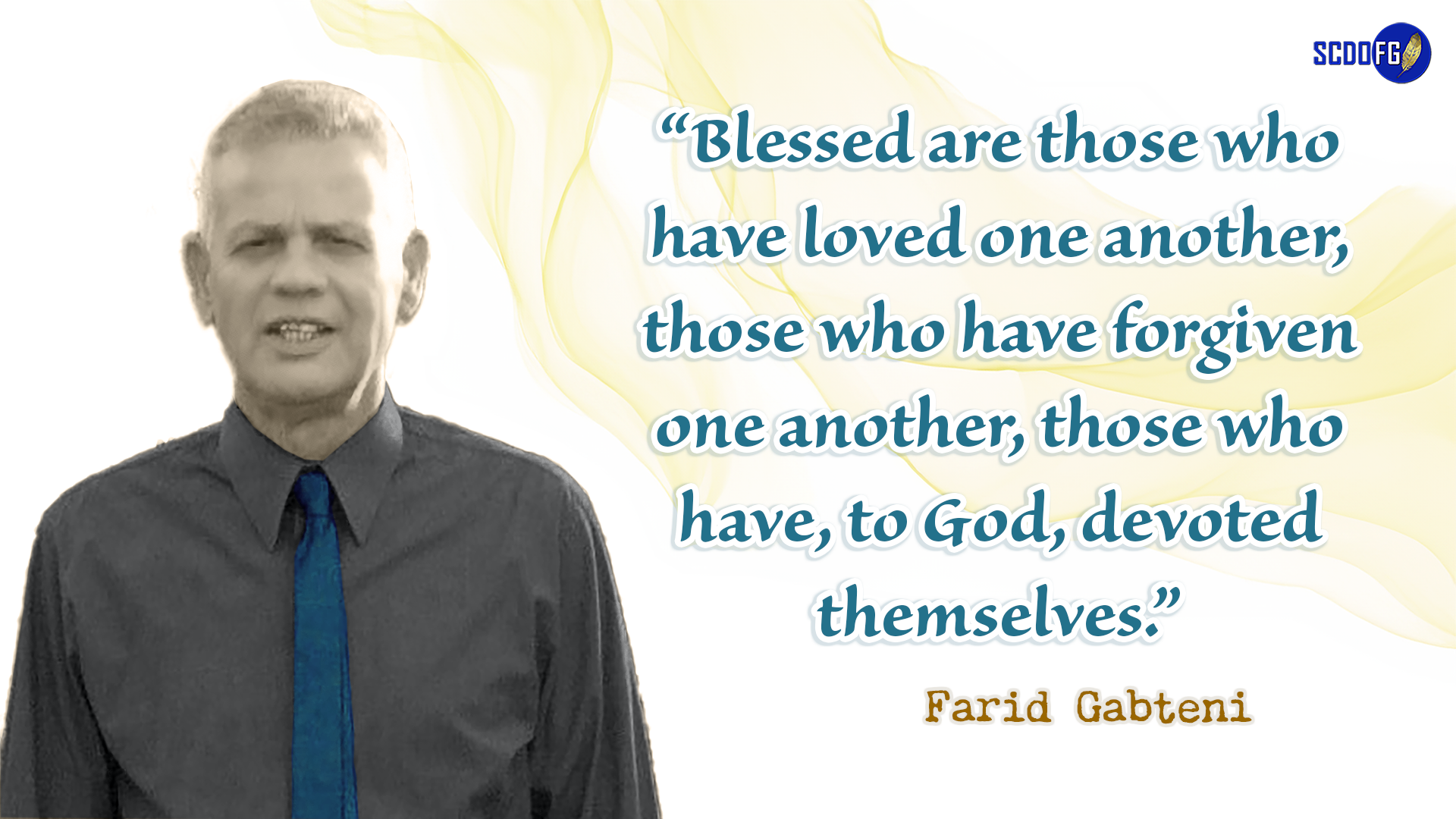
« Blessed are those who have loved one another, those who have forgiven one another, those who have, to God, devoted themselves. » — Farid Abbes Raja Gabteni

















![Portrait of Farid Abbes Raja Gabteni with a quote “‘And indeed, Prostratoriums (Mosques) are for God; so do not invoke alongside God anyone [else]’; ‘Say, ‘Indeed, I do not possess for you any harm, nor any [perfect] sense’’ (Qurân/Chapter 72, verses 18 and 21). This is what God Teaches and, likewise, the righteous among His Allies; God Alone Is Worthy of Adoration and Invocation; His beneficent Servants are indeed praiseworthy and serve as reference models, yet they are not perfect and must in no way be the object of worship due to God Alone.”](https://scdofg.net/wp-content/uploads/2026/07/Farid-Gabteni-quotes-123.png)